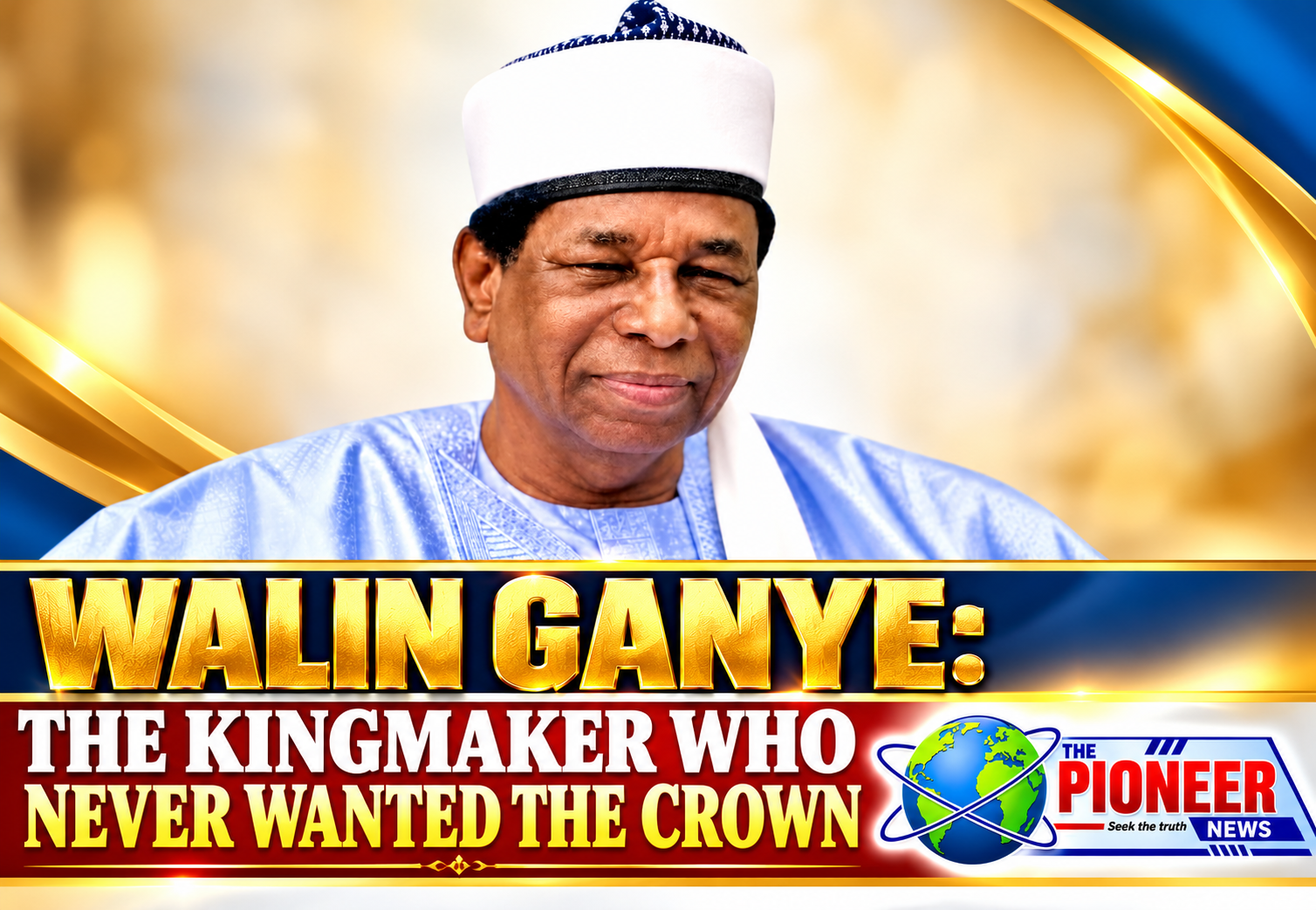
Every generation is asked a quiet question: who will stand for the people when it costs something? Most answer with speeches. A rare few answer with a lifetime. In Adamawa and well beyond, one name keeps surfacing whenever that question is posed: Alhaji Sadiq Mohammed Walin Ganye, Chairman of the Board of Trustees of the International Peace Commission (IPC) and a revered elder statesman.
His story runs against the grain of Nigerian politics. In a culture where ambition is usually announced with posters, convoys and campaign slogans, Walin Ganye has built enormous moral and political capital while holding no office, and while declining to chase one. That is not a gap in his résumé. It is the whole point of him.
Politics rewards those who want something. Trust, however, is earned by those who want nothing for themselves. This is the paradox at the centre of Walin Ganye’s standing.
He has never sought elective or appointive position, and those close to him say he will not. His ambition is of a different and rarer kind: to find, mentor and support men and women of capacity and conscience, and to place them where they can use public office to deliver the dividends of democracy to ordinary people. Where others measure success by the titles they collect, he measures it by the roads built, the schools opened, the hospital bills paid and the communities reconciled by the leaders he has helped to the table.
Philosophers call this stewardship. Nigerian politics calls it kingmaking. In his case the two words meet, because the kingmaker never wanted the crown, only a throne worth sitting on.
A people’s greatest need in the political arena is a voice that cannot be bought and a shield that does not flinch. Walin Ganye has been both for his people. In moments when their interests were threatened, marginalised or simply ignored, he has stepped forward, not from the safety of a podium, but in the rooms where decisions are made.
That consistency explains the confidence he commands. People do not entrust their hopes to someone because he is loud. They do so because, over decades, he has been present, reliable and unselfish. Trust is not declared; it is accumulated, one kept promise at a time, and he has accumulated it in abundance.
If politics is his arena, compassion is his compass. Those who know him speak of a generosity that has no boundary of tribe, creed or party. The vulnerable, among them the sick, the widowed, the unemployed and the young with ability but no sponsor, find in him a door that is open and a hand that is extended.
Crucially, his giving is not theatre. It is not timed to election cycles or staged for cameras. It is habitual, almost instinctive, the conduct of a man who understands that wealth and influence are held in trust for others. In a time when public giving is often turned into political advertising, his example restores a forgotten meaning to the word philanthropy: love of humanity, practised quietly and without condition.
What makes Walin Ganye uncommonly effective is the span of his networks. He is rooted in the grassroots: the villages, wards and local communities where democracy is either won or lost. Yet he is equally at home in the corridors of national power, where policy is made and resources are allocated.
Few figures can bridge both worlds. Those who can are invaluable, because they carry the voice of the market square to the council chamber and bring the attention of the centre back to the periphery. This double access is why the politicians he backs are heard, and why the communities he serves are not forgotten.
To call him a harbinger is to say he reads the political weather before it breaks. Time and again, his movements, alliances and counsel have preceded shifts in the political landscape. Observers have learned to watch where he stands, because it often signals where the tide is turning.
But he is a game changer, not merely a forecaster. His method is to redirect the contest from personalities to principle, from “who will rule?” to “who will serve?” By insisting that the needs of the people come first, he has helped reset the terms of political conversation among those who look to him for direction.
His chairmanship of the Board of Trustees of the International Peace Commission is no accident of résumé. Peace is the thread running through his public life: reconciling aggrieved parties, cooling tempers before they become conflicts, and persuading rivals that shared progress is better than a victory that leaves ruins. Any democracy is only as strong as its capacity to settle disputes without bloodshed, and he has spent a lifetime strengthening that capacity.
History is rarely kind to those who grasp. It is generous to those who give. Walin Ganye’s legacy will not be measured by offices held, because he held none by choice. It will be measured by the leaders he nurtured, the vulnerable he lifted, the quarrels he settled and the confidence he restored in the idea that politics can be an instrument of service.
Men of this type are scarce in any age. When one appears, wisdom lies in recognising him while he is still among us, and in learning from his example that the highest form of power is the power to make others succeed.
In an era hungry for integrity, Alhaji Sadiq Mohammed Walin Ganye reminds us of a simple truth: you do not need a crown to be a king in the hearts of the people.

