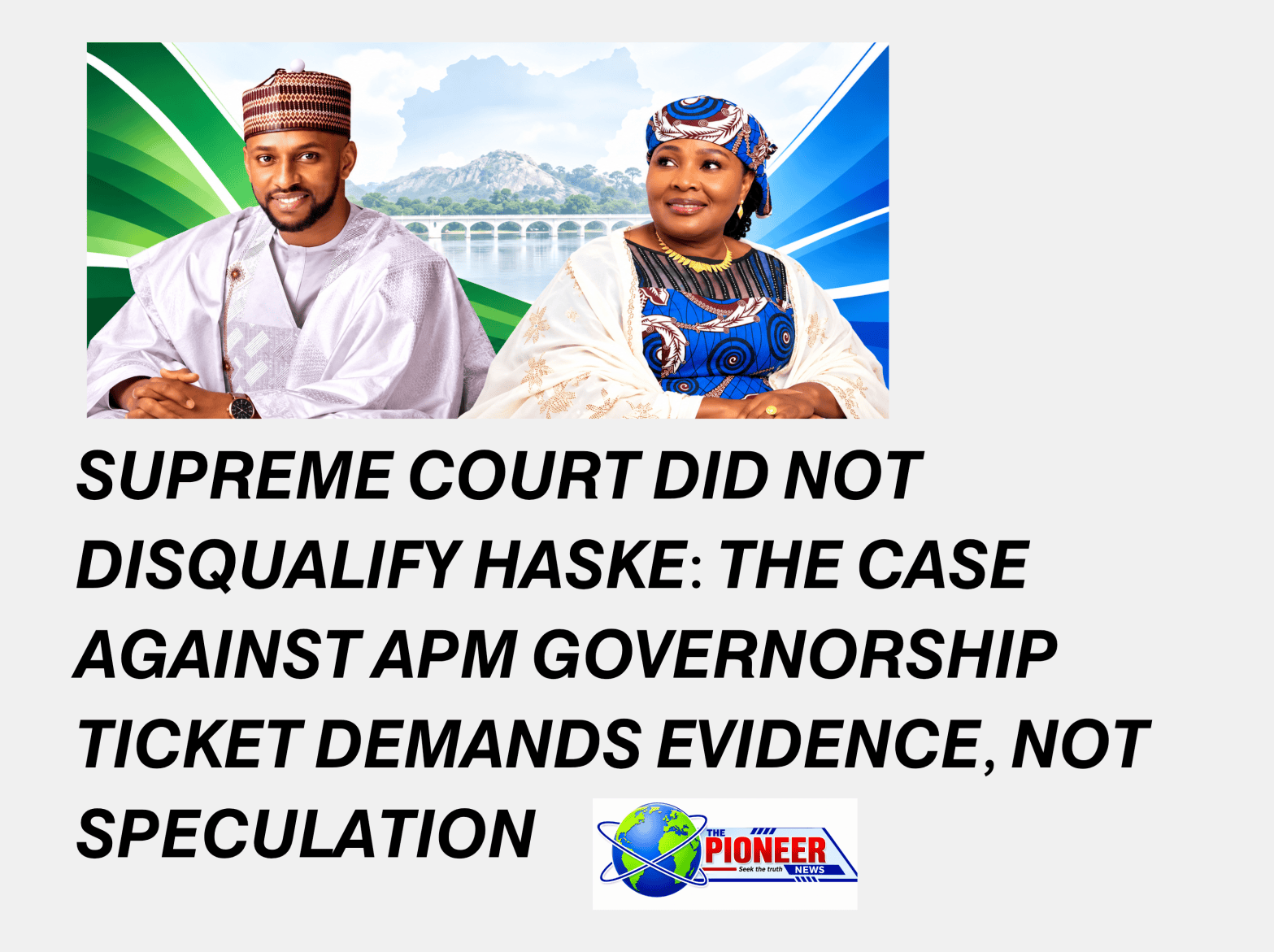
Why the September 24 ruling settles the law but not Haske’s candidacy
YOLA — A Supreme Court judgment meant to settle a national legal question has instead ignited a local political firestorm. Across Adamawa State, the ruling on Nigeria’s Electoral Act 2026 is being read by some as a death sentence for the governorship candidacy of Abdulrahman Bashir Haske — the former APC aspirant now flying the flag of the Allied Peoples Movement (APM). A closer reading of the judgment tells a very different story.
Some political actors have seized on the ruling to argue that any politician who defected after contesting a primary is now automatically disqualified. That conclusion does not survive scrutiny. The Supreme Court did not disqualify Abdulrahman Haske. It did not rule on the validity of his APM nomination. It did not even mention his name.
On September 24, 2026, a unanimous seven-member panel of the apex court — led by Justice Adamu Jauro — restored Sections 77(5), 77(6), 77(7) and 84(2) of the Electoral Act 2026, overturning a Court of Appeal decision that had struck the provisions down. The dispute arose from a challenge by the Zenith Labour Party (ZLP), not from any case involving Haske or the APM.
What the court restored was a legal framework — statutory rules governing party membership registers and candidate nomination. It did not deliver a verdict on any individual candidate’s status. That distinction is the whole ballgame.
WHAT THE SUPREME COURT ACTUALLY RESTORED
- Section 77(5) — Only members listed on a party’s membership register, submitted to INEC at least 21 days before a primary, congress or convention, may participate in that exercise.
- Section 77(6) — Parties must use that same submitted register for their primaries, congresses and conventions.
- Section 77(7) — A party that fails to submit its register within the stipulated window forfeits the right to field a candidate.
- Section 84(2) — Candidates must be nominated through direct primaries or consensus.
These are real, enforceable obligations. But there is a wide gulf between a law demanding compliance and a court finding that one particular candidate breached it. The second requires facts, documents, and — where disputed — a competent tribunal’s ruling. Nothing in the September 24 judgment supplies any of that for Haske.
Haske contested the APC governorship primary in Adamawa State. Following that outcome, he resigned from the APC and secured the APM’s governorship ticket for 2027. TheCable reported on September 12 that Haske announced his defection and acceptance of the APM nomination after consultations with political stakeholders. The APM has since presented him publicly as its candidate, unveiling retired senior NNPC executive Safiel Glah as his running mate on September 21.
That sequence — primary, resignation, fresh ticket — is a matter of public record. What is not established by any public record is whether every statutory box in his APM membership and nomination was ticked. That is a separate question, and no news report or court filing has answered it.
Much of the current outcry centres on the restored 21-day membership-register rule. But settling whether Haske’s nomination complied requires answers to specific, checkable questions:
- When did Haske formally become an APM member?
- What membership register governed the APM nomination exercise?
- When was that register submitted to INEC?
- What was the date and format of the nomination — direct primary or consensus?
- Did the process comply with both the Electoral Act and APM’s own constitution?
These are evidentiary questions. They cannot be resolved by pointing at a Supreme Court judgment that never examined them. Notably, coverage by The Trumpet on the ruling’s fallout for defecting politicians — including Haske alongside figures like Ovie Omo-Agege and Victor Ochei — makes clear that the decision restored the law, not individual verdicts on any of these candidacies.
A candidate can be legally exposed without being legally disqualified. If a rival, aggrieved aspirant or interested party alleges non-compliance, that allegation opens a legal contest — it does not, by itself, decide one. Until the relevant facts are established and a competent authority rules on them, calling Haske “disqualified” is an assertion dressed up as a fact.
Nowhere in the judgment does the Supreme Court state:
“Abdulrahman Bashir Haske is disqualified from contesting the 2027 Adamawa governorship election.”
No such finding exists — because the court was never asked to make one.
The debate in Adamawa deserves to move from political noise to documentary proof. If Haske’s critics believe the Electoral Act was breached, the burden is theirs to produce the APM membership records, INEC filings, nomination documents, and the dates that matter. If the APM insists the process was clean, it should be equally ready to produce the paperwork. That is where this fight is actually won or lost — not in press statements, and not in a judgment that never named Haske.
The Supreme Court’s decision matters. It confirms that the Electoral Act’s provisions on membership registers and nomination procedure remain fully operative, and every political party — APM included — must take its statutory obligations seriously ahead of 2027.
But equally, the court:
- Did not hold that every politician who defected after a primary is automatically disqualified.
- Did not nullify Haske’s APM ticket.
- Did not make any factual finding about Haske’s APM membership or nomination process.
Presenting the judgment as an automatic disqualification order against Abdulrahman Bashir Haske misstates what the apex court actually decided. Whether his candidacy survives any future legal challenge will turn on the facts, the documentary trail, and — if litigation follows — the ruling of a competent court, not on inference from a judgment that addressed none of it.
THE BOTTOM LINE
Read the judgment. Examine the facts. Separate legal interpretation from political speculation. The Electoral Act imposes real obligations on parties and candidates, and those obligations must be honoured — but any claim of disqualification must rest on the specific facts and legal findings needed to prove it.
For Haske and his supporters, the real test isn’t whether opponents have declared his ticket dead. It’s whether the documentary trail of his APM membership and nomination holds up. Until that is established, the claim that the Supreme Court has knocked Abdulrahman Bashir Haske out of the 2027 Adamawa governorship race remains exactly what it is — an assertion, not a determination of the court.

