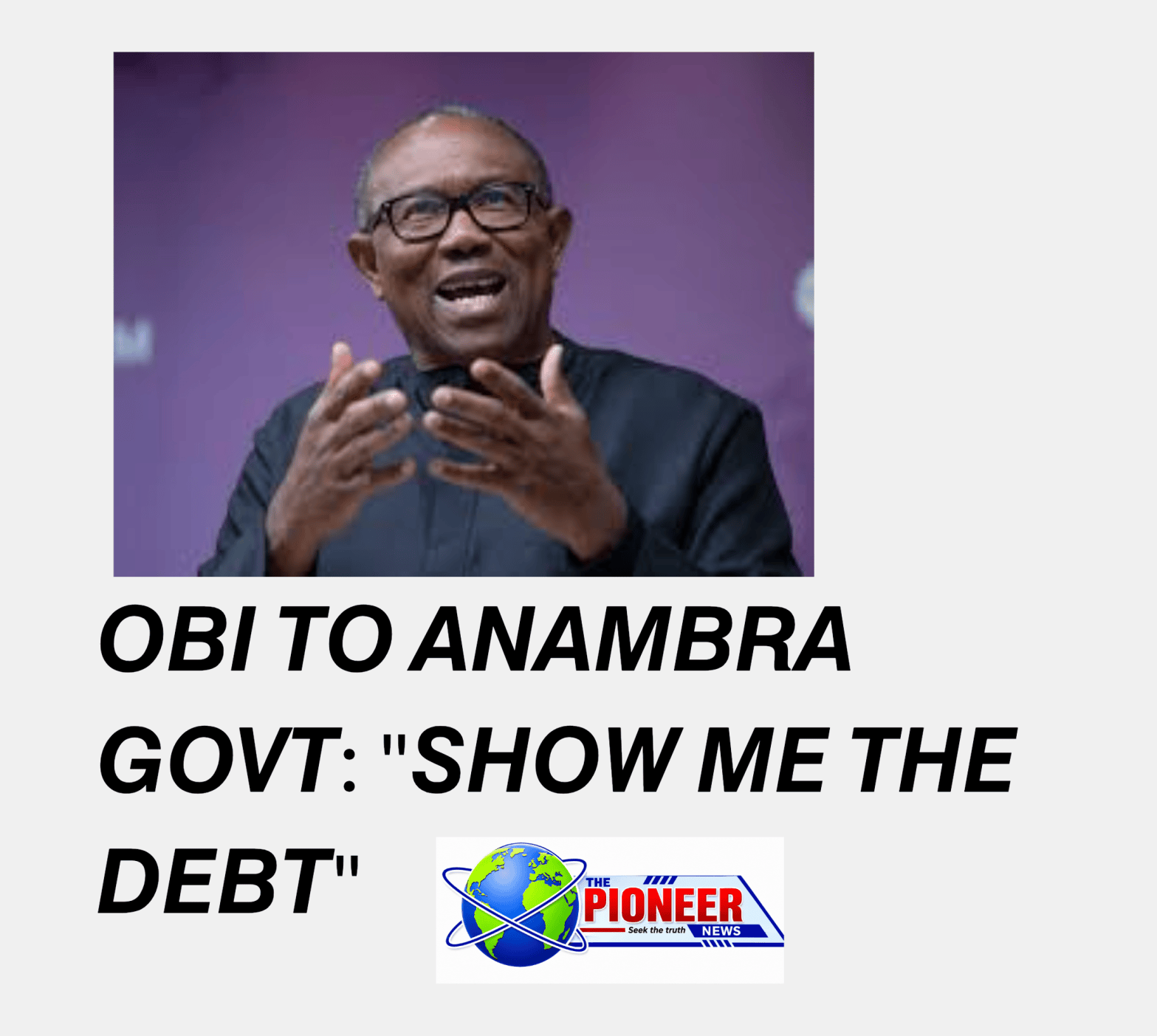
Ex-Governor Demands Proof Behind Loan Allegations, Says He Left N2.1bn Untouched for Successor
Highlights:
“I owed no salary, pension, gratuity or contractor — not one”
“I left N2.1bn ecological fund in First Bank, untouched”
“Let Nigerians decide 2027 — not governors”
Former Anambra State Governor and Nigeria Democratic Congress (NDC) presidential candidate Peter Obi has pushed back hard against claims that his administration left behind unpaid loans still being serviced by the state, daring officials to put their evidence on the table.
In a video that swept across social media on Monday, a combative Obi insisted he handed over a state with its books balanced — every naira owed, paid; every obligation, cleared before he left office.
The remarks come in direct response to Anambra’s Commissioner for Finance, Izuchukwu Okafor, who told the Voice of Ndi Anambra Podcast that the state’s monthly federal allocation is still being docked to offset loans inherited from previous administrations — Obi’s included, alongside that of his successor, Willie Obiano.
Obi wasn’t having it.
“As at the day I left office, I was not owing any salary, pension, or gratuity that Anambra State Government was supposed to pay,” he declared, adding that not a single contractor or supplier with properly processed paperwork was left waiting for payment.
“I was not owing any supplier or contractor that had executed his job and his documents processed — not one. The day I left office, I paid what was due to be paid.”
Obi then turned to a pointed detail: a N2.1 billion ecological fund, released by the Federal Government roughly three months before he left office for a designated erosion-control project — money he says he refused to spend, even as aides urged him to.
He named the account outright — First Bank of Nigeria, a branch near Nnamdi Azikiwe University — and said the funds sat there, ring-fenced for their intended purpose, resisting pressure to divert them for discretionary use.
“My people were saying, ‘Let’s expend this money.’ But I kept telling them, government is a continuity, and I want the person coming after me to succeed.”
Then came the challenge — direct, almost theatrical in its confidence:
“I say it again, if you go to the account, I’m going to give you the account number. I have given you the bank and the branch. If you see anything contrary to the day I left office, I will stop campaigning.”
Pivoting to the road ahead, Obi conceded that governors are free to back whichever candidate they choose — pointing to the wave of state executives already aligned with President Bola Ahmed Tinubu as unremarkable, ordinary democratic politics.
But his real target, he said, isn’t gubernatorial endorsement — it’s the ballot box itself.
“I’m not urging them to support me. I am only urging them to allow free, fair and credible elections. I’m talking to the people because they have only one vote.”
He drew a line back to his 2023 run, launched without a single councillor or entrenched political structure behind him — a position he says remains unchanged today.
“When I started my presidential bid in 2023, I never had any councillor in power. Today, it is still the same case. The only thing is I am campaigning to be the president of Nigeria.”
His closing message was unambiguous: the presidency belongs to the electorate, not the political class.
“It is the people of Nigeria that will decide, not the governors — unless they’re going to write the results or rig the election, which is what I’m preaching against. Let it be a free, fair and credible election. Whatever the people decide, I will respect it.”
With state finances, past-administration accountability, and electoral credibility now firmly in the spotlight, Obi’s remarks look set to sharpen the political battle lines as Nigeria edges closer to the 2027 general elections.
 PIONEER NEWS