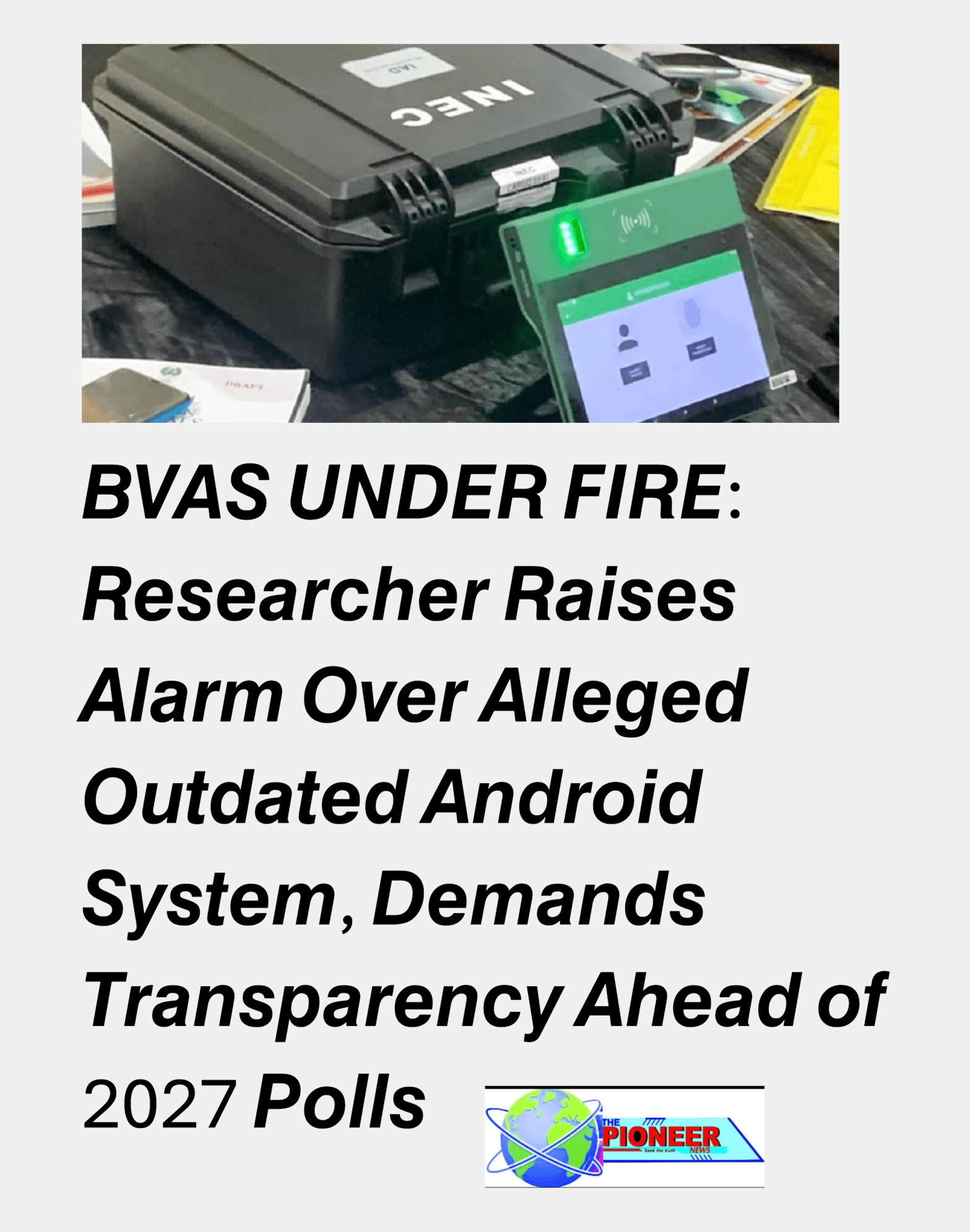
Questions Mount as INEC Insists Election Technology Remains Secure, Reliable
Fresh concerns have emerged over the technological foundation of the Independent National Electoral Commission’s (INEC) Bimodal Voter Accreditation System (BVAS), after a leading election researcher alleged that official INEC documents indicate the devices may still be operating on Android 6 or Android 7—software platforms introduced nearly a decade ago.
The allegation was made by Oluwafemi Adebayo, Head of Research and Strategy at Kimpact Development Initiative, who warned that if the findings are accurate, they could have significant implications for the security, efficiency and reliability of the technology expected to play a decisive role in Nigeria’s 2027 General Elections.
Speaking during an interview on ARISE Television’s Morning Show, Adebayo reviewed INEC’s preparations following the August 1 mock accreditation exercise conducted ahead of the August 15 Osun State Governorship Election.
While acknowledging that INEC has consistently projected confidence through voter registration activities, PVC distribution and mock accreditation exercises, he argued that the Commission’s true level of readiness can only be measured on election day.
“Administratively, INEC will always say it is prepared, but the real test of that preparedness will be what Nigerians witness on election day,” he said.
The debate follows reports of accreditation difficulties experienced by some voters during the Osun mock exercise.
Although INEC Chairman, Professor Joash Ojo Amupitan (SAN), explained that the glitches were resolved within an hour and attributed the problems largely to compatibility issues involving older Permanent Voter Cards (PVCs), Adebayo said the explanation leaves critical questions unanswered.
According to him, Kimpact subsequently reviewed INEC’s training manuals and operational documents to better understand the accreditation process.
The review, he said, revealed that election officials can identify voters through three separate methods: by surname, through the last six digits of the Voter Identification Number (VIN), or by scanning the QR code printed on the back of the PVC.
He argued that these multiple verification options raise questions about why older PVCs alone would significantly disrupt accreditation if alternative identification methods remain available.
Beyond the accreditation process itself, Adebayo said his organisation turned its attention to the software powering BVAS.
According to him, publicly available technical information about the devices remains limited. However, after examining screenshots contained in INEC’s own manuals and consulting individuals familiar with the technology, Kimpact concluded that the interface appears consistent with Android 6 or Android 7.
If correct, he warned, the implication is that BVAS could be relying on an operating system first introduced in 2015 and 2016.
Adebayo argued that operating systems of that age generally no longer receive routine security updates from Google, potentially exposing election technology to cybersecurity risks while also raising concerns about processing capability, software support and long-term reliability.
He also questioned whether the BVAS hardware contains the advanced biometric processors commonly found in modern identity verification systems, saying greater public transparency is needed regarding both the software and hardware specifications of the devices.
The Kimpact official maintained that Nigerians deserve a clearer understanding of the technology that will underpin the country’s electoral process in 2027.
He called on INEC to release more detailed technical information about the BVAS platform, arguing that public confidence in election technology should be built on openness, independent scrutiny and verifiable facts rather than assurances alone.
Despite the concerns raised, INEC has consistently maintained that BVAS remains secure, reliable and central to credible elections, insisting that the technology has significantly reduced identity fraud, multiple voting and other forms of electoral malpractice.
As political parties, election observers and civil society organisations intensify preparations for the 2027 General Elections, attention is expected to remain focused on the integrity, security and transparency of Nigeria’s electoral technology.
For now, the claims regarding the Android version allegedly running on BVAS remain assertions by the researcher and have not been officially confirmed by INEC, setting the stage for renewed public debate over the future of election technology in Africa’s largest democracy.

