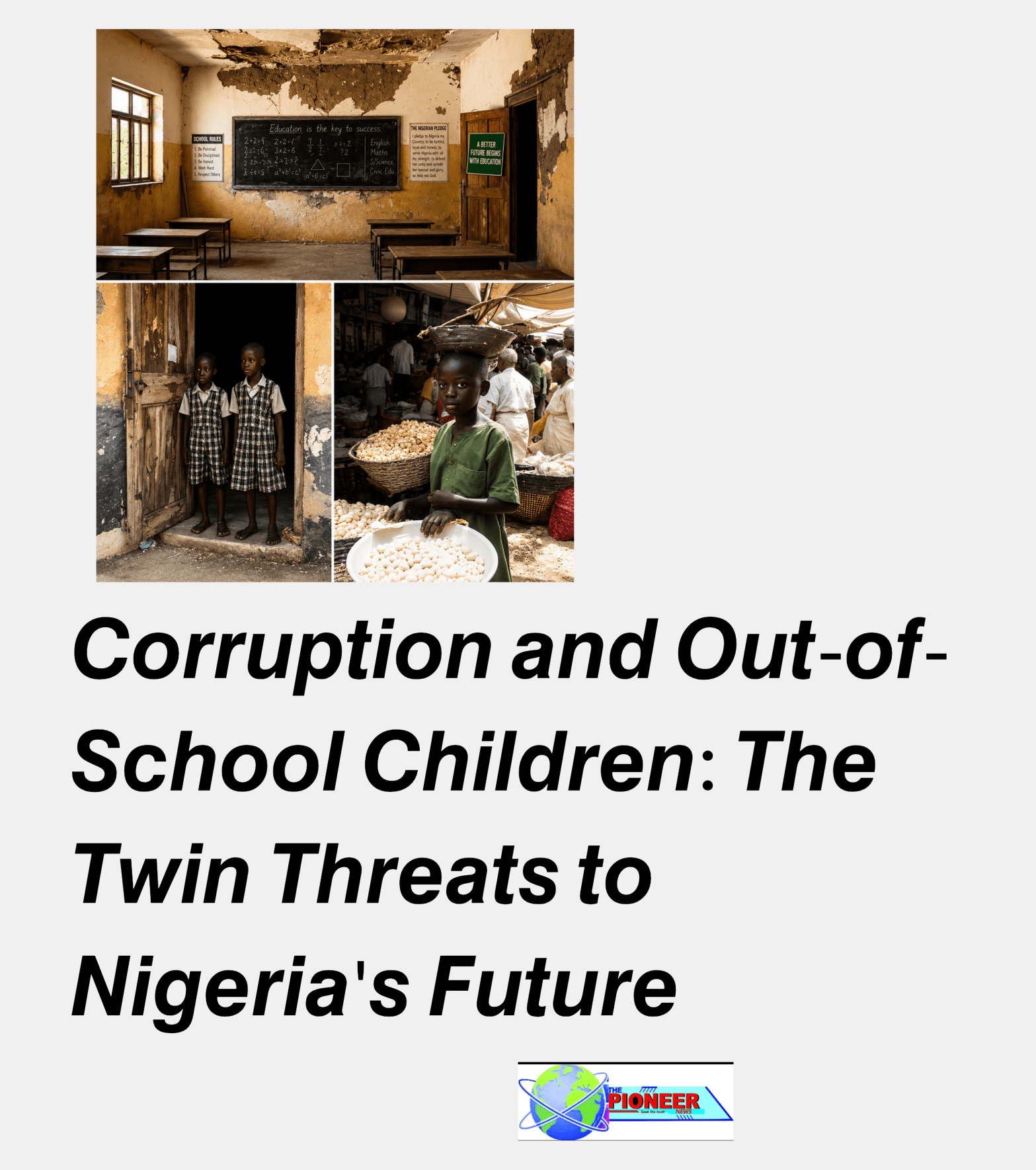
Without confronting graft and returning millions of children to the classroom, Nigeria’s dream of sustainable development will remain elusive
By Reuben Nathan Ibrahim
Yola
Nigeria, Africa’s most populous nation and one of its largest economies, stands at a critical crossroads. Despite its enormous human and natural resources, the country continues to grapple with two interwoven crises that threaten its future: entrenched corruption and the alarming rise in the number of out-of-school children.
These challenges are not isolated problems. They reinforce one another, weakening institutions, deepening poverty, and limiting opportunities for millions of Nigerians. With more than 20 million children estimated to be out of school, while billions of naira earmarked for education, healthcare, and infrastructure are routinely lost to corruption or mismanagement, one unavoidable question confronts the nation: How can Nigeria truly develop under these conditions?
Corruption remains one of the greatest impediments to Nigeria’s development. Funds allocated for classrooms, textbooks, teachers’ salaries, healthcare facilities, and critical infrastructure are too often diverted, mismanaged, or spent on poorly executed projects. Across the country, abandoned construction sites and substandard public facilities stand as visible reminders of squandered opportunities.
The cost of corruption extends far beyond financial losses. It erodes public confidence in government, weakens institutions, discourages merit, and promotes a culture where influence is valued above competence. When citizens lose trust in public institutions, national progress becomes increasingly difficult to achieve.
Equally disturbing is Nigeria’s growing out-of-school population. Poverty, insecurity, displacement, child labour, harmful cultural practices, and inadequate educational infrastructure have forced millions of children away from classrooms and onto the streets.
The North-East, particularly states such as Adamawa, has suffered immensely from years of insurgency and displacement, leaving countless children without access to quality education.
Every child denied an education today represents a lost opportunity for tomorrow. An uneducated child is more likely to face unemployment, poverty, and social exclusion, increasing the risk of crime, instability, and economic hardship. Nigeria is not merely losing students—it is losing future doctors, engineers, teachers, entrepreneurs, scientists, and leaders who could drive national transformation.
Addressing these twin challenges requires political will, institutional reforms, and collective responsibility.
Strengthen Accountability: Government spending must be transparent and subject to rigorous public scrutiny. Communities, Parent-Teacher Associations (PTAs), civil society organisations, and the media should actively monitor public projects to ensure that allocated funds achieve their intended purpose. Anti-corruption agencies must move beyond public announcements and pursue timely investigations, prosecutions, and convictions where wrongdoing is established.
Return Every Child to School: Nigeria must make free and compulsory basic education a practical reality rather than a constitutional aspiration. This requires expanding access to schools in underserved communities, improving school infrastructure, strengthening school feeding programmes, enhancing security around learning environments, and providing vocational and skills acquisition opportunities for children who have already dropped out.
Promote a Culture of Integrity: The fight against corruption cannot be left to government alone. It begins in our homes, schools, workplaces, markets, and places of worship. Nigerians must reject the culture of resignation that says, “This is Nigeria; nothing will change.” Sustainable national development begins with personal integrity and collective responsibility.
Conclusion
No nation can attain lasting prosperity while corruption drains its resources and millions of its children remain outside the classroom. The billions lost annually to corruption could build schools, equip hospitals, train teachers, and create opportunities for generations yet unborn.
The children we neglect today will shape the Nigeria we inherit tomorrow. Investing in transparency, accountability, and quality education is not merely a social obligation—it is a national imperative.
If Nigeria is to fulfil its enormous potential, the fight against corruption must be pursued with unwavering determination, while every child, from Yola to Lagos and from Maiduguri to Calabar, must be given the opportunity to learn, dream, and contribute to nation-building.
The time for excuses has passed. The time for decisive action is now.
Reuben Nathan Ibrahim writes from Yola, Adamawa State, on education, governance, public policy, and social justice.
Reuben Nathan Ibrahim writes from Yola, Adamawa State, on education, governance, public policy, and social justice.

