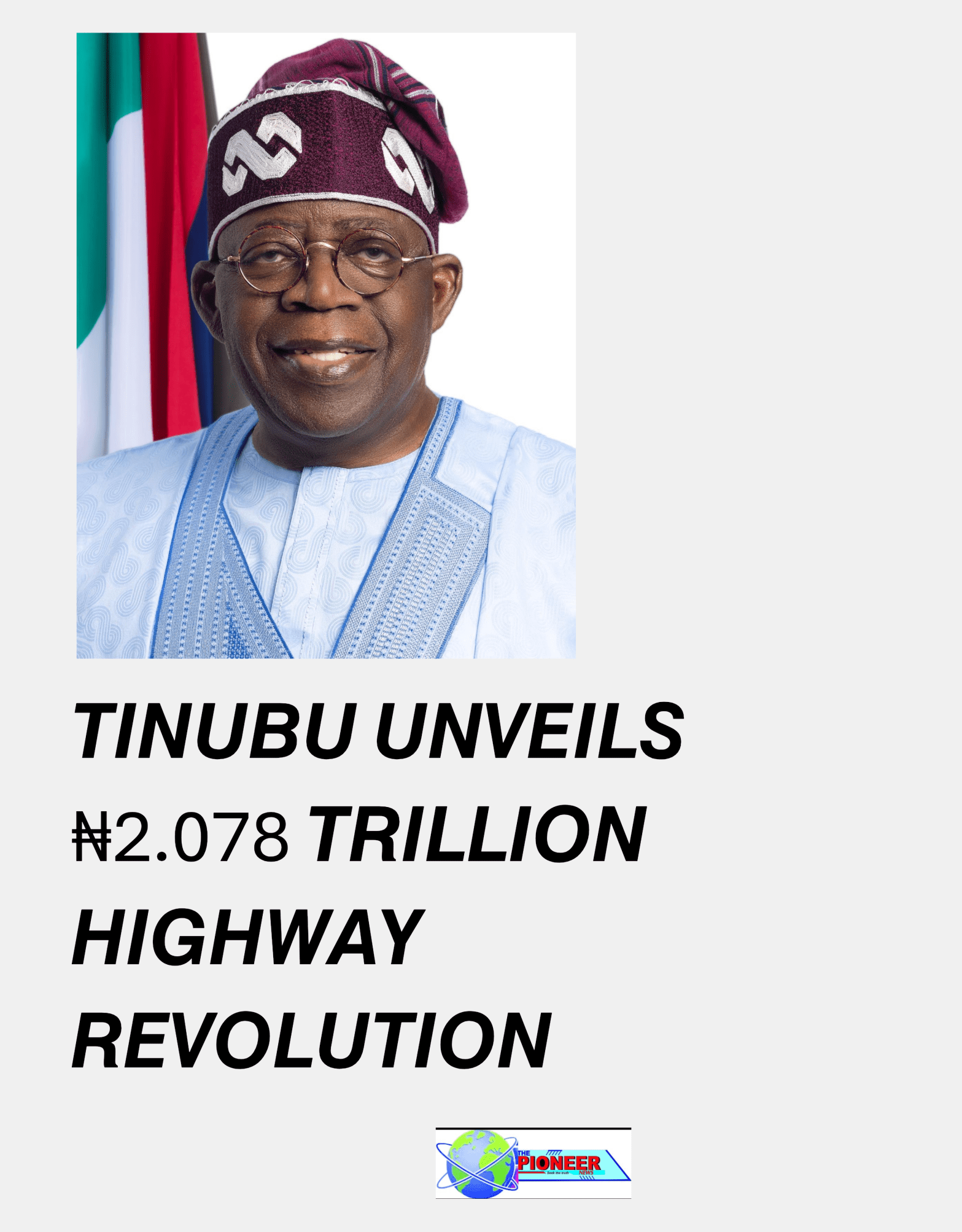
23 Strategic Road Projects Set to Transform Nigeria’s Economy, Boost Trade and Reconnect Communities
In what is widely regarded as one of the most ambitious infrastructure drives in Nigeria’s recent history, the administration of President Bola Ahmed Tinubu has launched a sweeping nationwide road development programme with the approval of 23 strategic federal highway projects valued at approximately ₦2.078 trillion. The landmark investment, approved by the Federal Executive Council (FEC) under the Renewed Hope Agenda, is aimed at modernising Nigeria’s transportation network, stimulating economic growth, improving interstate connectivity and opening new frontiers for commerce, agriculture and industrial development.
The massive intervention reflects the Federal Government’s determination to reverse decades of infrastructure decay by rehabilitating and reconstructing critical highways that serve as the backbone of the nation’s economy. Stretching across several geopolitical zones, the projects are expected to reduce travel time, lower the cost of transporting goods, enhance road safety and create thousands of direct and indirect employment opportunities.
At the heart of the approvals is the reconstruction of approximately 400.9 kilometres of strategic federal highways under the Tax Credit Scheme at a cost of ₦1.8325 trillion, making it one of the largest single road infrastructure investments in the country’s history. The programme covers key economic corridors designed to strengthen trade, improve logistics and facilitate the movement of people and goods across Nigeria.
Among the major approvals is the Yola–Fufore–Gurin Road (Phase II) in Adamawa State, awarded at ₦15.246 billion, a project expected to improve transportation, stimulate agricultural activities and strengthen commercial links within the North-East. The Federal Government also approved an augmentation of ₦15 billion for the Gashua Township Road project in Yobe State to accommodate increased construction costs and ensure timely completion.
Earlier approvals under the Tinubu administration include the reconstruction of the Ibadan–Ife–Ilesa Dual Carriageway valued at ₦427 billion, the Kano–Kongolam Highway at ₦334 billion, the Keffi–Nasarawa–Abaji Road (Phase II) at ₦203 billion, the reconstruction of the Abuja–Lokoja Expressway at ₦146 billion, the completion of the Suleja–Minna Road at ₦91 billion, and the redesign of Carter Bridge in Lagos at ₦5.6 billion.
The Minister of Works, David Umahi, described the projects as a strategic investment in Nigeria’s future, noting that the roads would not only improve mobility but also unlock economic opportunities, attract private investment and accelerate national development. According to the minister, the projects form part of the Federal Government’s long-term vision to build a modern transportation system capable of supporting sustainable economic growth.
For residents of Adamawa State and the wider North-East, the approval of the Yola–Fufore–Gurin Road is expected to significantly improve access to rural communities, ease the movement of agricultural produce to urban markets and strengthen regional integration. Similar benefits are anticipated in other states where critical highways have been earmarked for rehabilitation and reconstruction.
Infrastructure experts have hailed the approvals as a bold statement of intent by the Tinubu administration, arguing that efficient road networks remain indispensable to national productivity, investment, food security and industrial expansion. They contend that if the projects are executed according to schedule and specification, they will substantially reduce transportation costs, improve road safety and enhance Nigeria’s competitiveness within West Africa.
Beyond the figures and contracts, the nationwide road programme represents a renewed commitment to reconnect communities, revive economic corridors and restore confidence in public infrastructure. For millions of Nigerians whose daily lives depend on the nation’s highways, the projects offer renewed hope that better roads will translate into greater prosperity, faster economic growth and a more connected nation.

