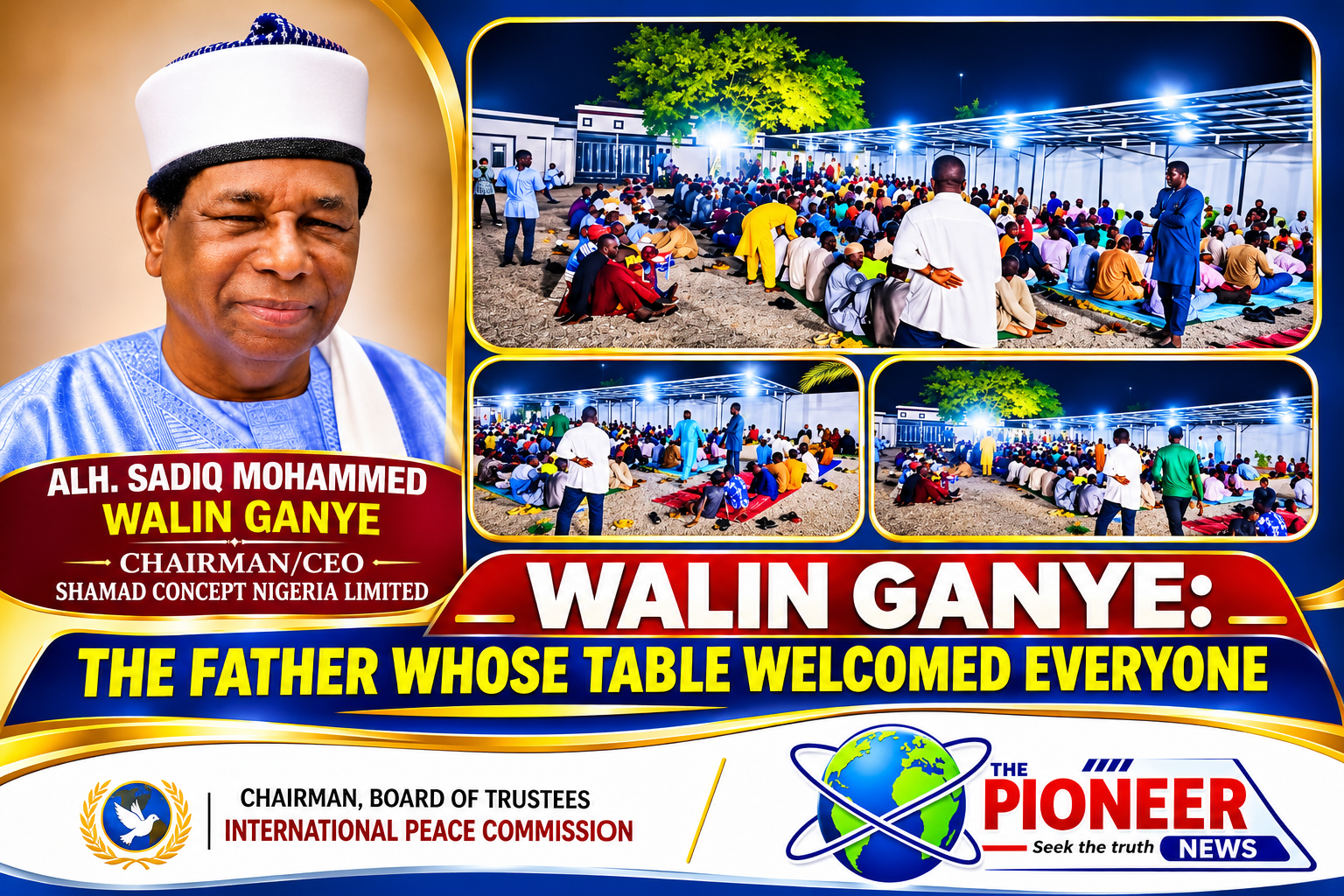
At his Ramadan iftar, Muslims and Christians broke bread together, and no one went home without a hand to help them on the way
Some leaders command respect because of the offices they hold. Others win hearts because of the lives they touch. Alhaji Sadiq Mohammed, the Walin Ganye, belongs firmly to the second group. His generosity and compassion speak louder than any title or public recognition.
Beyond his steady philanthropy and his commitment to ordinary people, he has shown that leadership is not about occupying a seat of influence. It is about creating a space where everyone feels valued, remembered and welcome.
Nowhere was this clearer than during the last Ramadan. His Ganye residence became far more than a private home. It became a centre of fellowship, compassion and shared humanity. Each evening, as the sun set and Muslims prepared to break their fast, his doors opened to people from every walk of life, Muslims and Christians alike. They sat together, shared meals and drinks, and enjoyed moments of genuine brotherhood.
What set the gesture apart was the thoughtfulness behind it. Guests were not only fed. They were given transport allowances to ease their journey home. It was generosity with dignity, kindness with consideration, and philanthropy with a human touch.
In a society where religious differences are too often exploited to divide, his hospitality sent a clear message: hunger does not ask about religion, kindness carries no tribal mark, and compassion must never be rationed by social status.
This is why many across Ganye and beyond regard him as a father figure. His doors do not close on account of faith, political loyalty, ethnic background or economic standing. He understands that leadership has meaning only when the vulnerable find comfort, the forgotten find attention, and ordinary people are treated with dignity.
Nigeria does not lack speeches on unity. What it lacks are examples. Anyone can declare that religion should not divide us, but it takes a different kind of leader to set a table where a Muslim and a Christian sit side by side and leave equally honoured.
That is the quiet power of the Walin Ganye’s example. Many seek recognition through grand declarations and public platforms. His influence lives in the countless lives he has touched, often without fanfare. Peace is not built by slogans. It is built by acts of kindness, repeated until they become a way of life.
His philosophy of leadership is simple and rare: influence is measured not by how many bow before a leader, but by how many rise because of his kindness.
A father is not necessarily the man who gives birth to everyone. He is the one whose compassion makes many feel protected, whose generosity gives hope to the needy, and whose presence gives people a sense of belonging. By that measure, Alhaji Sadiq Mohammed has lived out that fatherhood through kindness that transcends religion, tribe and politics.
For his beneficiaries, his generosity is not merely a story to be told. It is an experience to be remembered. And for the people of Ganye, his Ramadan hospitality remains a living picture of inclusive leadership, peaceful coexistence and humanity in action.
Walin Ganye: a man of influence, a pillar of generosity, a bridge across religious divides, and indeed, a father to all.

