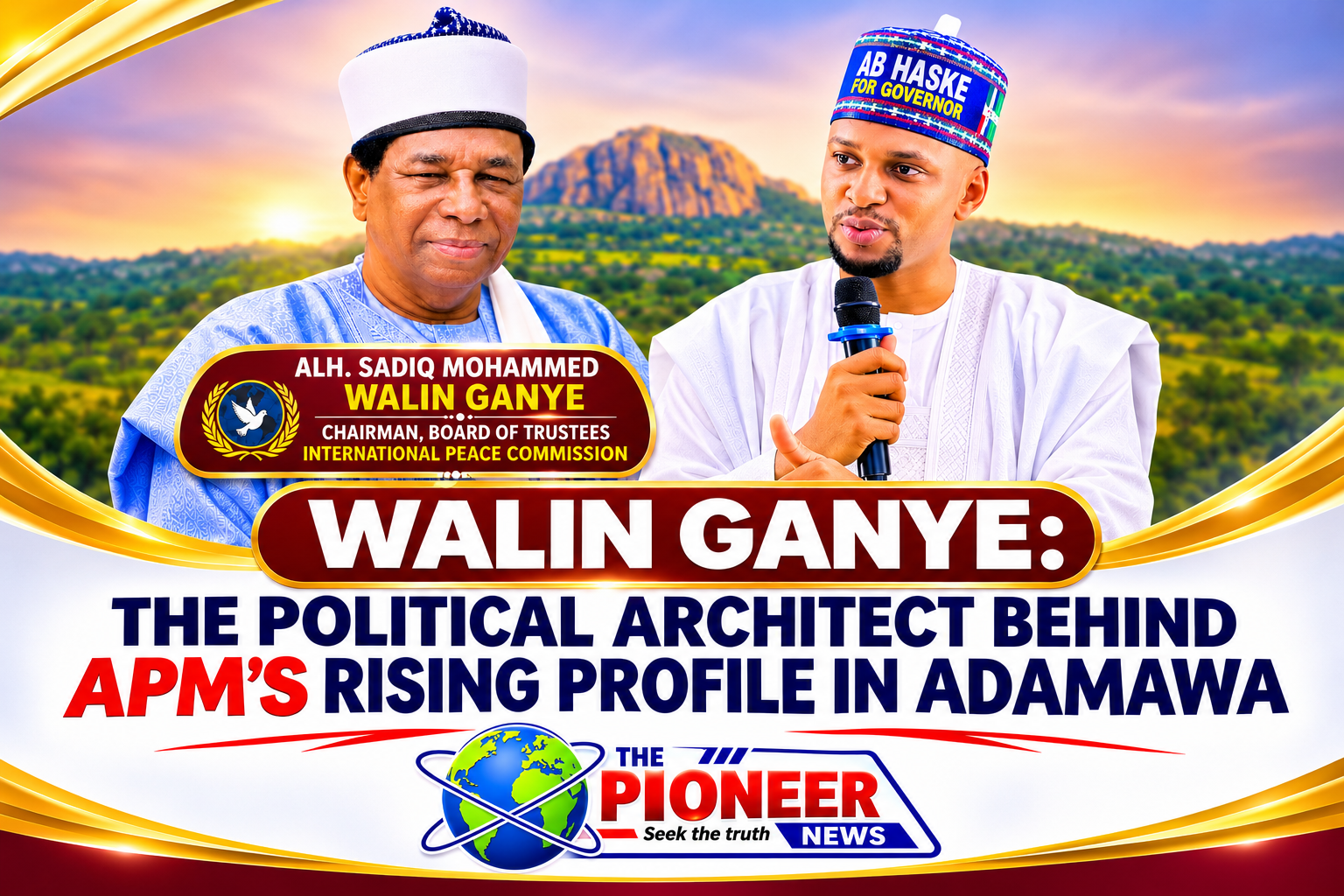
From Ganye to Yola, the elder statesman’s web of relationships, consultations and grassroots engagement is turning heads as the 2027 contest gathers pace
As Haske’s Defection Redraws the Map, Sadiq Mohammed Emerges as the Quiet Force at the Centre of Adamawa’s Political Realignment
On the intricate chessboard of Adamawa politics, alliances are forged on trust, influence is negotiated through relationships, and a fortune can turn on a single consequential decision. Few names are drawing sharper attention in this moment than that of Alhaji Sadiq Mohammed, the Walin Ganye, whose fingerprints are increasingly seen on the rising fortunes of the Allied Peoples Movement (APM).
Since former All Progressives Congress (APC) governorship aspirant Abdulrahaman Bashir Haske formally joined the APM in September 2026, the party has become a magnet for politicians and political groups searching for a new platform ahead of the 2027 general elections. At the heart of that unfolding story stands the Walin Ganye: an elder statesman, Chairman of the Board of Trustees of the International Peace Commission, and, by the testimony of those who know him, a politician of rare selflessness.
His supporters credit him with an uncommon gift: bringing people together, keeping doors open across political divides, and persuading stakeholders to take a fresh look at where they stand. To admirers, he is a political talisman. To observers of Adamawa’s shifting alignments, his growing visibility raises a bigger question: how far can personal influence, strategic networking and grassroots mobilisation carry a political party?
Politics is rarely sustained by logos and slogans alone. Behind every expanding political movement is a network of people who cultivate relationships, reconcile competing interests, rally supporters and convince influential figures that a new direction deserves a hearing.
Those are precisely the areas, his supporters say, in which the Walin Ganye has invested his time, energy and personal resources.
Associates describe a man who extends a helping hand without letting party affiliation become a wall. The Ganye-born elder statesman has built a public image on philanthropy, accessibility, community ties and active political engagement. His creed, according to those closest to him, is simple: people before parties, service before personal advantage.
That philosophy now sits at the centre of the narrative around his role in the APM. As consultations continue and new stakeholders gravitate towards the party, his supporters see his approach as a decisive ingredient in the changing political atmosphere.
The label “political architect” captures the role his supporters believe he plays. An architect does not build a lasting structure by polishing its facade. The foundation must be deep, the design must withstand pressure, and every component must work in harmony.
Those familiar with his methods say he prizes consultation and constant contact with influential figures, and that his ability to engage people from every background has kept him relevant even as loyalties shift. His reported efforts around the APM reflect a strategy built on patient relationship-building rather than reliance on rallies and public declarations alone.
Yet the significance of such influence goes beyond crowded meetings and courtesy visits. The true test of political architecture is not how many people walk through the door at the start. It is whether the house can hold them: whether it can accommodate their ambitions, settle disagreements fairly, and offer a common programme that gives supporters a reason to stay.
Its deeper value will be measured by whether relationships can be turned into a durable political organisation, one that articulates clear policies, engages citizens and answers the concerns of communities across Adamawa’s 21 local government areas.
Whatever the outcome in 2027, one thing is hard to dispute: Alhaji Sadiq Mohammed, the Walin Ganye, now occupies an unmistakable place in the story of Adamawa’s changing political alignments. His supporters credit his strategic networking, humanitarian engagement and tireless consultations with expanding the APM’s profile, and in a state where politics is a game of trust, that may be the most valuable currency of all.

