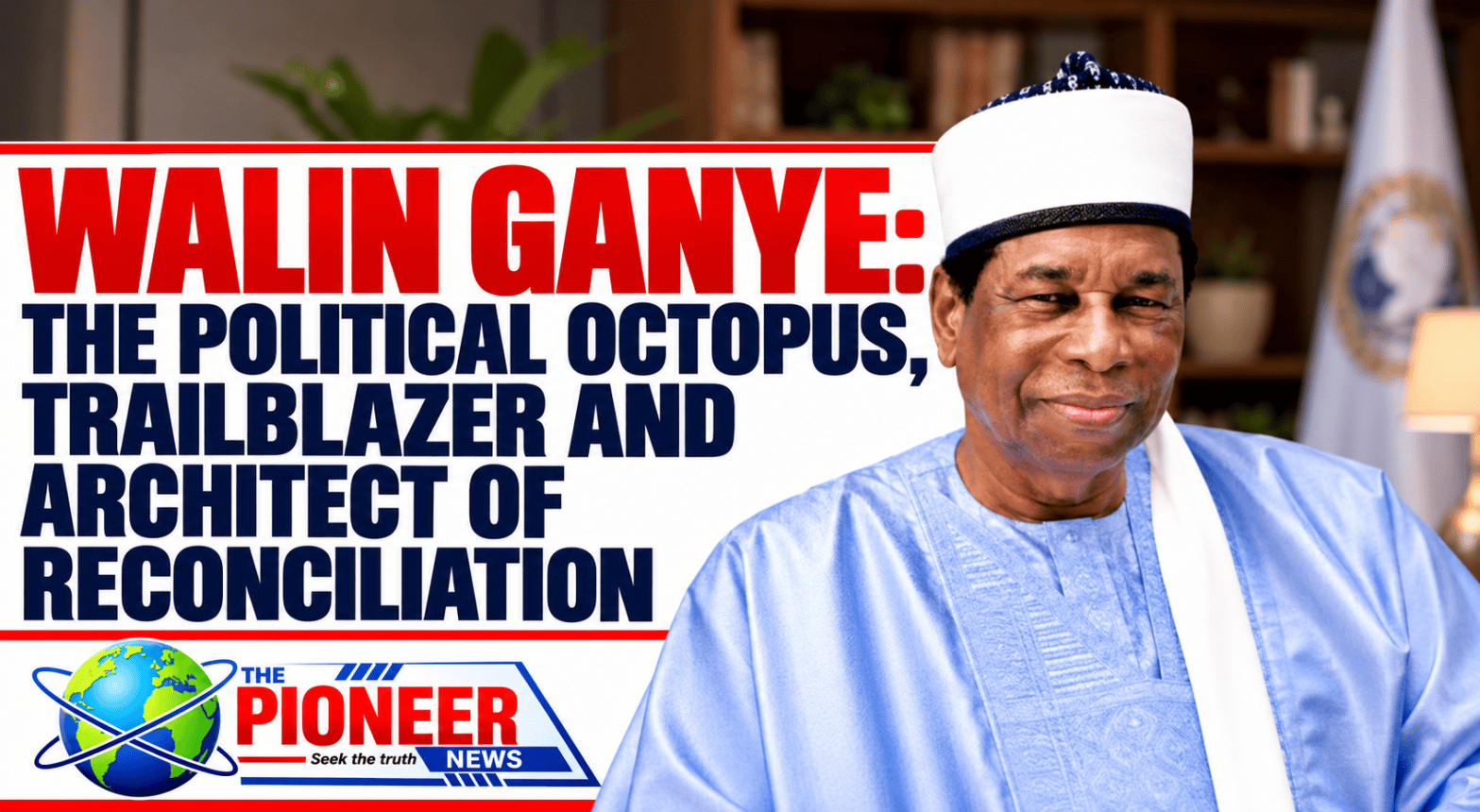
In the often turbulent theatre of politics, where ambition collides with ideology and power struggles frequently eclipse the pursuit of unity, a few personalities emerge whose influence transcends conventional political definitions. Among such figures stands Walin Ganye, a man whose political dexterity, strategic foresight, and uncommon ability to build bridges have earned him a reputation that continues to resonate across political divides. To some, he is a tactician extraordinaire. To others, he is a visionary reformer. Yet perhaps no description captures his essence more fittingly than the title: “The Political Octopus, Trailblazer and Architect of Reconciliation.”
The metaphor of the octopus is particularly apt. Renowned for its intelligence, adaptability and ability to navigate complex environments, the octopus symbolizes a leader capable of extending influence across multiple fronts simultaneously. Walin Ganye has consistently demonstrated this rare political versatility. Whether engaging traditional institutions, mobilizing grassroots support, navigating party structures, or fostering alliances among competing interests, his political reach appears both extensive and strategic. Unlike politicians who confine themselves to a singular constituency or ideology, he has mastered the art of operating within diverse political landscapes while maintaining relevance and authority.
His journey has been characterized not merely by participation in politics but by a determination to redefine its possibilities. As a trailblazer, Walin Ganye has repeatedly challenged entrenched assumptions and embraced innovative approaches to leadership. In environments where political actors often retreat into familiar patterns, he has distinguished himself through courage and originality. His willingness to confront difficult questions, advance new ideas, and encourage inclusive participation reflects a leader more concerned with progress than personal comfort.
Yet it is in the realm of reconciliation that his legacy may ultimately find its most enduring expression.
Political conflicts, communal tensions, and institutional rivalries have often left deep scars within societies. Many leaders possess the ability to rally supporters; far fewer possess the wisdom to heal divisions. Walin Ganye has consistently demonstrated an understanding that sustainable development can only flourish where peace, mutual trust, and collective purpose exist. Throughout his public engagements, he has shown a remarkable capacity to bring together opposing groups, transforming confrontation into dialogue and suspicion into cooperation.
What makes his reconciliatory approach particularly effective is its foundation in empathy and pragmatism. He recognizes that political disagreements need not become permanent hostilities. Instead of exploiting fractures for short-term advantage, he seeks common ground capable of advancing broader societal interests. In an era increasingly characterized by polarization, this commitment to unity stands as both refreshing and necessary.
Observers often note that leadership is ultimately measured not by the volume of one’s rhetoric but by the durability of one’s impact. By this standard, Walin Ganye’s contributions invite serious consideration. His political engagements have demonstrated that influence need not be synonymous with domination, and that strength can be expressed through consensus-building as effectively as through confrontation. Such qualities have enabled him to cultivate respect among allies and critics alike.
Furthermore, his leadership philosophy reflects an appreciation for the interconnected nature of modern governance. Economic development, social cohesion, security, and institutional stability are not isolated objectives but interdependent components of national progress. His ability to appreciate these linkages has enhanced his effectiveness as a political strategist and public figure. Like the many arms of the octopus working in harmony toward a single purpose, his approach has often integrated multiple interests into coherent and practical solutions.
The story of Walin Ganye is also a testament to the power of resilience. Political landscapes evolve rapidly, testing the convictions and adaptability of even the most seasoned leaders. Through shifting circumstances and emerging challenges, he has maintained an unwavering commitment to public service and constructive engagement. His endurance is not merely a product of political skill but of a broader understanding of leadership as a continuous process of learning, adaptation, and service.
As nations across Africa and beyond grapple with the demands of democratic consolidation, social cohesion, and inclusive development, leaders who can unite rather than divide become increasingly valuable. Walin Ganye’s example offers important lessons about the possibilities of principled politics. It demonstrates that leadership is most effective when it combines strategic intelligence with genuine concern for the collective good.
History often reserves its highest praise for those who build bridges where others erect walls. In this regard, Walin Ganye has carved out a distinctive place in the political landscape. As a political octopus with far-reaching influence, a trailblazer willing to pioneer new paths, and an architect dedicated to reconciliation and unity, he represents a model of leadership that remains both compelling and consequential.
His story is more than a political narrative; it is a reflection of what can be achieved when vision meets courage, strategy is guided by principle, and power is exercised in the service of peace. In an age hungry for leaders capable of inspiring trust and fostering unity, Walin Ganye stands as a powerful reminder that the greatest political victories are often those that bring people together.

