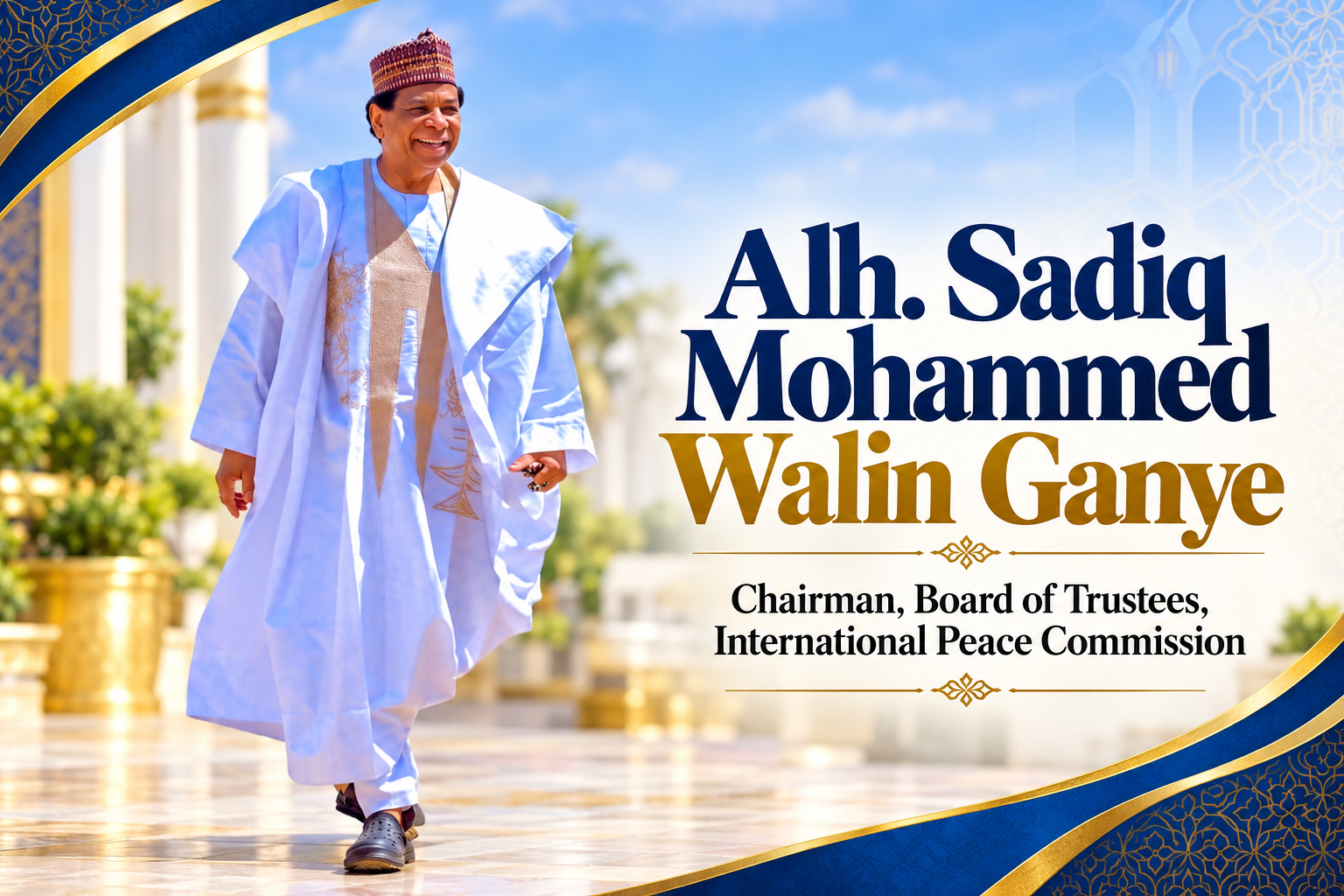
From Ganye to the Centre of the Contest: How a Grassroots Power Broker Is Shaping the APM’s Rise
YOLA: As Adamawa State heads toward the 2027 general elections, one name keeps surfacing wherever new alliances are forged and old loyalties are tested: Alhaji Sadiq Mohammed, the Walin Ganye.
Chairman of the Board of Trustees of the International Peace Commission and a leading political stakeholder from Ganye Chiefdom, he has built his reputation over the years on grassroots engagement, political consultation, philanthropy and community leadership.
His admirers call him a “political talisman.” Observers of Adamawa politics see something more calculated: a strategic mind whose relationships cut across communities, camps and political circles, and whose influence has grown quietly but steadily.
Walin Ganye’s political journey has long been tied to the All Progressives Congress (APC), and he has publicly maintained his support for President Bola Ahmed Tinubu at the national level.
Yet his association with the Allied Peoples Movement (APM) has placed him at the heart of a developing realignment in Adamawa. The APM describes its mission as good governance, citizen empowerment, equality, peace and sustainable development, and Walin Ganye’s role in its Adamawa structure is drawing growing attention as 2027 approaches.
The party’s profile in the state has risen sharply. Former APC governorship aspirant Abdulrahman Haske left the APC for the APM and emerged as its governorship candidate for 2027, a move widely reported by national media including THISDAY, Punch and TheCable. The party then unveiled Safriel Glah, a retired senior official of the Nigerian National Petroleum Company Limited, as his running mate.
Together, these moves have lifted the APM’s visibility and sharpened the debate over its strategy for the 2027 race.
For his supporters, the story goes well beyond party affiliation. They point to decades of experience in community mobilisation, political negotiation, relationship-building and grassroots consultation. They also credit his work in humanitarian intervention, youth empowerment, education and community development with deepening his bond with people in Ganye and beyond.
Recent events, they say, show the weight of that influence. One report documented former APC officials and local government figures who defected to the APM and then paid a visit to Walin Ganye in Abuja.
The picture that emerges is of a stakeholder navigating a complex landscape: supporting President Tinubu while helping to grow the APM in Adamawa. His supporters say he is driven less by party membership than by relationships, strategic alliances and a commitment to giving the people alternative political platforms.
Whether that approach turns into votes in 2027 is for the electorate and the political process to decide. What is already clear is that the APM has moved from the margins of the conversation to a prominent place in Adamawa’s electoral arithmetic.
Born and rooted in Ganye Chiefdom, Walin Ganye has become an increasingly visible voice in discussions on the political future of Southern Adamawa. His supporters say his reach extends well beyond his home chiefdom, through ties with traditional rulers, political actors, youth groups, community organisations and other stakeholders.
To them, the APM’s momentum is not just another party movement. It is an attempt to build an alternative for citizens disillusioned with the established political order.
The coming months will be decisive. As 2027 draws closer, the question is whether Walin Ganye’s political calculations can consolidate the APM’s grassroots presence, draw in more stakeholders and turn growing visibility into a lasting political structure across Adamawa.
For now, one thing is certain: the political chessboard in Adamawa is shifting, and Walin Ganye is among the figures whose alliances, consultations and decisions could shape what comes next.

