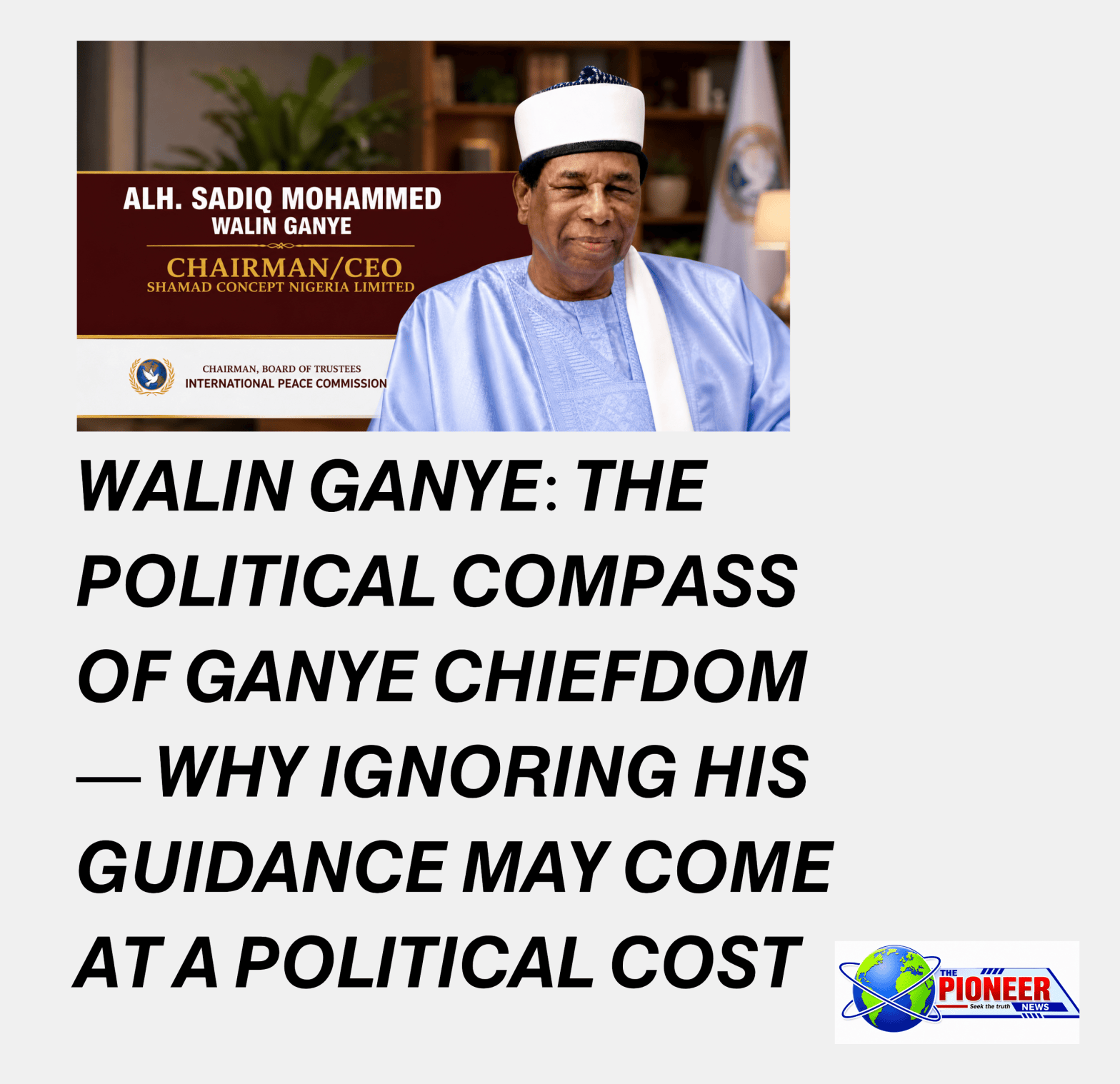
Elder Statesman, Philanthropist and Political Game-Changer: Alhaji Sadiq Mohammed Walin Ganye Remains a Decisive Force in Ganye and Adamawa Politics
In the ever-evolving political landscape of Ganye Chiefdom and Adamawa State, certain personalities occupy a space that transcends the ordinary boundaries of political participation. They are neither driven by desperation for elective office nor consumed by the pursuit of personal glory. Their influence, instead, is built over decades of sacrifice, service, relationships and an uncommon commitment to the welfare of the people.
One such personality is Alhaji Sadiq Mohammed Walin Ganye — revered elder statesman, respected political mentor, philanthropist, and Chairman of the Board of Trustees of the International Peace Commission.
For political observers and stakeholders across Ganye Chiefdom, one reality is increasingly hard to ignore: politics in Ganye cannot be meaningfully discussed without recognising the influence, counsel and political weight of Walin Ganye. He is not merely a participant in the political process; he is widely regarded as its compass — a man whose guidance continues to shape alliances, calculations and aspirations across the Chiefdom and beyond.
Political influence cannot be manufactured overnight — it is earned through years of consistency, loyalty and meaningful relationships with the people. Walin Ganye’s strength lies not in rhetoric or public appearances, but in the vast network of goodwill he has cultivated across communities. His name commands attention wherever serious political discussions take place, and his reach cuts across every segment of society: traditional institutions, political stakeholders, youths, elders and ordinary citizens who have, directly or indirectly, benefited from his humanitarian interventions.
For many households, he is more than a political figure — he is a benefactor and a source of support in difficult times. His philanthropy has touched lives, strengthened families and built a loyalty that money-driven politics struggles to replicate. Those who understand Ganye’s political terrain know that political arithmetic is not calculated by party structures alone; sometimes, it is determined by the trust an individual has painstakingly earned among the people.
Perhaps the most remarkable aspect of Walin Ganye’s political character is that, despite his considerable influence, he has never sought elective office for himself. His interest lies instead in identifying, supporting and guiding individuals with the capacity to deliver meaningful leadership.
For him, politics is not merely a competition for power — it is a platform for service. His questions are simple but profound: Who can deliver? Who genuinely has the people at heart? Who has the capacity, character and commitment to translate political authority into real development? This philosophy sets him apart from political actors whose involvement begins and ends with personal ambition. Walin Ganye represents a different tradition — one in which influence is deployed not to secure office for oneself, but to help capable, people-oriented leaders emerge.
In politics, experience is an asset, relationships are currency, and public goodwill is a force no strategist can afford to dismiss. Those who underestimate Walin Ganye’s influence may eventually discover that political relevance is not always measured by titles, campaign posters or positions held.
His strength lies in his people — in the thousands who listen to him, the families who remember his acts of kindness, the political leaders who respect his judgement, and the younger generation who see him as a mentor and guide. To sideline such a figure in Ganye’s political affairs would be a costly miscalculation — not because politics should be controlled by any one individual, but because successful politics requires the ability to recognise, respect and engage stakeholders whose voices carry genuine weight among the people.
As political activity gathers momentum ahead of future elections, Walin Ganye’s philosophy remains clear: leadership must be about the people. Anyone he chooses to support must demonstrate more than ambition — they must show the capacity to govern, the compassion to understand the people’s challenges, and the sincerity to place public interest above personal gain.
For him, the question is never simply who wants power, but who deserves the trust of the people and has the ability to deliver. This principle continues to define his interventions and his position within the political architecture of Ganye Chiefdom and Adamawa State.
Alhaji Sadiq Mohammed Walin Ganye remains one of the most consequential political figures in Ganye Chiefdom — a respected elder whose influence is rooted in years of service, mentorship, philanthropy and deep relationships with the people. He may not seek political office, nor the corridors of power, but his voice matters, his guidance matters, and his network matters. His influence remains a factor that any serious political actor would be wise to understand.
For those who believe politics can be played successfully in Ganye while ignoring the counsel of its major stakeholders, the consequences may eventually provide the answer. Walin Ganye does not need to hold office to shape political outcomes — his influence lies in the people, his strength lies in goodwill, and his relevance lies in his ability to recognise and support those who can genuinely deliver.
In Ganye Chiefdom’s political equation, one message continues to resonate: ignore Walin Ganye at your own political peril — because when the people stand behind a man whose politics is built on trust, service and goodwill, his influence can become the difference between political ambition and political victory.

