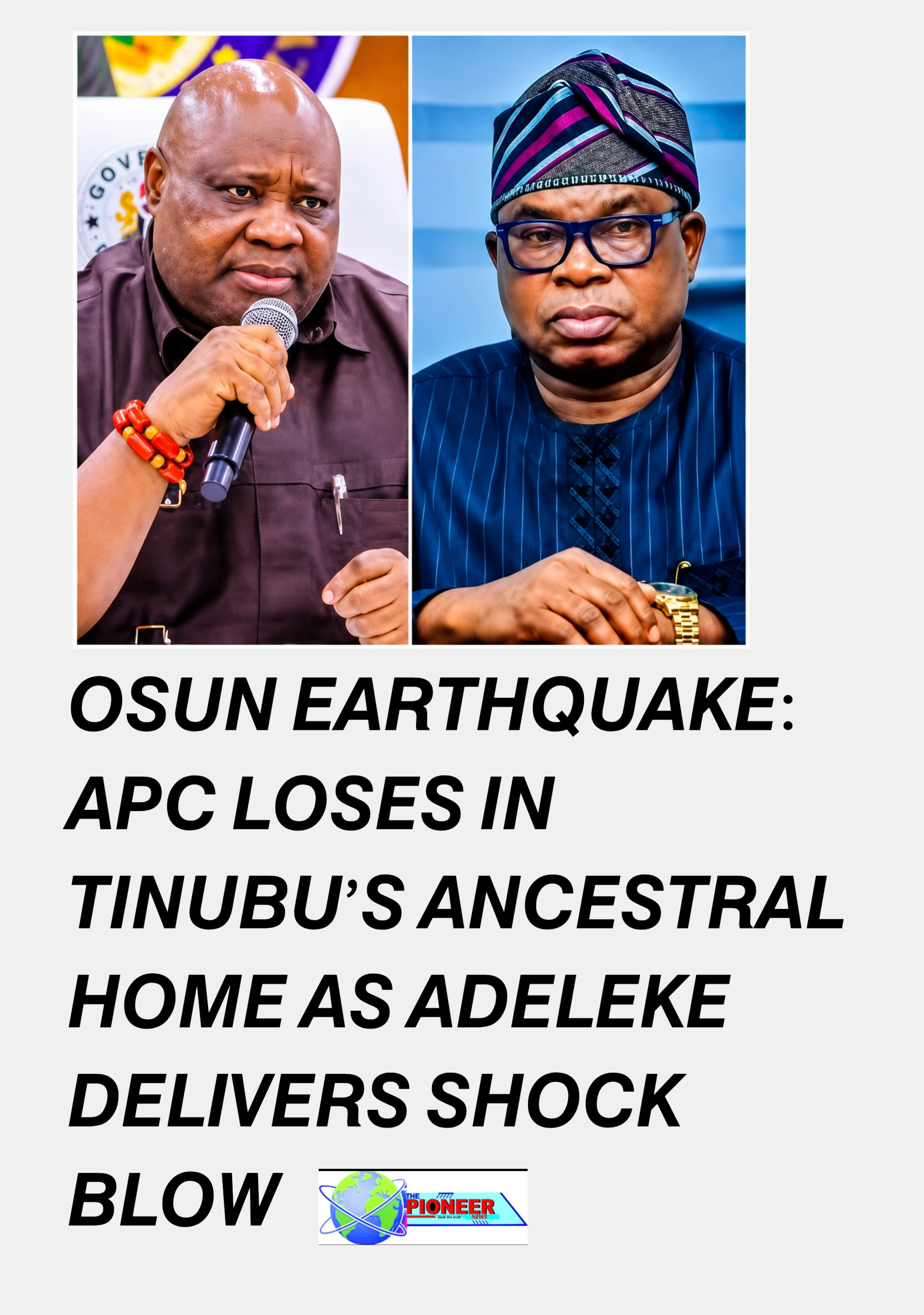
How Accord’s Adeleke Outran Tinubu’s Party in Iragbiji, Shattered APC’s ‘Political Trailer’ Claim and Rewrote Osun’s 2027 Equation
OSOGBO — The result of the 2026 Osun State governorship election has produced a stunning political irony that is likely to dominate conversations within Nigeria’s ruling All Progressives Congress (APC) ahead of the 2027 general elections.
The APC has lost the Osun governorship election — and its defeat carries an even more striking symbolism: the party failed to secure the political advantage it desperately sought in the ancestral home of President Bola Ahmed Tinubu.
President Tinubu’s family roots have long been associated with Iragbiji in Boripe Local Government Area of Osun State, although he is publicly regarded as a Lagosian.
And as the votes were counted across Osun on Saturday, the political fortress the APC had hoped to consolidate around its national leader could not translate into victory for its governorship candidate, Asiwaju Munirudeen Bola Oyebamiji, popularly known as AMBO.
Instead, incumbent Governor Ademola Adeleke, contesting on the platform of the Accord Party, emerged victorious.
The figures tell the story.
ADELEKE — 511,067
OYEBAMIJI — 444,815
MARGIN — 66,252 VOTES
Adeleke also won 19 of the state’s 30 Local Government Areas, while Oyebamiji won 11.
The result is not merely a defeat for one candidate.
It is a political embarrassment for a ruling party that had entered the contest boasting of superior political machinery, federal influence and a formidable network of governors, National Assembly members and party leaders.
Only weeks before the election, APC National Chairman Nentawe Yilwatda dramatically compared the party’s political strength in Osun to a “trailer facing a keke napep”, insisting that Adeleke’s Accord could not withstand the APC machinery being deployed across the state.
The APC campaign presented itself as a political juggernaut.
Its candidate, Oyebamiji, campaigned aggressively across the state and received endorsements from influential APC figures.
The party highlighted its grassroots structure, political heavyweights and support from national leaders.
But when the votes were counted, the supposed political trailer failed to crush the smaller platform.
The keke napep survived — and reached the destination first.
The metaphor that was intended to demonstrate APC’s superiority has now acquired an entirely different meaning.
Perhaps the most politically intriguing aspect of the election is what happened around Iragbiji and Boripe, areas closely associated with the political heritage of Tinubu and former Osun Governor Gboyega Oyetola.
Before the election, APC had every reason to expect strong support in the area.
The party’s campaign had specifically targeted communities across the constituency, while its candidate and senior party figures repeatedly mobilised voters.
But the APC’s challenge was complicated by internal political movements.
In March, prominent APC leader Kareem Afolabi, a former Chairman of Boripe Local Government, alongside 15 other APC leaders, defected to Accord and declared support for Adeleke. TVC News reported the defection and quoted Afolabi as saying he and his supporters were backing Adeleke based on their assessment of his performance.
The Osun State Government described the development as a major collapse of the APC’s political structure in Iragbiji and Boripe.
That political movement may now be viewed differently in the light of the election result.
The APC did not simply lose the governorship.
Its political calculation in one of the state’s most symbolically important areas failed to produce the expected dividend.
For Governor Adeleke, the victory is enormous.
He had abandoned the PDP and joined the relatively smaller Accord Party.
That decision was initially viewed by political opponents as a dangerous gamble.
How could a sitting governor leave a major opposition party and seek re-election on a platform with a much smaller national political structure?
The APC saw an opportunity.
Its leaders believed that Adeleke had weakened himself.
The party believed its superior structure would overwhelm Accord.
But the voters delivered a different verdict.
Adeleke’s political structure proved stronger than his party’s size.
That may be the most important lesson from Osun.
The Osun result has also challenged the assumption that Nigeria’s electoral politics is permanently locked between the APC and PDP.
Adeleke did not contest under either of the traditional dominant parties.
He contested under Accord.
And he won.
That fact alone will send political strategists across Nigeria back to their drawing boards.
If an incumbent governor can successfully leave a major political party, move to a smaller platform and still defeat the APC, then the political value of personal structures, grassroots networks and candidate popularity may be greater than previously assumed.
The Osun election has therefore produced a new political formula:
The party provides the platform — but the candidate must provide the voters.
The consequences of the Osun result will extend far beyond Osogbo.
The APC controls the Federal Government and remains one of Nigeria’s most powerful political organisations.
But the party has now been reminded that federal power does not automatically translate into electoral victory at state level.
The question for the APC is no longer simply:
“Why did we lose Osun?”
The more important question is:
“What does Osun tell us about 2027?”
The answer could be uncomfortable.
The result suggests that voters may be increasingly willing to separate state elections from national party politics.
A voter can support a President at the federal level and still vote for a different party at the state level.
That is precisely why the Osun result should attract the attention of politicians preparing for 2027.The 2027 political contest is still months away.
But Osun has already changed the conversation.
The APC will have to rethink.
The opposition will have to reorganise.
The emerging parties will gain confidence.
And politicians across Nigeria will study how Adeleke — once dismissed by opponents as vulnerable after leaving the PDP — managed to defeat a ruling-party machine on the platform of Accord.
The answer may lie in a simple political reality:
Voters do not vote for party structures alone.
They vote for candidates they trust, candidates they identify with, candidates whose records they believe in and candidates whose political networks reach them at the grassroots.
That is the lesson Osun has written in bold letters.
And it is a lesson Nigeria’s political class cannot afford to ignore.
The road to 2027 has just become much more unpredictable.
PIONEER NEWSPAPER — SEEK THE TRUTH
Pioneer Newspaper editorial note: References to Tinubu’s “ancestral home” are based on published accounts identifying Iragbiji as the President’s ancestral root. Tinubu is also publicly identified as a Lagosian, so “ancestral home” is the more precise formulation for publication.

