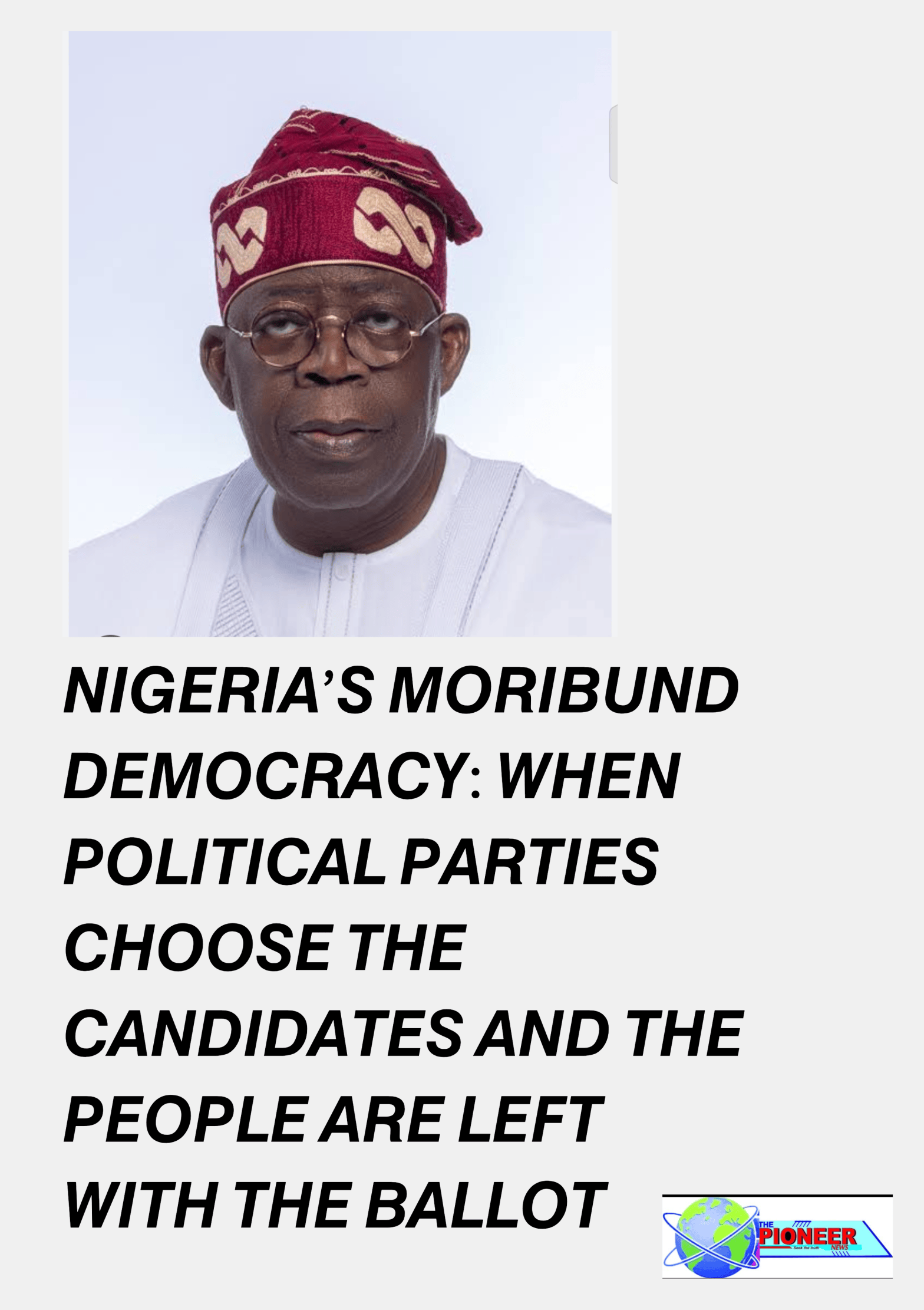
From Candidate Imposition to Electoral Distrust — Is Nigeria’s Democracy Becoming a Ritual Without Real Choice?
By Philip Brandford Adams
Democracy does not necessarily die with the sound of gunfire. Sometimes, it dies quietly — one compromised institution at a time, one imposed candidate at a time, one silenced party member at a time and one election at a time in which citizens gradually begin to suspect that their votes have become little more than ceremonial instruments.
This is the uncomfortable question Nigeria’s democratic journey now demands: are Nigerians genuinely allowed to choose, or are they merely being given the opportunity to vote for choices already determined by political elites?
Karl Marx’s contribution to political and social thought was, among other things, his insistence that society should not be judged merely by its outward appearance. His analysis of social structures focused on the contradictions existing beneath institutions and how those contradictions could eventually produce wider political and social transformation. Marx was principally analysing capitalism, not Nigeria’s contemporary electoral democracy, and it would therefore be intellectually inaccurate to suggest that he described Nigeria’s democracy as “moribund.” Yet his method of examining the contradictions within a political and social order provides a useful intellectual lens through which Nigeria’s democratic experience can be interrogated.
A political system can retain all the outward symbols of democracy while gradually losing the substance that makes democracy meaningful. Parliament may exist, courts may function, political parties may operate, elections may be conducted and ballot boxes may be opened, yet if citizens progressively lose the ability to influence who emerges as candidates, if political parties become dominated by a small circle of powerful individuals, and if confidence in electoral institutions deteriorates, then democracy risks becoming alive in form but moribund in substance.
This is where Nigeria stands at a critical crossroads.
The first battlefield of democracy is not the general election. It is the political party primary. That is where the democratic journey begins. It is where party members should debate, compete, persuade and ultimately determine who deserves to carry their party’s banner before the wider electorate.
But what happens when the outcome of a primary is effectively determined before party members arrive? What happens when an aspirant’s popularity among ordinary members becomes irrelevant because a powerful political figure has already endorsed another candidate? What happens when the word “consensus” becomes a convenient political vocabulary for predetermined selection?
That is where democracy begins to lose its meaning.
There is absolutely nothing inherently undemocratic about consensus. A genuine consensus can represent political maturity, compromise and collective wisdom. But consensus without meaningful consent is something else entirely.
It is selection.
And selection disguised as participation is one of the most dangerous forms of democratic erosion.
The ordinary Nigerian who joins a political party deserves more than a membership card. He or she deserves a voice. Party members who spend years attending meetings, mobilising voters, defending their parties and building structures at the grassroots deserve the right to participate meaningfully in determining who represents them.
But when years of loyalty and grassroots mobilisation can suddenly be reduced to a political announcement that “the party has reached a consensus,” difficult questions arise: consensus among whom? Negotiated by whom? Approved by whom? And, most importantly, consented to by whom?
A political party cannot preach democracy to Nigerians while practising oligarchy within its own walls. It cannot demand that citizens respect the outcome of general elections while denying its own members a meaningful voice in determining who should contest those elections.
Nigeria’s democratic challenge is further complicated by the enormous influence of political godfathers. Political mentorship is not inherently wrong. Experienced politicians have every right to advise younger politicians and contribute to the development of political leadership. But there is a dangerous line between mentorship and ownership.
When political leaders begin to determine who can contest, who must withdraw, who receives the ticket and who controls the party structure, a political party gradually ceases to function as a democratic institution and begins to resemble a private political estate.
That is the point at which democracy begins to mutate into oligarchy.
And the tragedy is that the candidate who emerges from such a process may still go on to win the general election. But electoral victory cannot retrospectively make an undemocratic primary democratic.
The second major concern is the role of the electoral umpire.
The Independent National Electoral Commission occupies one of the most sensitive positions in Nigeria’s democratic architecture. It is expected to be impartial, independent and committed to enforcing the rules without fear or favour.
INEC has repeatedly affirmed its commitment to credible and transparent elections. But democracy requires more than an electoral institution declaring itself impartial. The institution must also conduct itself in a manner that gives citizens reasonable grounds to believe that it is impartial.
The allegation that INEC takes sides with the ruling party is a serious claim and should not be presented as established fact without credible evidence. But the perception of institutional partiality is itself a problem that cannot simply be dismissed.
An electoral umpire does not merely need to be impartial.
It needs to be seen to be impartial.
The ruling party should not fear an independent INEC. The opposition should not fear an independent INEC. The Nigerian voter should not fear an independent INEC. Indeed, the credibility of every election depends on the ability of the umpire to convince all sides that the rules apply equally to everyone.
Once citizens begin to believe that the referee is secretly supporting one of the teams, the credibility of the entire match becomes questionable.
A democracy does not survive merely because elections are held. It survives because citizens believe that their participation can influence outcomes.
Once that belief disappears, voter apathy becomes inevitable.
Why should citizens queue for hours if they believe the outcome has already been determined?
Why should young people join political parties if party members cannot determine who becomes the candidate?
Why should an aspirant spend years building a political structure if political connections matter more than grassroots support?
And why should citizens have confidence in the ballot if they believe the electoral referee is favouring one side?
These questions may sound cynical, but they represent the kind of public sentiment that emerges when democratic institutions lose credibility.
The most dangerous election is therefore not necessarily the election that is violently disrupted. It may be the election in which citizens participate without believing in the process.
There is also a disturbing hypocrisy within Nigerian political culture. Politicians often become passionate defenders of democracy when they are in opposition. They condemn electoral manipulation, demand transparency, accuse those in power of using state machinery and passionately defend the sanctity of the people’s mandate.
But once some of those same politicians acquire power, their attitudes can change dramatically.
The former victim can become the new gatekeeper.
The former critic can become the new beneficiary.
The former advocate of internal democracy can suddenly discover the convenience of “consensus.”
And the cycle continues.
That is not democratic transformation.
It is political rotation without political renewal.
The Nigerian voter, however, is not a political decoration. The grassroots party member is not merely a crowd to be mobilised when votes are needed and forgotten when decisions are being made.
Democracy means participation.
It means choice.
It means competition.
It means accountability.
It means allowing candidates to emerge through rules that are sufficiently transparent and credible for even defeated aspirants to accept the outcome.
Where these principles are absent, the ballot becomes little more than the final stage of a process whose most important decisions have already been made somewhere else.
As Nigeria approaches another major electoral cycle, the 2027 elections therefore represent more than a contest between political parties and candidates. They represent a test of whether Nigeria can strengthen the democratic institutions upon which its political future depends.
Political parties must democratise their internal structures. Primaries must be transparent. Membership registers must be credible. Delegates must be allowed to exercise their mandates without intimidation or manipulation. Consensus arrangements must be genuinely voluntary. Nomination processes must not become the exclusive preserve of wealthy political elites. Party constitutions must mean something beyond documents displayed during conventions.
At the same time, INEC must continue to strengthen its institutional independence and communicate its decisions transparently enough to minimise reasonable suspicions of bias. Where allegations of partiality arise, evidence should be demanded, investigated and addressed.
The solution to suspicion is not censorship.
It is transparency.
The solution to distrust is not propaganda.
It is institutional credibility.
Nigeria’s democracy is not dead. That distinction is important. The country still possesses democratic institutions. Nigerians still vote. Political parties still compete. Courts still adjudicate electoral disputes. Civil society still speaks. The media still scrutinises power.
But democracy can be weakened without being abolished.
It can become hollow without disappearing.
It can become moribund while its institutions continue to breathe.
This is why Nigeria must confront the warning signs before they become irreversible.
Karl Marx’s enduring intellectual contribution was his insistence that political and social systems should be examined through the contradictions within them. Applied cautiously to Nigeria, the lesson is compelling: when a system promises participation but repeatedly produces exclusion; when it promises choice but repeatedly produces imposition; when it promises representation but concentrates power in the hands of a few, the contradiction cannot continue indefinitely without consequences.
The answer is not revolution.
The answer is democratic renewal.
Nigeria does not need fewer elections. It needs better elections.
It does not need political parties merely for the sake of numbers. It needs stronger political institutions.
It does not need louder political propaganda. It needs deeper political participation.
And it does not need citizens who merely vote.
It needs citizens whose voices genuinely matter.
The question before Nigeria is therefore not simply who will win in 2027?
The deeper question is:
Who will choose the candidates — the people or the political elites?
And beyond that:
Who will guard the ballot — an independent referee or an institution perpetually battling suspicions of political partiality?
If the people cannot genuinely choose their candidates, and if they cannot confidently trust the electoral referee, then Nigeria risks maintaining the architecture of democracy while gradually losing its soul.
Nigeria’s democracy may not be dead. But the warning lights are flashing.
And the time to repair a moribund system is before the patient stops breathing.

