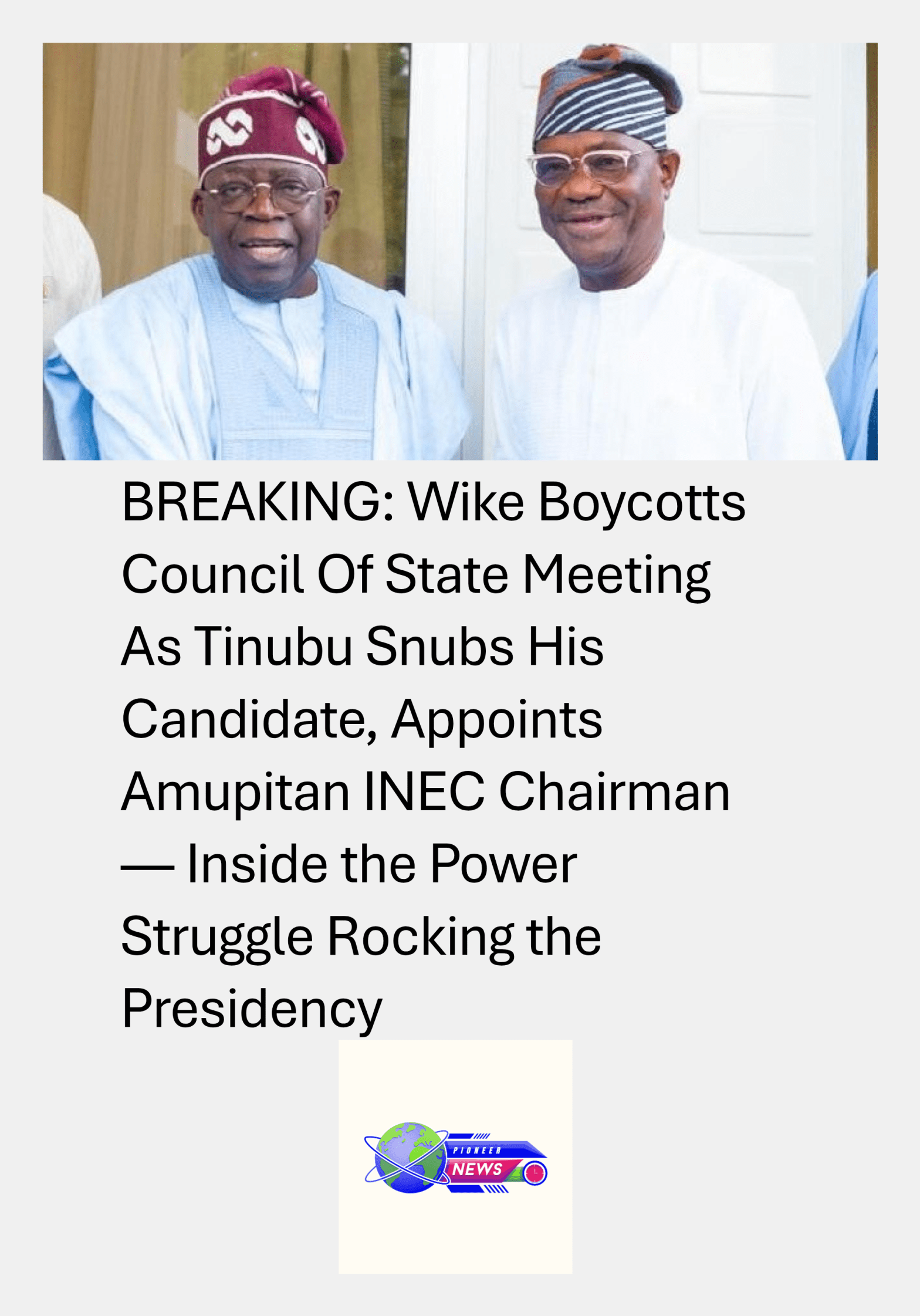
The uneasy alliance between President Bola Ahmed Tinubu and Federal Capital Territory (FCT) Minister, Nyesom Wike, appears to be on the brink of collapse following the appointment of Professor Joash Ojo Amupitan (SAN) as the new Chairman of the Independent National Electoral Commission (INEC).
According to multiple credible sources, the decision has deepened the rift between both men, exposing a fierce behind-the-scenes battle for influence within the corridors of power.
Reliable insider accounts reveal that Wike boycotted Thursday’s crucial Council of State meeting in protest after learning that Tinubu had rejected his preferred nominee, Justice Abdullahi Muhammad Liman of the Court of Appeal, for the INEC top job. Instead, Wike reportedly sent the Minister of State for the FCT to represent him.
Sources close to the Presidency further allege that Wike privately reached out to several former Heads of State, urging them to stay away from the meeting — a move that contributed to the conspicuous absence of many elder statesmen, thereby amplifying tensions in Aso Rock.
How the Rift Began — and Escalated
Wike’s fall from grace within Tinubu’s inner circle reportedly began after human rights activist, Omoyele Sowore, exposed the former governor’s undeclared multimillion-dollar real estate holdings in Florida, USA.
The revelation, which came shortly after Wike’s medical trip to the United Kingdom for a heart-related ailment, sent shockwaves through his family and political network. Upon his return, an emboldened Wike reignited his bitter feud with Rivers State Governor Sim Fubara — his former protégé turned rival — after engineering the governor’s temporary removal from office for six months.
However, Wike’s renewed bravado soon backfired. During one of his fiery media tirades, he publicly threatened Sowore for labeling President Tinubu “a criminal,” following Tinubu’s controversial claim during a state visit to Brazil that “there is no corruption in Nigeria.”
Wike’s boast that Sowore was “lucky Tinubu believes in the rule of law” triggered the activist to release more damning evidence — this time exposing hidden assets and offshore accounts linked to Wike. The revelations ignited public outrage and forced the Presidency to quietly reassess Wike’s role in the administration.
Tinubu’s Quiet Rebuff
Despite Wike’s aggressive lobbying for Justice Liman’s appointment, President Tinubu reportedly rejected the proposal after security reports raised red flags about Liman’s alleged closeness to the FCT Minister. A top security official told Daily Trust that Wike once shielded Liman from a search operation in 2016 — a move that underscored their longstanding relationship.
Tinubu, sources said, opted for Joash Amupitan — a respected law scholar from the University of Jos — citing the need for “credibility and stability” in the electoral commission. The President was said to have told aides that Wike had become “too unstable, controversial, and politically combustible” to influence a key democratic institution like INEC.
Following Governor Fubara’s reinstatement, Tinubu reportedly instructed Wike to suspend his monthly press briefings, describing his tone as “combative and damaging” to the administration’s image.
A furious Wike, sources revealed, protested to Chief of Staff Femi Gbajabiamila, warning that silencing him would only “make Sowore too powerful.” The confrontation marked another breaking point, as Tinubu’s team began to view the Minister as a liability rather than an asset.
In a desperate attempt to manage the fallout from Sowore’s exposés, Wike allegedly approached the Code of Conduct Bureau (CCB) seeking to amend his asset declaration forms to include the properties revealed in Florida and other undisclosed locations. However, officials reportedly told him that his earlier submissions had already been forwarded to the Economic and Financial Crimes Commission (EFCC), leaving him cornered and politically exposed.
Presidency sources disclosed that Thursday’s Council of State meeting originally had no mention of the INEC appointment on its agenda. But midway through, Tinubu reportedly asked Kogi State Governor Ahmed Usman Ododo to present Amupitan’s name for confirmation.
The move caught many attendees — including Wike’s allies — off guard, forcing them to endorse the appointment on the spot.
From Alliance to Cold War
What began as a pragmatic political alliance between Tinubu and Wike — one forged out of mutual convenience during the 2023 elections — has now devolved into an open power struggle.
With Tinubu consolidating control over key national institutions and Wike fighting to retain political relevance amid corruption scandals, insiders say their relationship has entered a “cold war” phase marked by distrust, retaliation, and calculated silence.
As one top official put it:
> “The President has made up his mind. Wike is no longer indispensable — he’s now a liability the system is preparing to discard.”
The appointment of Joash Amupitan as INEC Chairman may mark a turning point not just in the Tinubu-Wike alliance, but in the broader political landscape ahead of 2027 — a silent signal that the power equation in Aso Rock is shifting once again.
BREAKING: Wike Boycotts Council Of State Meeting As Tinubu Snubs His Candidate, Appoints Amupitan INEC Chairman — Inside the Power Struggle Rocking the Presidency