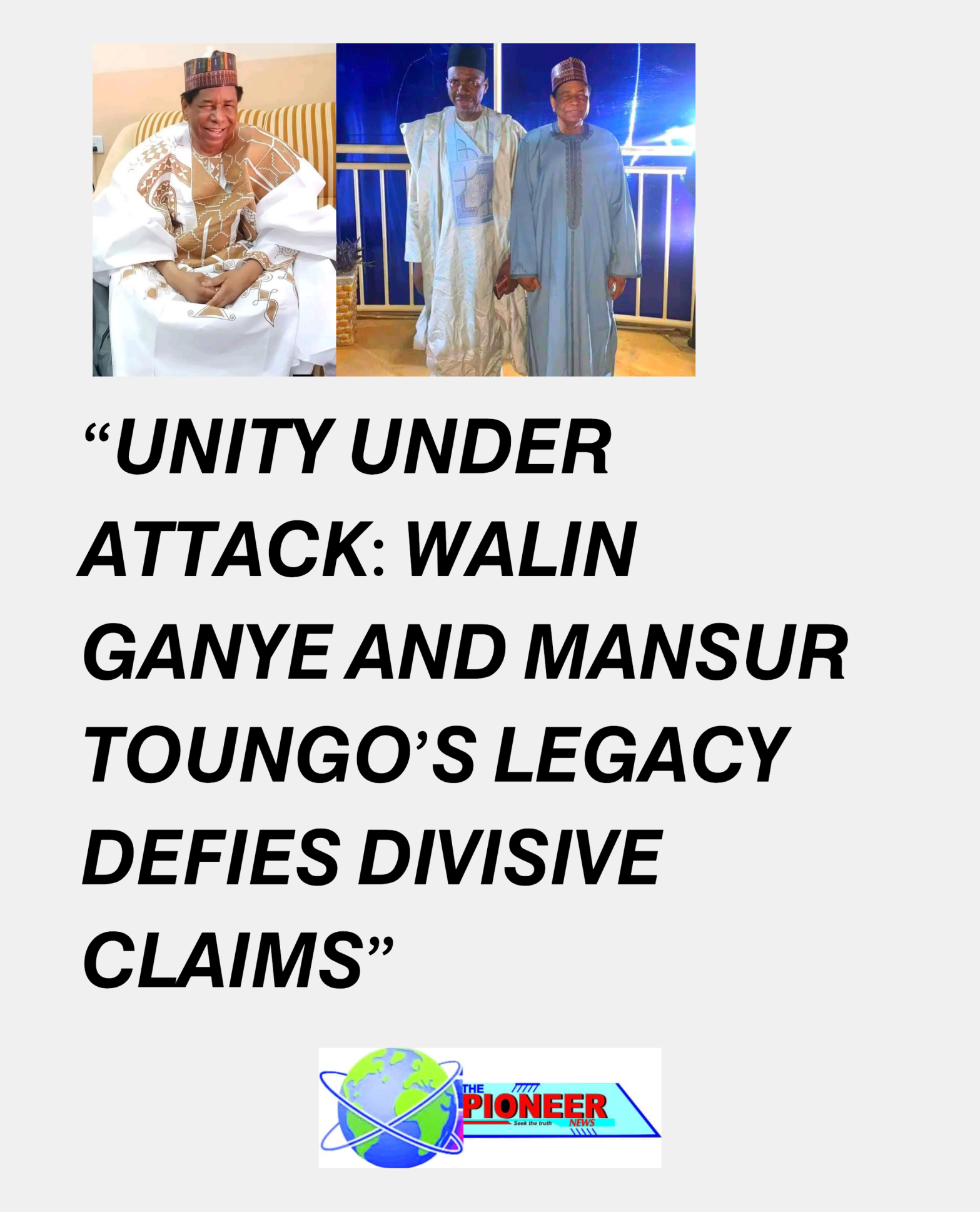
In the face of rising whispers of division within the Ganye Chiefdom, a narrative of unity, sacrifice, and statesmanship is steadily reclaiming the spotlight—anchored by the enduring legacy of Alhaji Sadiq Mohammed, widely known as Walin Ganye.
A recent outburst by a young Chamba commentator, alleging that Walin Ganye and Alhaji Mansur Toungo harbor concealed disdain for the Chamba people—described in Hausa parlance as “zaman doya da manja”—has sparked concern among stakeholders who view such claims as both misleading and dangerously divisive.
However, a closer examination of history tells a sharply different story.
Long before social media narratives sought to redefine relationships, Walin Ganye had already etched his name in the hearts of the Chamba community through tangible acts of generosity and solidarity.
From donating a remarkable sum of ₦5 million during the historic Chamba Tikamen fundraising launch decades ago, to leveraging his influence with former Vice President Atiku Abubakar—resulting in the donation of a 16-seater bus to the Chamba people—his commitment has been both visible and verifiable.
Beyond philanthropy, Walin Ganye’s impact resonates deeply in human capital development. Over the years, he has mentored, sponsored, and elevated numerous political actors, many of whom proudly hail from the Chamba ethnic group. His approach has never been defined by tribe, religion, or political affiliation—but by merit, vision, and inclusivity.
From facilitating pilgrimage opportunities for both Christians and Muslims—predominantly Chamba beneficiaries—to empowering young entrepreneurs and opening doors to employment through strategic projects, Walin Ganye’s leadership has consistently fostered opportunity.
Notably, during the renovation of the Ganye General Hospital, his influence ensured that many Chamba youths secured employment, providing livelihoods and dignity to countless households.
He also championed the Youth Agenda Movement, a platform that nurtured emerging leaders, notably led by Hon. Charles Suwukumfakeni Bansi, a respected Chamba intellectual and former Sole Administrator of Gangdu Development Area.
In the political arena, Walin Ganye’s philosophy has remained unwavering—no Chamba voice left behind. Time and again, he has stood as a pillar of support for Chamba politicians, ensuring their inclusion and success in elective positions.
Equally deserving of recognition is Alhaji Mansur Toungo, whose contributions to the political rise of prominent Chamba figures cannot be overlooked.
From steadfastly backing the illustrious career of His Excellency Martin N. Babale—from local government leadership to the National Assembly—to supporting the two-term legislative journey of Abdulrazak Namdas, Toungo’s role has been both strategic and impactful.
His doors have remained open to countless Chamba individuals seeking assistance, guidance, and opportunity.
With such overwhelming evidence of goodwill and inclusion, many are left questioning the motives behind the recent accusations. Are these claims rooted in ignorance, or are they deliberate attempts to sow discord for personal gain?
To label leaders of such pedigree as insincere allies is not only misleading—it risks undermining decades of unity painstakingly built across communities.
In a time where unity is paramount, the people of Ganye Chiefdom are urged to reject divisive rhetoric and embrace the enduring truth: Walin Ganye and his contemporaries have remained consistent architects of peace, inclusion, and progress.
The narrative of “zaman doya da manja”—implying deceit beneath the surface—finds little grounding in the weight of documented actions and lived realities.
Rather than tear down bridges, Ganye must rise collectively to strengthen them.
In the final analysis, Alhaji Sadiq Mohammed, Walin Ganye, stands tall as a unifying pillar in the Ganye Chiefdom, whose enduring legacy is deeply etched in the lives of the people he has uplifted across divides. His decades of selfless service, bridge-building, and inclusive leadership cannot be rewritten or diminished by the noise of mischief-makers or the rantings of those driven by narrow interests. History, evidence, and the collective memory of the people remain his strongest allies. Such a legacy—built on sacrifice, empowerment, and unity—cannot and will not be erased or challenged by any payboy or a chorus of detractors.
 PIONEER NEWS