Direct remittance to Federation Account ends decades of deductions, scraps frontier fund, tightens fiscal discipline
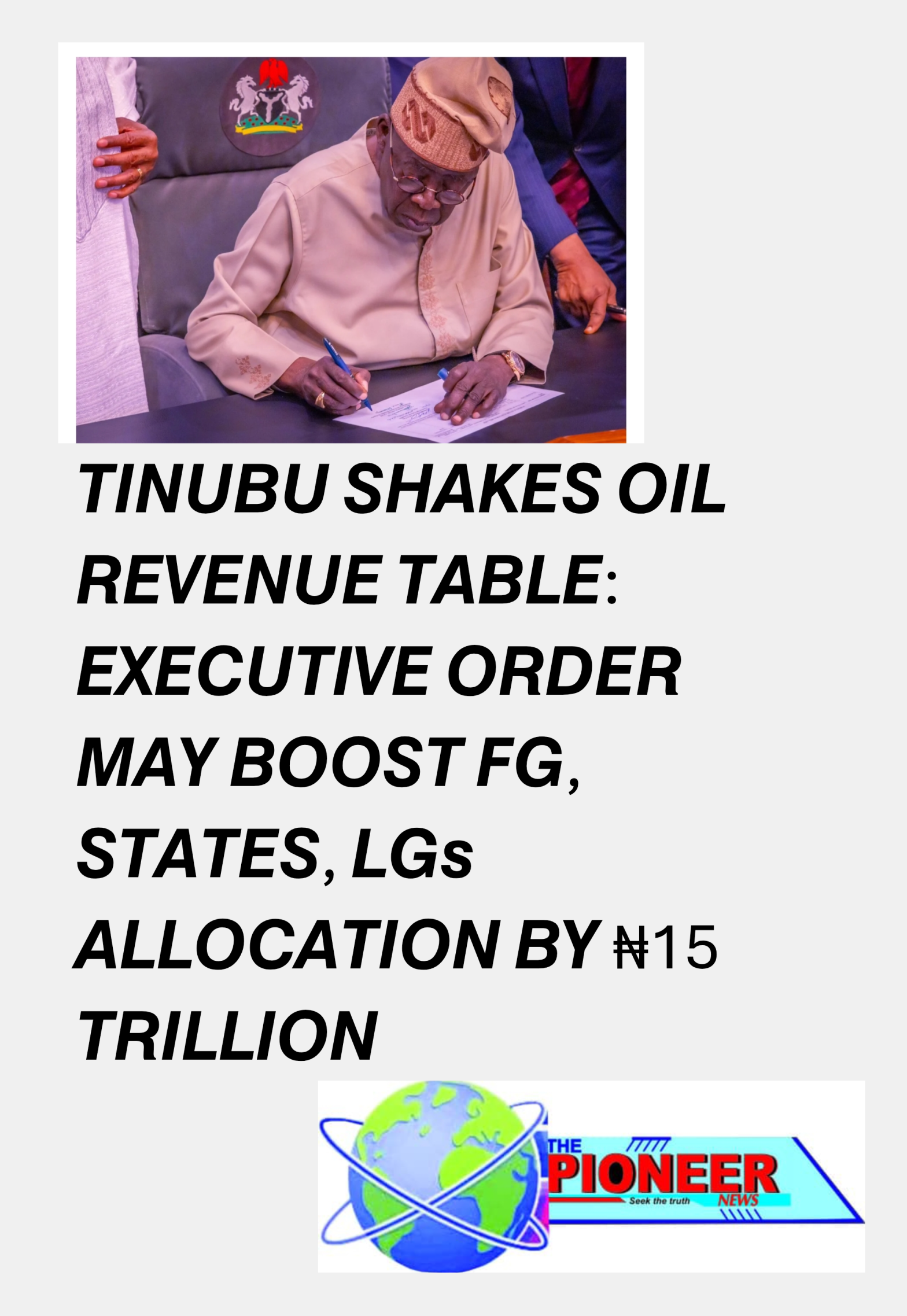
The PUNCH News gathered that the, Nigeria’s fiscal landscape is set for a dramatic reset as President Bola Ahmed Tinubu signs a far-reaching Executive Order that could inject about ₦14.57 trillion—nearly ₦15 trillion—into the Federation Account, significantly raising revenue allocations for the Federal Government, states, and local governments.
Under the sweeping directive, royalty oil, tax oil, profit oil, profit gas, and all other revenues due to the Federation from production sharing, profit sharing, and risk service contracts must now be paid directly into the Federation Account, ending layers of deductions that have thinned public revenue for years.
An analysis of 2025 revenue inflows submitted to the Federation Account Allocation Committee shows the scale of the windfall. The reforms capture multiple revenue streams previously retained or routed through agencies:
Oil & gas royalties: ₦7.55tn
Gas flaring penalties (via NUPRC): ₦611.42bn
Petroleum Profits Tax & Hydrocarbon Tax: ₦4.905tn
Midstream & Downstream Gas Infrastructure Fund: ₦596.61bn
NNPC management fees & frontier exploration funds: ₦906.91bn
Together, the affected streams total ₦14.57tn, now set to flow straight to the Federation Account.
The Order abolishes the 30% Frontier Exploration Fund and scraps the 30% management fee on profit oil and profit gas previously retained by Nigerian National Petroleum Company Limited. Effective February 13, 2026, the policy reasserts government ownership and control over mineral resources and aims to seal revenue leakages.
Since the Petroleum Industry Act (PIA) came into force in 2021, only 40% of Production Sharing Contract proceeds reached the Federation Account, with 60% retained by NNPC—split evenly between frontier exploration and management fees. That structure is now dismantled.
All operators and contractors under Production Sharing Contracts must pay royalties, taxes, profits, and gas revenues directly into the Federation Account. The Nigerian Upstream Petroleum Regulatory Commission is also directed to remit all gas flare penalties straight to the Federation Account, while spending from the Midstream and Downstream Gas Infrastructure Fund must fully comply with public procurement laws.
Invoking Section 5 of the Constitution, with ownership grounded in Section 44(3), the President declared an end to what he called “excessive deductions, overlapping funds, and structural distortions” that have weakened remittances and slowed development.
“When revenues meant for federal, state, and local governments are trapped in layers of charges and retention mechanisms, development suffers. That must end,” Tinubu said, adding that oil and gas revenues “must serve Nigerians first.”
He stressed that as Nigeria strengthens security, expands education and healthcare, stabilises the economy, and advances its energy transition, every legitimate naira due to the Federation must be protected.
Sources confirmed that implementation began in January, with the impact expected to reflect in next week’s FAAC meeting. The President has also approved an implementation committee to ensure coordinated execution and announced a comprehensive review of the PIA to fix structural and fiscal anomalies.
While some industry voices warn of operational adjustments, early assessments suggest NNPC may be the least affected among key institutions. The national oil company is projected to forgo ₦906.91bn—split evenly between management fees and frontier exploration deductions (₦453.455bn each) in 2025. Notably, frontier exploration receipts fell ₦257.066bn short of the ₦710.520bn budgeted for the year.
Other sector agencies may face deeper revenue losses and restructuring, as the reforms rebalance authority and cash flows toward the Federation Account.
Tinubu’s order redraws Nigeria’s oil-revenue architecture—tightening oversight, boosting shared revenue, and repositioning NNPC as a purely commercial entity.
“Nigeria can no longer afford leakage where there should be leadership. We are safeguarding the Federation Account. We are strengthening our budget. We are acting in the national interest,” the President declared—reaffirming his “Nigeria First” pledge.
Bottom line: If faithfully implemented, the Executive Order could mark the largest single reset of oil-sector remittances in years, delivering a powerful fiscal lifeline to all tiers of government.
 PIONEER NEWS