Reports that Governor Agbu Kefas abruptly cut short his Christmas vacation in Wukari Local Government Area amid rising public anger did not come as a surprise to keen observers of Taraba State politics. Beneath the festive cheer, a storm of frustration has been brewing—one driven by insecurity, unpaid wages, and a growing perception of leadership vacuum at the highest level of the state.
Across Wukari and beyond, many of the same citizens who enthusiastically rallied behind Governor Kefas during the elections now speak in tones of disappointment and betrayal. Their grievances point not to isolated incidents, but to a widening crisis of governance marked by absence, silence, and weakened executive authority.
At the core of the discontent is the belief that the governor has failed to consistently discharge the most fundamental constitutional duty of his office: the protection of lives and property. Taraba State, long plagued by communal clashes, farmer–herder conflicts, and ethnic tensions, demands a hands-on, visible, and empathetic leader. Instead, critics say, the governor has often appeared distant—both physically and politically—at moments when leadership was most urgently required.
Nowhere is this more evident than in conflict management. Across the state, violent crises have erupted with troubling frequency, yet the governor’s responses have been widely perceived as slow, muted, or entirely absent. The lingering communal clashes between the Karimjo and Wurkun communities in Karim Lamido Local Government Area remain a painful reminder. Despite the recurring violence and its devastating toll, Governor Kefas reportedly declined to visit the affected communities, allowing the conflict to fester and resurface intermittently.
A similar pattern has unfolded in other flashpoints. In Takum Local Government Area, deadly clashes between Tiv communities and Fulani herdsmen occurred without a gubernatorial visit. In Wukari itself, tensions between Jukun and Tiv communities were met with silence rather than decisive engagement. Most alarming was the killing of over sixty people by suspected herdsmen in Munga Lailau, Karim Lamido Local Government Area—an atrocity of national significance that demanded strong leadership, public empathy, and visible action. Yet, once again, the governor did not visit the scene.
From Bali to other volatile areas, farmer–herder conflicts have reinforced a single narrative: a government seemingly detached from the human cost of insecurity. For many residents, this perceived detachment strikes at the very heart of constitutional governance and raises troubling questions about commitment and compassion.
Beyond security, economic hardship has further inflamed public anger. Civil servants across Taraba State reportedly endure repeated delays in salary payments, plunging families into financial distress. Retirees, despite official assurances, continue to wait endlessly for their gratuities. In a state already burdened by inflation, unemployment, and rising living costs, these failures are not merely bureaucratic lapses—they are daily struggles that erode dignity and hope.
Governance thrives on trust, and that trust is rapidly evaporating. When workers cannot rely on timely salaries and pensioners are denied their lawful entitlements, confidence in leadership collapses. In Wukari, frustration has reportedly reached boiling point, turning what should have been a season of celebration into one of simmering resentment.
Equally disturbing is the growing perception that the governor does not fully control the levers of power within his own administration. Allegations of political actors operating beyond the law without consequences have fueled concerns about weak executive authority. One striking example is the reported removal of the Village Head of Karim Lawan in Karim Lamido Local Government Area by former Governor Darius Ishaku, followed by the alleged reinstatement of the same traditional ruler by Hon. Abel Diah and Sani Danladi—actions said to have occurred without gubernatorial approval.
By law, the appointment and removal of traditional rulers fall squarely within the governor’s constitutional powers. When such authority is openly usurped and met with silence, it sends a dangerous signal that executive power is either compromised or negotiable. In a state where traditional institutions wield enormous influence, this ambiguity risks deepening instability and emboldening impunity.
Taken together, these developments paint a stark picture of a state grappling with a crisis of leadership. The grievances from Wukari are not isolated complaints; they mirror a broader dissatisfaction spreading across Taraba State. Citizens are not merely demanding projects or political patronage—they are calling for presence, protection, fairness, and firm control of government.
Governor Agbu Kefas still has a window to change course. But reversing this narrative will require far more than cutting short a holiday. It will demand visible engagement with conflict-ravaged communities, prompt payment of salaries and gratuities, decisive assertion of constitutional authority, and a renewed commitment to inclusive and responsive governance.
For the people of Wukari—and Taraba State at large—the message is unmistakable: leadership must be seen, felt, and accountable. Anything less risks further erosion of legitimacy and a deepening crisis that the state can ill afford.
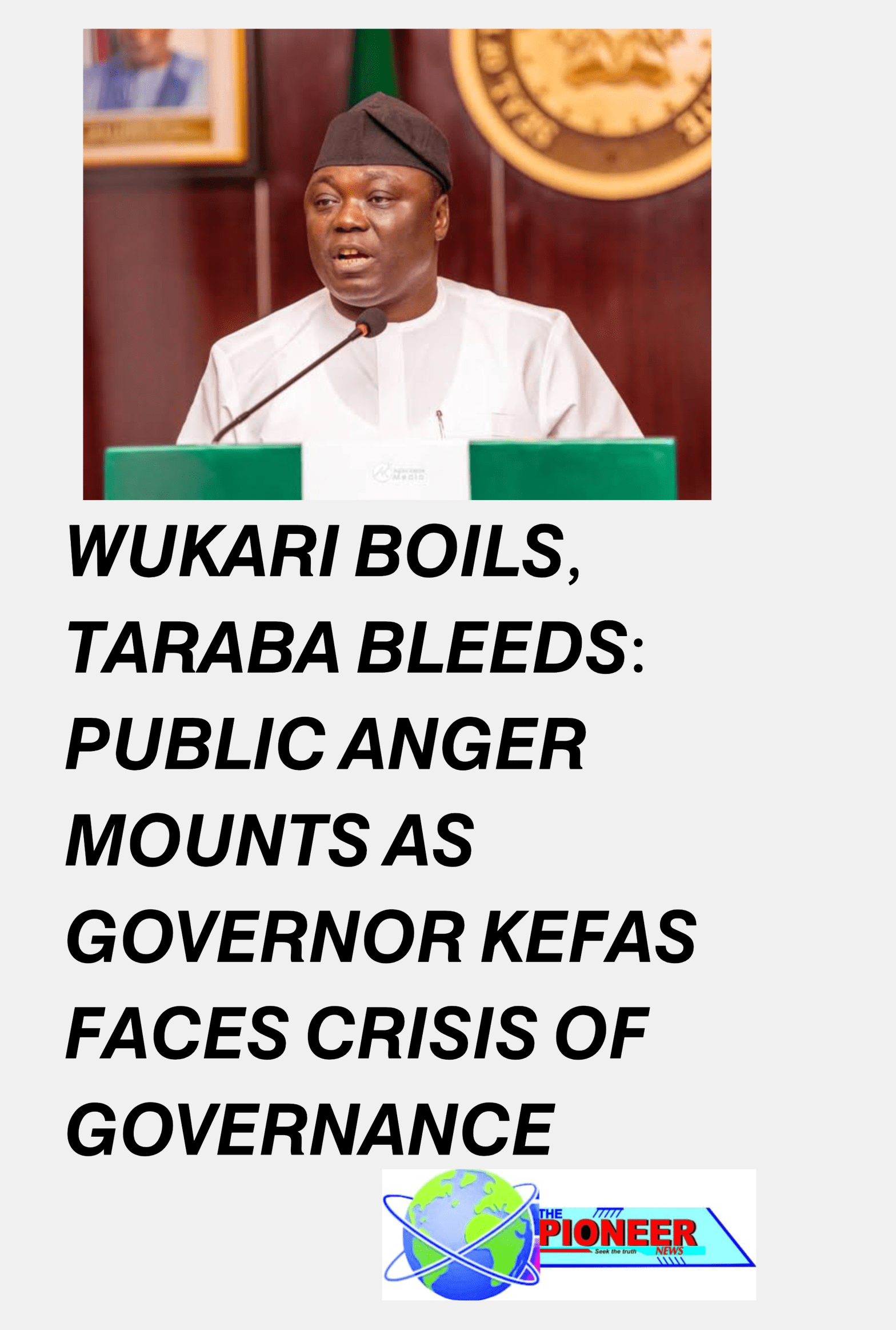
WUKARI BOILS, TARABA BLEEDS: PUBLIC ANGER MOUNTS AS GOVERNOR KEFAS FACES CRISIS OF GOVERNANCE
 PIONEER NEWS