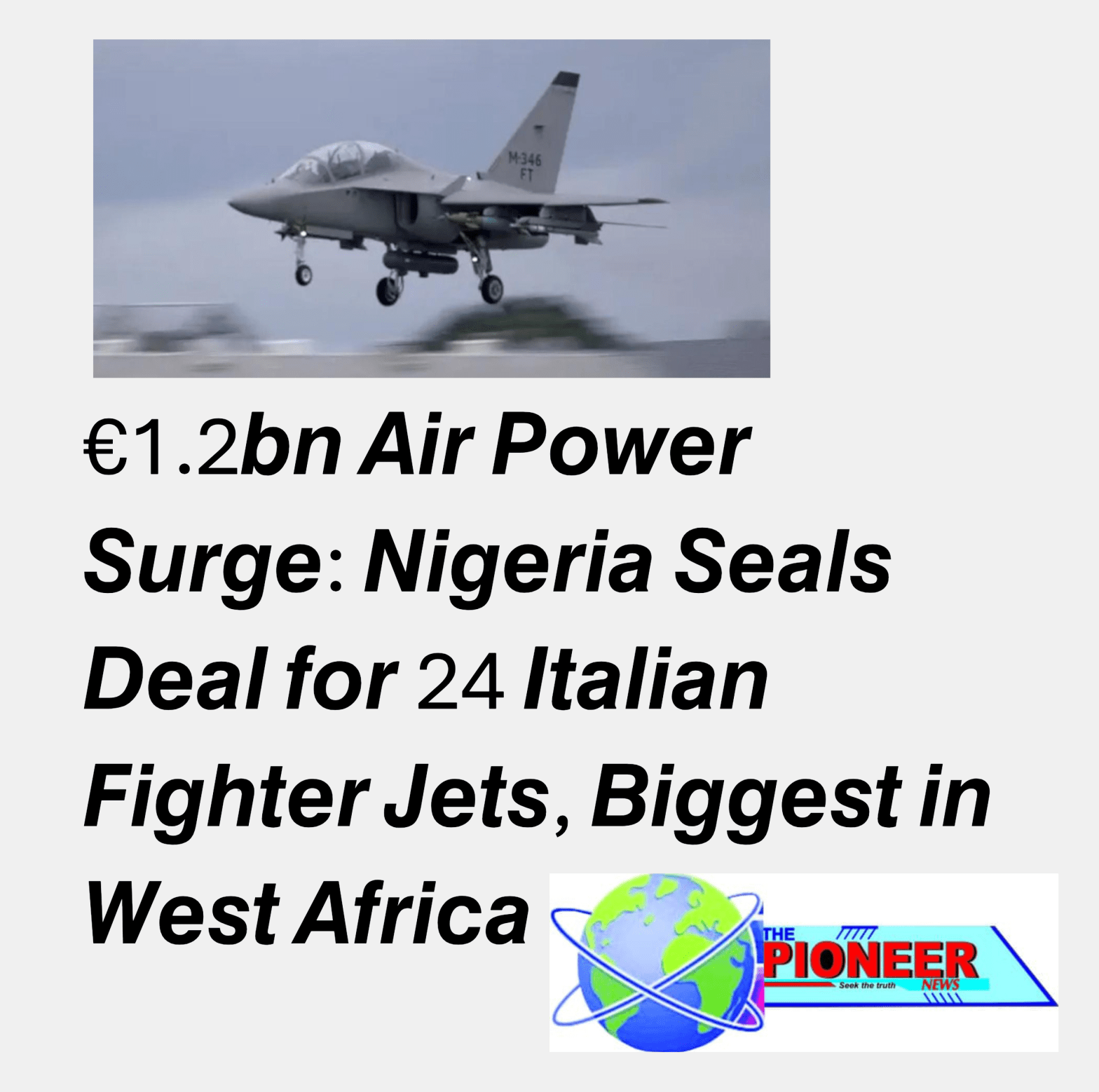
Nigeria has taken a dramatic leap in military firepower, sealing a landmark €1.2 billion deal to acquire 24 Italian-made M-346FA light fighter aircraft—now regarded as the single largest jet purchase by any country in West Africa.
The multibillion-naira defence deal, reached with Italian aerospace and defence heavyweight Leonardo S.p.A., is part of the Federal Government’s sweeping military modernisation drive aimed at repositioning the Nigerian Air Force (NAF) for modern warfare and complex internal security operations.
According to Business Inside Africa, the agreement goes far beyond the supply of fighter jets. It includes comprehensive maintenance packages, logistics support, spare parts, pilot training and long-term technical assistance—an indication, analysts say, that Abuja is prioritising sustained combat readiness rather than short-term military fixes.
The acquisition follows earlier approval by the Federal Executive Council (FEC) for a $618 million external borrowing plan to finance the procurement of the Italian-made attack aircraft and their accompanying munitions.
The timing of the purchase underscores the mounting security pressures confronting the country. Nigeria remains locked in a prolonged jihadist insurgency in the North-East, escalating banditry and mass kidnappings in the North-West, and deadly communal clashes in parts of the Middle Belt—conflicts that have displaced millions, strained government finances and crippled economic activity across vast regions.
Security experts believe the M-346FA jets will significantly boost Nigeria’s aerial surveillance, close air support and precision strike capabilities, offering greater operational flexibility in tracking and neutralising insurgents, bandits and other armed groups across difficult terrain.
Nigeria’s growing military muscle is also unfolding against a volatile regional backdrop. In a recent show of force, Nigerian troops were deployed to neighbouring Benin Republic following an attempted coup in which mutinous soldiers briefly seized strategic locations in Cotonou.
The deployment—carried out at the request of Benin’s government and with Senate approval—reportedly helped stabilise the situation and reinforced Abuja’s willingness to project military power beyond its borders amid a wave of coups and political instability sweeping parts of West Africa.
Observers say the choice of Italy marks a subtle but significant shift in Nigeria’s defence procurement strategy. By turning to Italian manufacturers, Abuja appears to be seeking modern platforms, competitive pricing and stronger after-sales support, while gradually reducing reliance on traditional arms suppliers such as the United States, Russia and China.
However, the massive arms purchase is expected to reignite fierce public debate. Critics argue that the timing is controversial, coming amid rising inflation, deepening debt, subsidy shocks and worsening living conditions for millions of Nigerians.
As fighter jets prepare to join Nigeria’s arsenal, the question dominating public discourse remains whether this show of military strength will translate into lasting security—and whether the economic cost will prove justifiable in a nation grappling with hardship on multiple fronts.
€1.2bn Air Power Surge: Nigeria Seals Deal for 24 Italian Fighter Jets, Biggest in West Africa
 PIONEER NEWS