United States President Donald Trump has delivered a blistering verdict on Nigeria’s security situation, declaring that Boko Haram, the Islamic State (ISIS), and other jihadist terror networks are operating freely in parts of the country.
Trump made the assertion while justifying Nigeria’s inclusion on the United States’ list of countries facing fresh travel restrictions, a move that has reignited global debate over insecurity, religious persecution, and counterterrorism efforts in Africa’s most populous nation.
“Radical Islamic terrorist groups such as Boko Haram and the Islamic State operate freely in certain parts of Nigeria,” Trump stated in a proclamation issued on Tuesday.
According to the US President, the persistent activities of these terror cells constituted a major national security concern for Washington, outweighing other considerations used in assessing countries placed under restriction.
Trump’s proclamation also referenced US visa overstay data, noting that Nigeria recorded a B-1/B-2 visa overstay rate of 5.56 percent, alongside an F, M, and J visa overstay rate of 11.90 percent.
However, analysts argue that the figures weaken the claim that immigration abuse was a decisive factor. Among the 15 newly restricted countries, Nigeria posted one of the lowest overstay rates.
White House fact sheets reviewed by DAILY POST reveal significantly higher overstay figures in several other affected nations. Angola recorded a B-1/B-2 overstay rate of 14.43 percent and an F, M, and J rate of 21.92 percent. Benin’s figures stood at 12.34 percent and a staggering 36.77 percent respectively, while Côte d’Ivoire recorded 8.47 percent and 19.09 percent.
Gabon posted rates of 13.72 percent and 17.77 percent, The Gambia 12.70 percent and 38.79 percent, Malawi 22.45 percent and 31.99 percent, Mauritania 9.49 percent, Senegal 4.30 percent and 13.07 percent, while Tanzania recorded 8.30 percent and 13.97 percent.
Despite these numbers, Nigeria was still swept into the restricted category—fueling the belief that terrorism, not migration abuse, was the driving force behind Trump’s decision.
Trump’s stance did not come as a surprise to close observers. In recent weeks, the US President has repeatedly condemned deadly attacks on Christians across Nigeria, particularly in the North and Middle Belt.
On October 31, Trump officially designated Nigeria a Country of Particular Concern (CPC) under the International Religious Freedom Act—an alarming classification reserved for nations accused of severe violations of religious freedom.
The American leader also went further, at one point threatening the possible deployment of US forces to wipe out terror groups operating in Nigeria—a remark that triggered sharp reactions from global powers, including China and Russia.
In November, the Trump administration spearheaded a high-profile discussion at the United Nations on violence against Christians in Nigeria. The session drew global attention after US rap star Nicki Minaj was invited to speak, following her public expressions of solidarity with victims of the attacks.
That same month, US Ambassador to the UN, Mike Waltz, accused “Boko Haram and 22 other Muslim extremist terrorist groups” of orchestrating atrocities across Nigeria.
In December, US Congressman Riley Moore led a congressional delegation on a fact-finding mission to Nigeria to assess the worsening security and religious persecution crisis.
What he saw, Moore later described as “heartbreaking.” He announced that US lawmakers were already working on a “strategic security framework” to confront the Boko Haram and ISIS threat, as well as what he termed “the genocide against Christians by radical Fulani Muslims in the Middle Belt.”
As international scrutiny intensifies, Trump’s blunt assessment has once again placed Nigeria’s security challenges on the global front burner—raising uncomfortable questions about the effectiveness of counterterrorism efforts and the true cost of a crisis that refuses to fade.
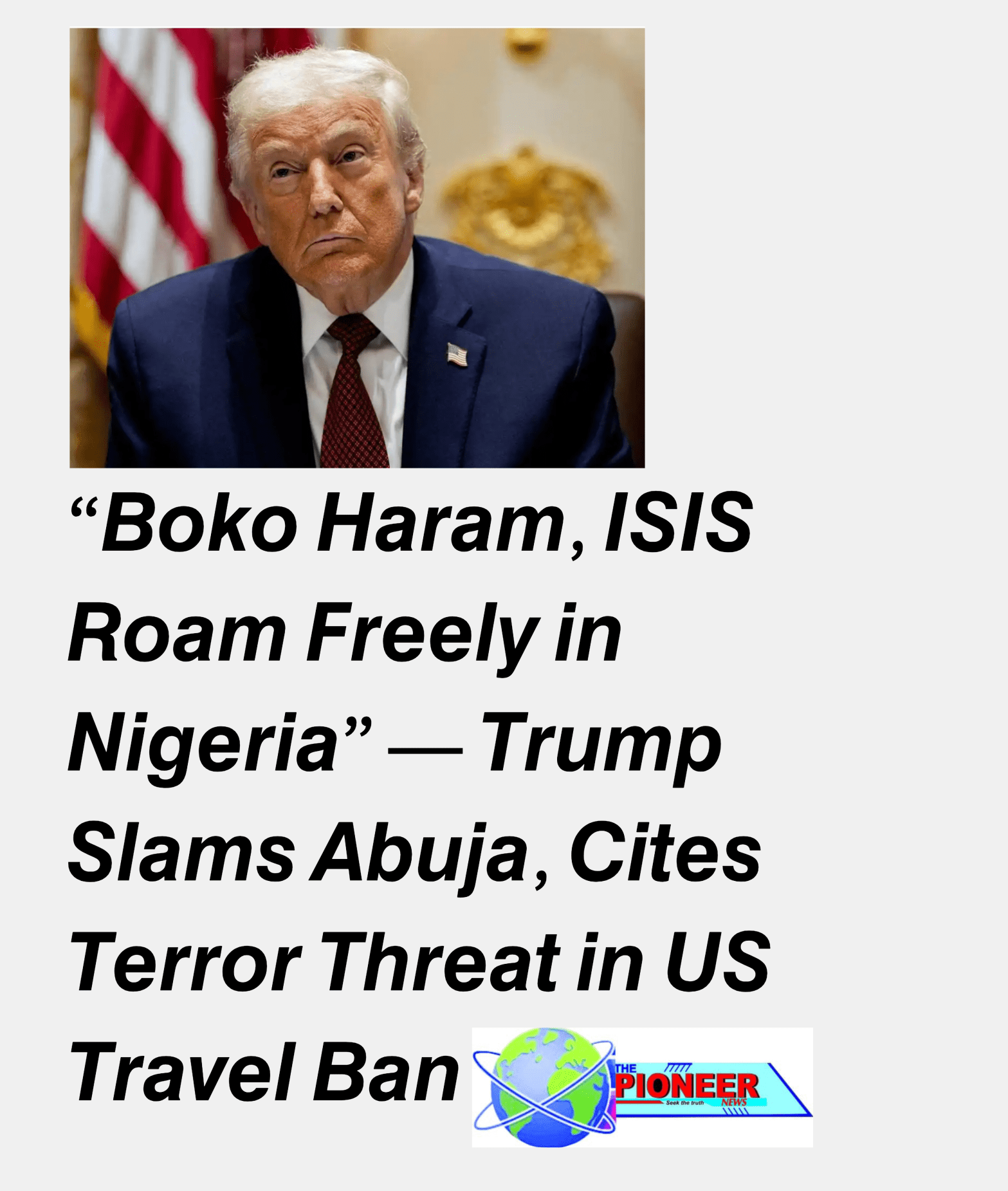
“Boko Haram, ISIS Roam Freely in Nigeria” — Trump Slams Abuja, Cites Terror Threat in US Travel Ban
 PIONEER NEWS