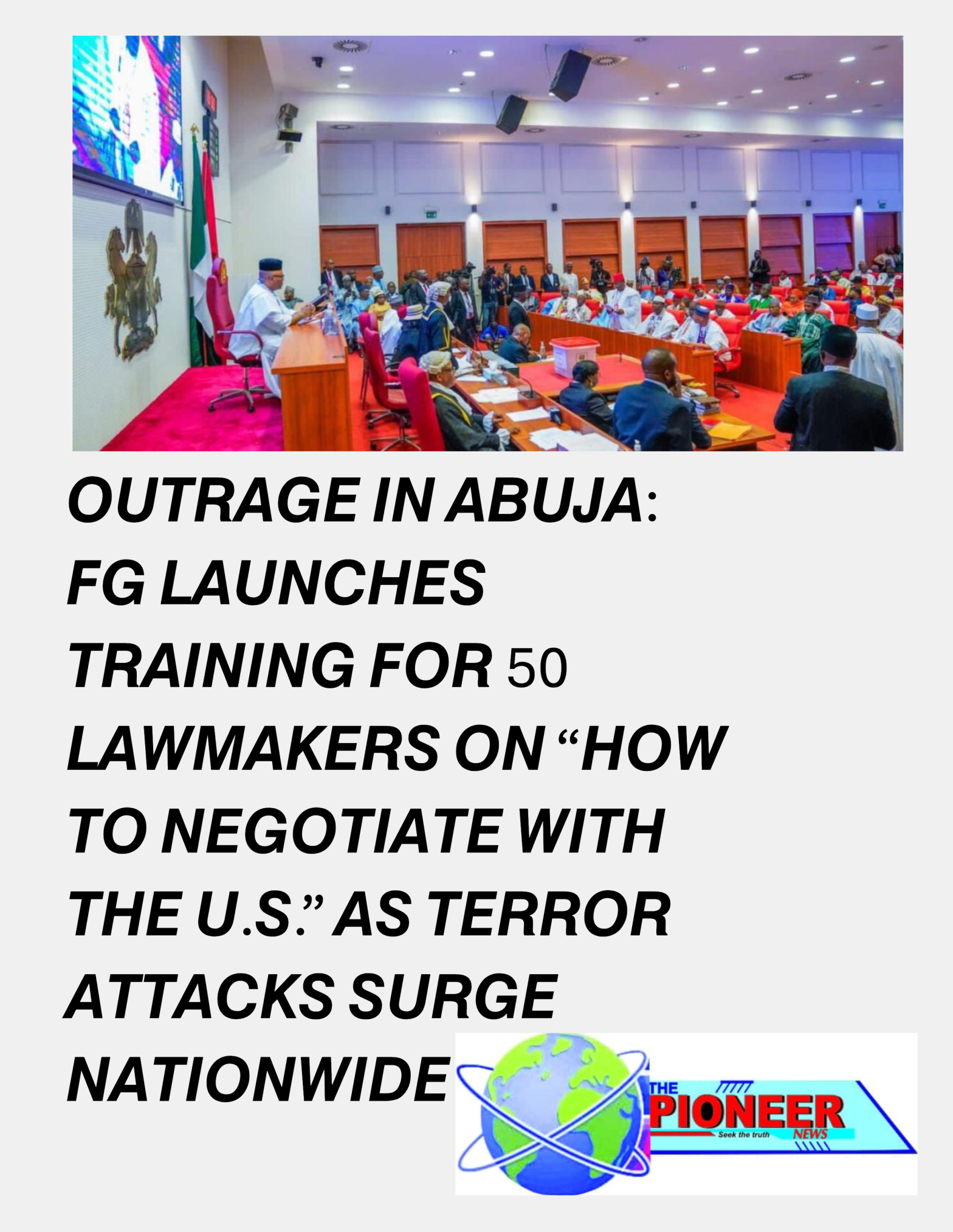
In a move that has ignited nationwide controversy, the Federal Government has invited 50 Senators and Members of the House of Representatives for a two-day crash course on “How to Navigate American Foreign Policy Under Donald Trump’s Administration”—even as Nigeria battles escalating terror attacks across churches, mosques, schools, and rural communities.
According to documents obtained by SaharaReporters, the Ministry of Finance—through a circular dated November 17, 2025 (Ref: FMF/HMS/CORRS/01/VOL.1/112)—confirmed that “all necessary arrangements have been concluded” for the high-level legislative training slated for November 21 and 22 at the National Assembly Complex.
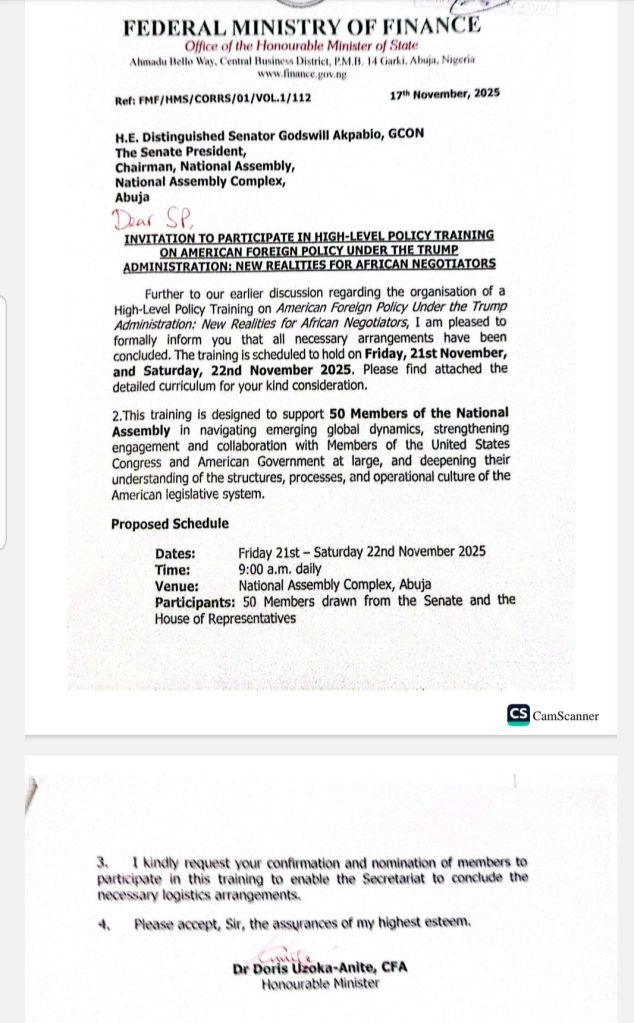
The letter, addressed to Senate President Godswill Akpabio and signed by Minister of State for Finance, Dr. Doris Uzoka-Anite, claims the programme will equip lawmakers to navigate “new realities for African negotiators” under the Trump administration, including deeper engagement with U.S. lawmakers and understanding the inner workings of America’s legislative system.
But Nigerians aren’t buying it.
One critic summed up the public sentiment bluntly:
“These people aren’t serious. Instead of solving insecurity, they’re training senators on how to negotiate with America.”
The ministry outlined that the programme will focus on geopolitical shifts under Trump, the operational culture of the U.S. Congress, and strategies for African legislators engaging Washington in an era of heightened global tensions.
The circular urged Akpabio to confirm attendance and forward the names of participating lawmakers so “logistics arrangements” could be concluded.
An excerpt from the letter reads:
> “This training is designed to support 50 Members of the National Assembly in navigating emerging global dynamics, strengthening engagement with the U.S. Congress, and deepening understanding of American legislative structures and processes.”
The decision comes as Nigeria experiences a frightening spike in coordinated terror attacks across multiple states—from Kaduna to Kogi, Kwara to the North-East—targeting worship centres, schoolchildren, and vulnerable communities.
Instead of unveiling concrete counterterrorism strategies, critics say the Tinubu administration appears more focused on diplomatic positioning than securing its citizens.
AKUME: ‘TRUMP’S COMMENTS EMBOLDENED TERROR GROUPS’
Amid the uproar, Secretary to the Government of the Federation (SGF), George Akume, issued a startling statement blaming recent attacks on remarks made by U.S. President Donald Trump.
Akume claimed Trump’s October 31 declaration designating Nigeria as a “country of particular concern” over alleged Christian genocide—and his threat to deploy U.S. troops—had emboldened extremist groups across Nigeria.
He argued that insurgency structures had previously been “significantly degraded,” but Trump’s rhetoric gave terror cells “a fresh international narrative” to justify renewed attacks.
In his words:
> “Recent pronouncements from the United States have inadvertently emboldened opportunistic violent groups seeking to exploit international narratives and attack soft targets.”
Trump’s comments, which included instructions to America’s “Department of War” to prepare for possible action in Nigeria, also came with threats to suspend U.S. support if President Tinubu fails to curb religious killings.
CRITICS: ‘AKUME’S CLAIMS EXPOSE GOVERNMENT FAILURE’
Security analysts and civil society groups have dismissed Akume’s assertions as an attempt to shift blame.
With frequent mass kidnappings, resurging Boko Haram activity, and expanding banditry, they argue the government is failing to protect its people—and resorting to diplomatic distractions and excuses.
While Akume insisted Nigeria does not need foreign troops and that its Armed Forces remain “capable, experienced, and professional,” observers note that ongoing attacks contradict the government’s narrative of progress.
As one security expert noted,
“If insurgents have been degraded, why are attacks increasing? Why are children still being kidnapped? Why does every week bring new mass casualties?”
The administration insists the training is critical for Nigeria’s global positioning, but to many citizens, it symbolizes the disconnect between Abuja’s political elite and the daily realities of insecurity.
At a time when families are burying loved ones, schools are shutting down, and communities are under siege, the Federal Government’s decision to train lawmakers on negotiating with Washington appears—at best—poorly timed and, at worst, a glaring indictment of misplaced priorit
 PIONEER NEWS