By LEADERSHIP Sunday
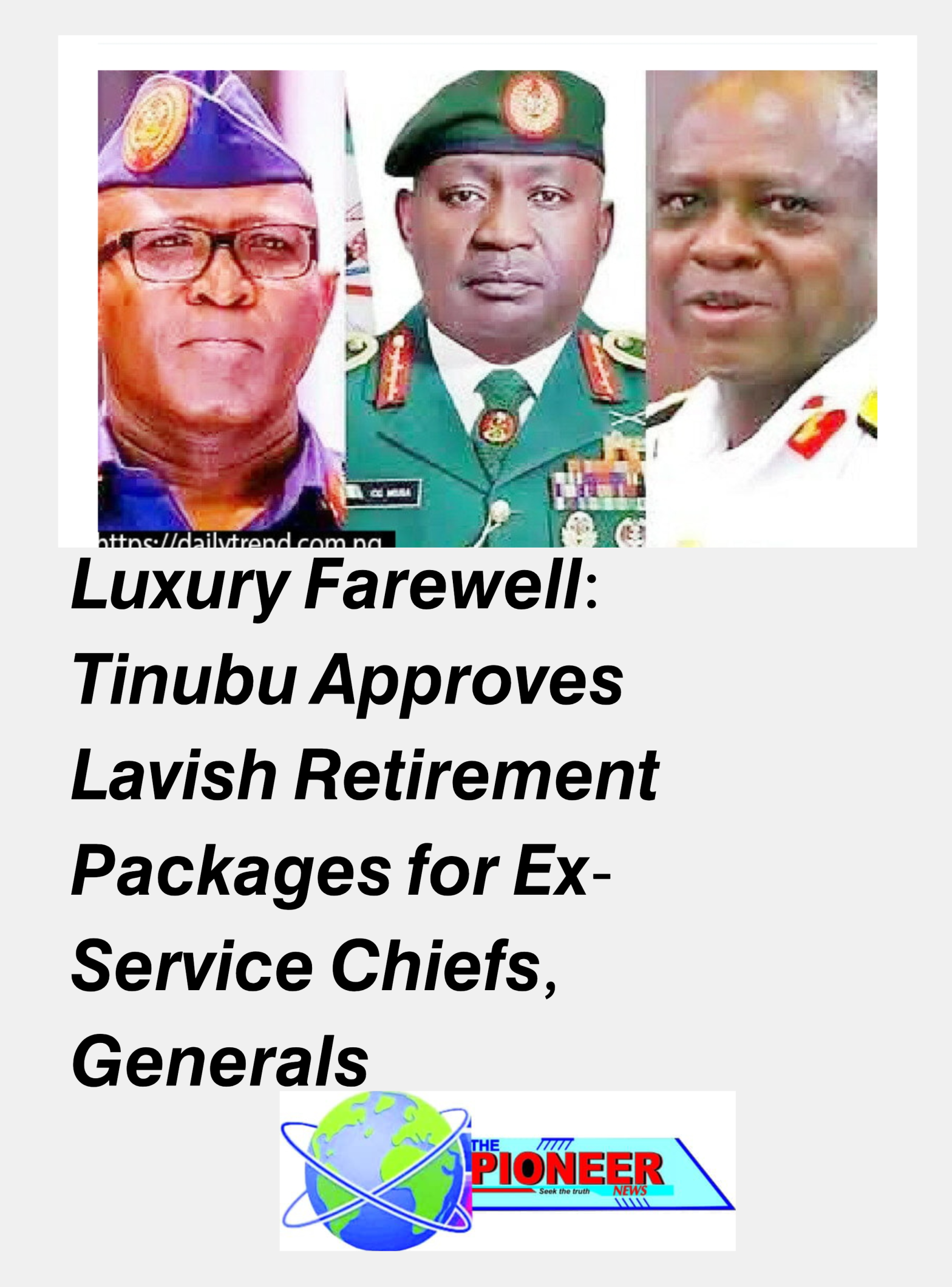
In what is being described as one of the most generous military retirement packages in Nigeria’s history, the newly retired Service Chiefs are set to go home in grand style — with bulletproof SUVs, luxury backup vehicles, and hefty annual medical allowances in dollars.
Under the Harmonised Terms and Conditions of Service (HTACOS) 2024, approved and signed by President Bola Ahmed Tinubu, each of the outgoing Chiefs will receive one bulletproof SUV and a Prado Jeep (or equivalent), both to be maintained and replaced every four years by their respective services.
The document, classified “Restricted” and obtained exclusively by LEADERSHIP Sunday, further reveals that each retired Service Chief will enjoy $20,000 yearly for medical expenses, alongside a full retinue of aides, security personnel, and domestic staff — even in retirement.
The HTACOS document stipulates that retiring Service Chiefs — including the former Chief of Defence Staff, General Christopher Musa, Chief of Naval Staff, Vice Admiral Emmanuel Ogalla, and Chief of Air Staff, Air Marshal Hassan Abubakar — are entitled to:
One bulletproof SUV or equivalent (maintained and replaced every four years)
One Prado Jeep or equivalent backup vehicle
Five domestic aides (two cooks, two stewards, one gardener)
One Aide-de-Camp or Security Officer
One Special Assistant (Lieutenant/Captain or equivalent)
Nine standard guards
Three service drivers
One service orderly
Full medical cover in Nigeria and abroad
They will also retain their military uniforms, firearms, and ceremonial rights — with weapons to be retrieved only upon death.
Rank-and-File Enjoy Tiered Benefits
The HTACOS also extends privileges to other senior officers:
Lieutenant-Generals and equivalents: Toyota Land Cruiser and Hilux, four residential guards, and $20,000 annual medical cover.
Major-Generals and Brigadier-Generals: One Land Cruiser, fewer aides, and $15,000 annual medical cover.
One-star officers: Toyota Camry, two guards, and $10,000 medical allowance per year.
With the latest shake-up, analysts estimate that over 60 generals may be forced into early retirement in accordance with military tradition — as officers are not permitted to serve under juniors from subsequent NDA courses.
Tinubu’s New Security Team
President Tinubu, in a sweeping security overhaul, appointed General Olufemi Oluyede as Chief of Defence Staff, Major-General W. Shaibu as Chief of Army Staff, Air Vice Marshal S. K. Aneke as Chief of Air Staff, and Rear Admiral I. Abbas as Chief of Naval Staff.
Major-General E. A. P. Undiendeye retains his position as Chief of Defence Intelligence.
A statement by Sunday Dare, Special Adviser to the President on Media and Public Communication, said the reshuffle was part of ongoing efforts to “further strengthen the national security architecture.”
Senate Set To Screen Nominees
The Senate Committees on Defence, Army, and Navy are expected to commence the screening of the newly appointed Service Chiefs this week, following a presidential communication to the National Assembly.
The exercise will reportedly be conducted behind closed doors, with nominees expected to pledge new strategies for combating insecurity nationwide.
Analysts: Tinubu’s Move Is a Calculated Power Play
Commenting on the development, Chief Okoi Obono-Obla, former Chairman of the Special Presidential Investigative Panel on Recovery of Public Property, described the reshuffle as “a calculated realignment of Nigeria’s security command to reinforce control and inject fresh energy.”
According to him:
> “President Tinubu’s decision reflects deep strategic rumination and political dexterity. He has balanced the nation’s geopolitical sensibilities while ensuring renewed vigor in the military hierarchy.”
He further noted that the change “ushers in a rejuvenated team capable of tackling insecurity with fresh zeal, dynamic strategies, and disciplined resolve.”
Massive Payouts Loom
With the lucrative retirement packages and mass exits expected across the armed forces, the Federal Government faces a heavy financial outlay to settle benefits for the departing generals — a move that could significantly impact defence spending in the short term.
Still, observers say the policy may boost morale among serving officers and signal Tinubu’s intent to professionalize the military while rewarding loyalty and service at the top echelon.
 PIONEER NEWS