
By Premium Times Nigeria
In what many have described as a landmark decision in Nigeria’s constitutional and political history, the Joint Committee of the National Assembly on the Review of the 1999 Constitution has approved the creation of an additional state for the South-East geopolitical zone.
The decision — reached during a high-powered two-day retreat in Lagos from October 24 to 25 — marks a significant step toward addressing the decades-long agitation over the South-East’s perceived marginalisation in Nigeria’s state structure and federal representation.
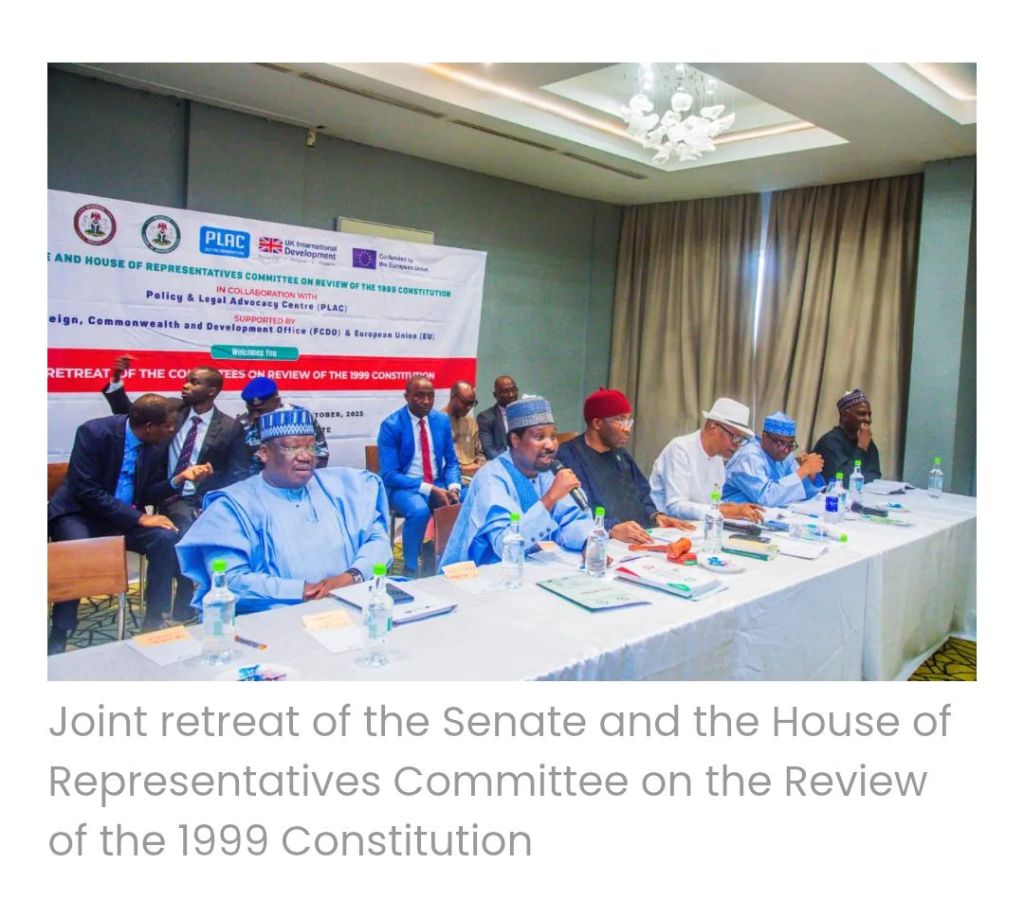
If ratified by both chambers of the National Assembly and the majority of state legislatures, the approval will increase the number of states in the South-East from five to six — aligning it with other zones that currently enjoy greater representation in the Nigerian federation.
Equity, Justice, and Balance for the South-East
The South-East remains the only geopolitical zone with five states — Anambra, Imo, Ebonyi, Abia, and Enugu — compared to six in most zones and seven in the North-West.
This imbalance has long fuelled calls for redress, with stakeholders insisting that equitable state distribution is vital for fairness in federal appointments, national resource allocation, and legislative representation.
During the retreat, which was chaired by Deputy Senate President Barau Jibrin and co-chaired by the Deputy Speaker of the House of Representatives Benjamin Kalu, lawmakers deliberated extensively before arriving at what observers have hailed as a “rare moment of unity” across party lines.
Mr. Kalu, a leading advocate for the move and a native of the South-East, described the approval as “not a political favour, but a constitutional necessity.”
> “This is about correcting historical imbalance and giving every Nigerian region a fair voice in the federation,” he said. “Equity must not just be preached — it must be practiced.”
Unanimous Support Across Party Lines
The motion for the creation of the new state was moved by Senator Abdul Ningi (PDP, Bauchi Central) and seconded by Ibrahim Isiaka (APC, Ogun State).
In a rare show of bipartisan consensus, members of the joint committee voted unanimously in favour, describing the move as a long-overdue correction of Nigeria’s structural inequities.
Several lawmakers who spoke during the session underscored that resolving the South-East’s underrepresentation would foster unity, strengthen national cohesion, and help douse long-standing feelings of alienation.
While the committee’s approval represents only the first step in a lengthy constitutional process, momentum is clearly building.
According to constitutional requirements, the creation of a new state must secure:
The support of two-thirds of members of both chambers of the National Assembly; and
The approval of at least two-thirds of all State Houses of Assembly across the federation.
Deputy Senate President Barau Jibrin, in his closing remarks, called on lawmakers to maintain the spirit of cooperation:
> “We have made history by taking this bold step. Now, we must strengthen what we have started. Let’s ensure our colleagues in both chambers and state assemblies key into this national process,” he said.
Broader Constitutional Overhaul Underway
Beyond the South-East matter, the Joint Committee also announced the establishment of a Subcommittee on State and Local Government Creation, which will review the 278 proposals submitted nationwide on new states, local councils, and boundary adjustments.
This constitution review, one of the most far-reaching since Nigeria’s return to democracy, also covers critical areas such as:
Devolution of powers and fiscal federalism,
Judicial and electoral reforms,
Gender inclusion, and
Local government autonomy.
If fully passed, the new constitutional changes would mark the first successful state creation in Nigeria since 1996, when then Head of State, General Sani Abacha, created six new states to expand the federation to 36.
The legal framework for state creation is contained in Section 8 (1a–1d) of the 1999 Constitution, which outlines the steps for initiating and ratifying new states through legislative and popular approval.
A Turning Point for the South-East — and the Nation
Political analysts and civil society groups have welcomed the move as a long-awaited correction to decades of imbalance in Nigeria’s federal structure.
Should the proposal scale through plenary and state-level votes, it would not only reshape Nigeria’s political map but also symbolise a renewed national commitment to inclusiveness, justice, and unity.
> “This is not just about the South-East,” said one lawmaker. “It’s about building a fairer Nigeria — where no region feels left behind.”
 PIONEER NEWS