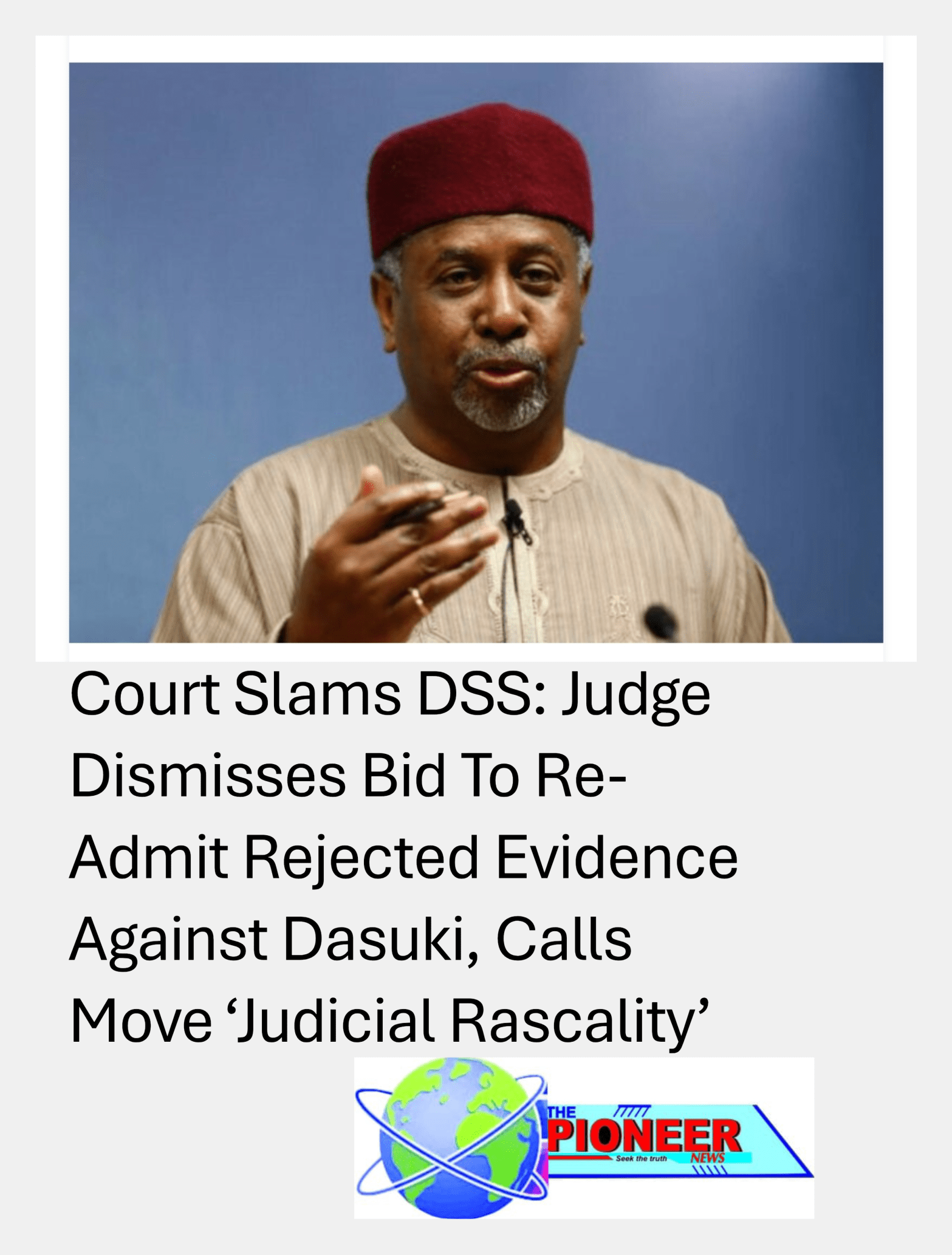
By Nafisat Abdulrahman
In a major setback for the Department of State Services (DSS), the Federal High Court in Abuja on Tuesday threw out the agency’s fresh attempt to re-admit exhibits previously rejected in the long-running trial of former National Security Adviser (NSA), Colonel Sambo Dasuki (rtd), describing the move as an abuse of court process and “judicial rascality.”
Delivering a scathing ruling, Justice Peter Lifu firmly dismissed the DSS’s application, declaring that the court could not be persuaded to revisit an issue it had already decided upon.
“I recall that on July 10, 2025, I delivered a considered ruling rejecting the same sets of exhibits due to improper foundation for their admission and lack of relevance to the charge. That ruling still subsists, and I am bound by it,” Justice Lifu stated.
The visibly displeased judge added:
> “Any attempt to go against that same ruling will amount to judicial rascality and pettiness. Common sense does not even support granting this kind of request. This court rejects the invitation, and the request is hereby dismissed.”
The exhibits in question, marked as items 18 to 28 on a 2015 search warrant, were recovered from Dasuki’s Abuja residence during a controversial DSS raid nearly a decade ago.
At the last sitting on September 25, DSS lead counsel, Oladipupo Okpeseyi, SAN, had urged the court to move proceedings to the agency’s headquarters to inspect vehicles allegedly seized from Dasuki’s premises, claiming they had been parked there for ten years.
Okpeseyi argued that the DSS had now laid the “proper foundation” for re-admitting the same items, insisting that their previous rejection was due to procedural lapses rather than irrelevance.
> “The rejection was not based on irrelevance to the trial,” he said, maintaining that the deficiencies earlier cited by the court had now been corrected.
However, Dasuki’s defence counsel, A. A. Usman, vehemently opposed the motion, calling it “strange, unconstitutional, and unknown to Nigerian law.”
“Once an exhibit has been rejected and marked as such, it stands rejected and cannot be re-admitted by the same court,” Usman asserted, stressing that the only lawful route open to the DSS was to appeal the initial decision.
> “You cannot invite a judge to sit as an appellate court over his own ruling,” he added, describing the DSS application as “baseless, ill-conceived, and a desperate ploy to turn back the hands of the clock.”
Justice Lifu, siding with the defence, reaffirmed that the rejected exhibits remain inadmissible and warned that the court would not tolerate attempts to undermine judicial integrity.
> “The exhibits remain rejected. The court will not revisit settled issues under any guise,” the judge ruled, striking out the application in its entirety.
The ruling marks yet another dramatic twist in Dasuki’s protracted legal battles, which began after his 2015 arrest on allegations of unlawful possession of firearms and the controversial diversion of $2.1 billion meant for arms procurement.
Background: The Dasuki Saga
Colonel Sambo Dasuki (rtd), who served as National Security Adviser under former President Goodluck Jonathan, was arrested in December 2015 by the DSS following allegations that funds meant for arms procurement were diverted to finance political activities.
The former NSA faced multiple charges, including unlawful possession of firearms and money laundering. Despite being granted bail several times by various courts, Dasuki remained in DSS custody for years, sparking national and international outrage over disregard for court orders.
He was eventually released in December 2019 after four years in detention. Since then, the cases against him have dragged on in different courts, with several controversial rulings and procedural battles between his defence team and government prosecutors.
Legal analysts say Tuesday’s ruling reinforces the judiciary’s stance on due process and signals a warning to security agencies against circumventing established legal procedures in high-profile cases.
 PIONEER NEWS