
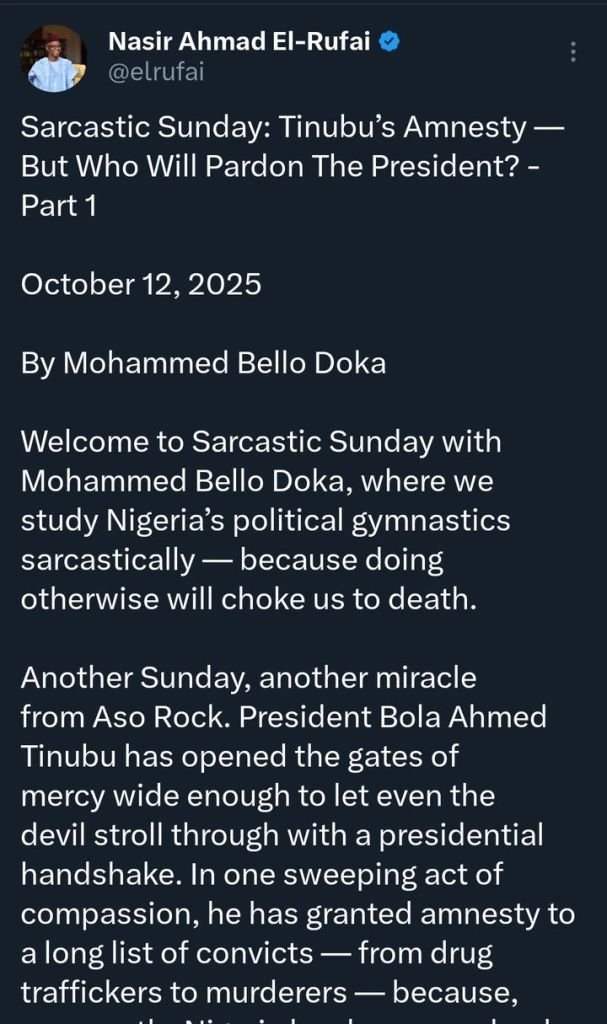
Former Kaduna State Governor, Mallam Nasir El-Rufai, has taken a fiery swipe at the administration of President Bola Ahmed Tinubu over the recent presidential pardon granted to several controversial convicts, including drug barons and Maryam Sanda, who was sentenced to death in 2020 for the murder of her husband.
In a statement shared on social media on Sunday, El-Rufai accused the government of masking political favoritism with the excuse of prison decongestion, saying the exercise was nothing short of a whitewash of privilege and impunity.
> “They told us it was about decongesting the prisons, but we all know that’s a lie,” El-Rufai wrote. “Our prisons were full of the wrong people anyway — the petty thieves, the unlucky youths, the street hustlers who couldn’t afford lawyers. Now, the presidential broom has swept them aside to make room for a new kind of elite: the VIP ex-convicts, freshly laundered and ready for political appointments.”
The former governor’s post has since sparked a wave of outrage across social media, with many Nigerians echoing his concerns over what they describe as a deepening culture of selective justice. Citizens have expressed dismay that while the poor languish in overcrowded prisons for minor infractions, the rich and politically connected continue to receive presidential mercy.
The inclusion of Maryam Sanda among those pardoned has reignited public anger. Sanda was convicted in 2020 for stabbing her husband, Bilyaminu Bello, to death in their Abuja home in 2017 — a case that gripped national attention and was hailed as a watershed in the fight against domestic violence.
Legal experts and human rights advocates have condemned the move as a grave assault on the credibility of Nigeria’s justice system, warning that it sends a dangerous message that serious crimes can be swept aside for those with influence.
Human rights lawyer, Barrister Aisha Abdullahi, described the development as “a mockery of justice,” saying, “When those convicted of murder and drug trafficking are forgiven overnight, it tells the ordinary Nigerian that justice is for sale.”
Critics argue that if the true goal were to decongest Nigeria’s prisons, the government should have focused on freeing awaiting-trial inmates, non-violent offenders, and citizens jailed for petty crimes, rather than those whose convictions were products of extensive judicial scrutiny.
With pressure mounting, Nigerians are demanding transparency from the Presidential Advisory Committee on Prerogative of Mercy, insisting the public deserves to know the criteria and motives behind the selective pardons.
For now, one question dominates the national conversation:
If the powerful can kill, smuggle, and steal — and still walk free — what justice remains for the powerless?


 PIONEER NEWS