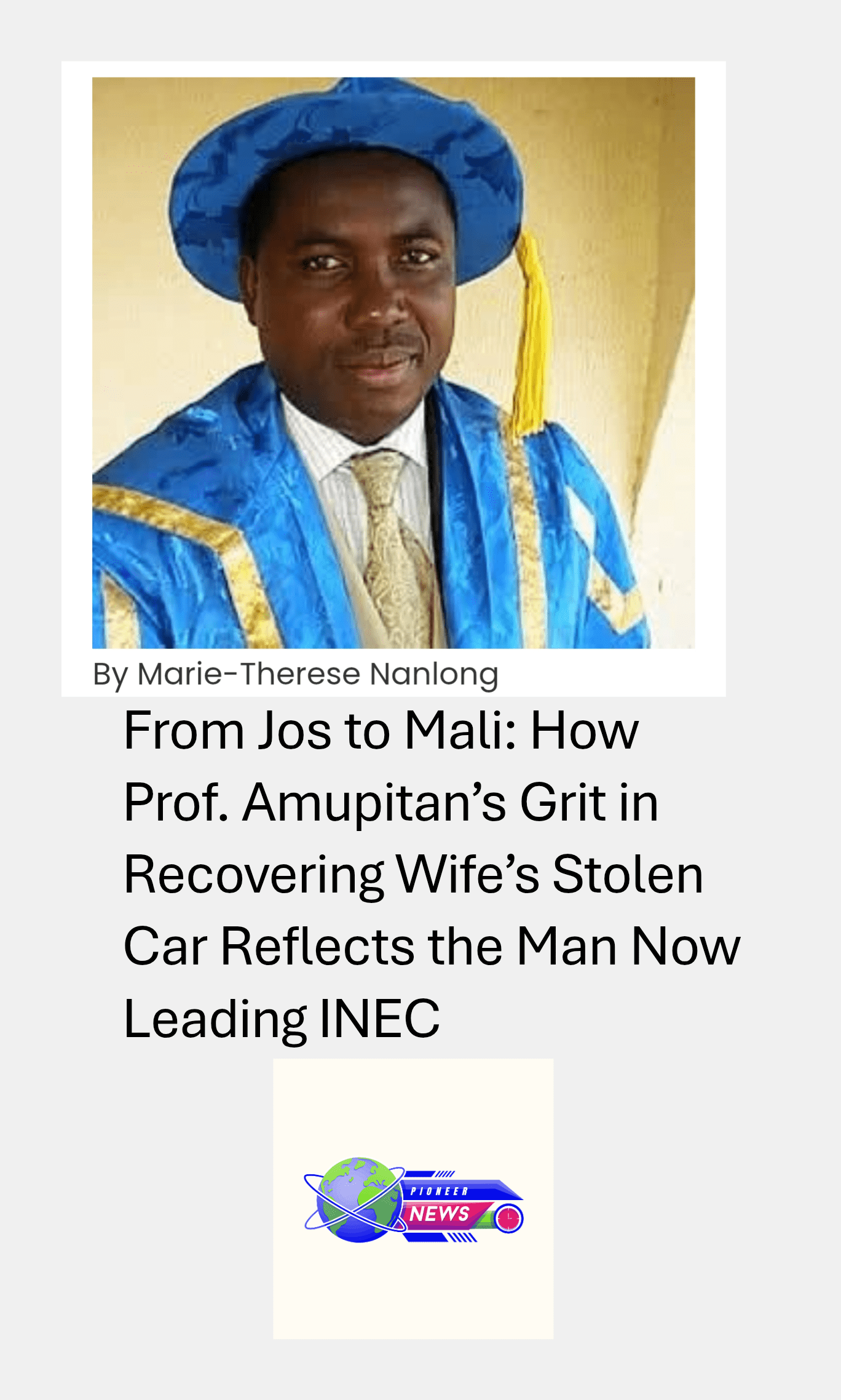
By Daily Trust Reporter
Jos, Plateau State — When armed car thieves snatched a vehicle belonging to Professor Joash Amupitan’s wife years ago, many believed it was gone for good. But the law professor, known for his quiet determination and uncommon courage, refused to let the case go cold.
Through painstaking collaboration between the Nigeria Police and Interpol, the vehicle was traced across several borders — from Jos, Plateau State, to distant Mali — and was eventually recovered and returned to him at the Police Headquarters in Jos.
For colleagues and close associates, that incident sums up the man who has now been appointed to head Nigeria’s Independent National Electoral Commission (INEC) — resilient, relentless, and guided by integrity.
Following his nomination and confirmation by the National Council of State, reactions have continued to trail Amupitan’s appointment, with many describing him as a reform-minded scholar whose entry into INEC could mark a turning point in Nigeria’s electoral history.
Governor Caleb Mutfwang of Plateau State hailed him as “a towering intellectual, a patriotic Nigerian, and a detribalised leader whose contributions have significantly shaped good governance and democratic growth.”
The governor commended President Bola Ahmed Tinubu for recognising merit above politics, describing the appointment as “a reflection of competence, capacity, and dedication to national service.”
Within the University of Jos, where Amupitan serves as Deputy Vice-Chancellor (Administration), the mood has been one of celebration.
Professor Thomas Oyelami, a close associate, recalled their postgraduate days together:
“I met him in our LLM class in 1990. He was the youngest, yet the most hardworking and intelligent. He is dogged — once he sets a goal, he follows through until it’s achieved.”
Professor Chentu Dauda, Dean of the Faculty of Arts, said Nigerians can rest assured that INEC is in capable hands.
“He has been given a well-deserved appointment. Nigerians can go to bed with both eyes closed because of his integrity. He became a DVC because of his strong character and commitment to fairness. I’m confident he will do his best with this new trust,” he said.
Professor Taye Obateru of the Department of Mass Communication described Amupitan as “humble, hardworking, and straightforward.”
“He combines academic and practical legal experience. If allowed to work independently, Nigerians will feel a difference in INEC’s credibility and performance,” Obateru added.
Beyond academia, Amupitan has been a strong voice for governance reform. At a 2021 constitutional review hearing, he proposed the creation of a Collegiate Presidency — a rotational leadership model aimed at deepening national unity and inclusiveness.
In his words:
“The proposed Presidential Council shall have each zone represented by an elected Vice-President, serving on a collegiate presidency where each takes turns as President for two years within a 12-year cycle.”
He argued that such an arrangement would reduce political tension and promote a sense of belonging among all regions.
A prolific scholar, Amupitan’s 2017 inaugural lecture titled “Nigerian Corporate Governance: From Concentrated Ownership to Dispersed Ownership — Which Way Forward?” underscored his passion for transparency, fairness, and institutional accountability.
As he assumes leadership of INEC, expectations are high. Colleagues and observers believe his combination of intellectual rigour, moral uprightness, and tested resilience will be critical in restoring public confidence in Nigeria’s electoral process.
Just as he once traced a stolen car across borders and brought it back home, many now hope Prof. Joash Amupitan will do the same for Nigeria’s democracy — retrieve it from the brink, and return it to the people.
 PIONEER NEWS