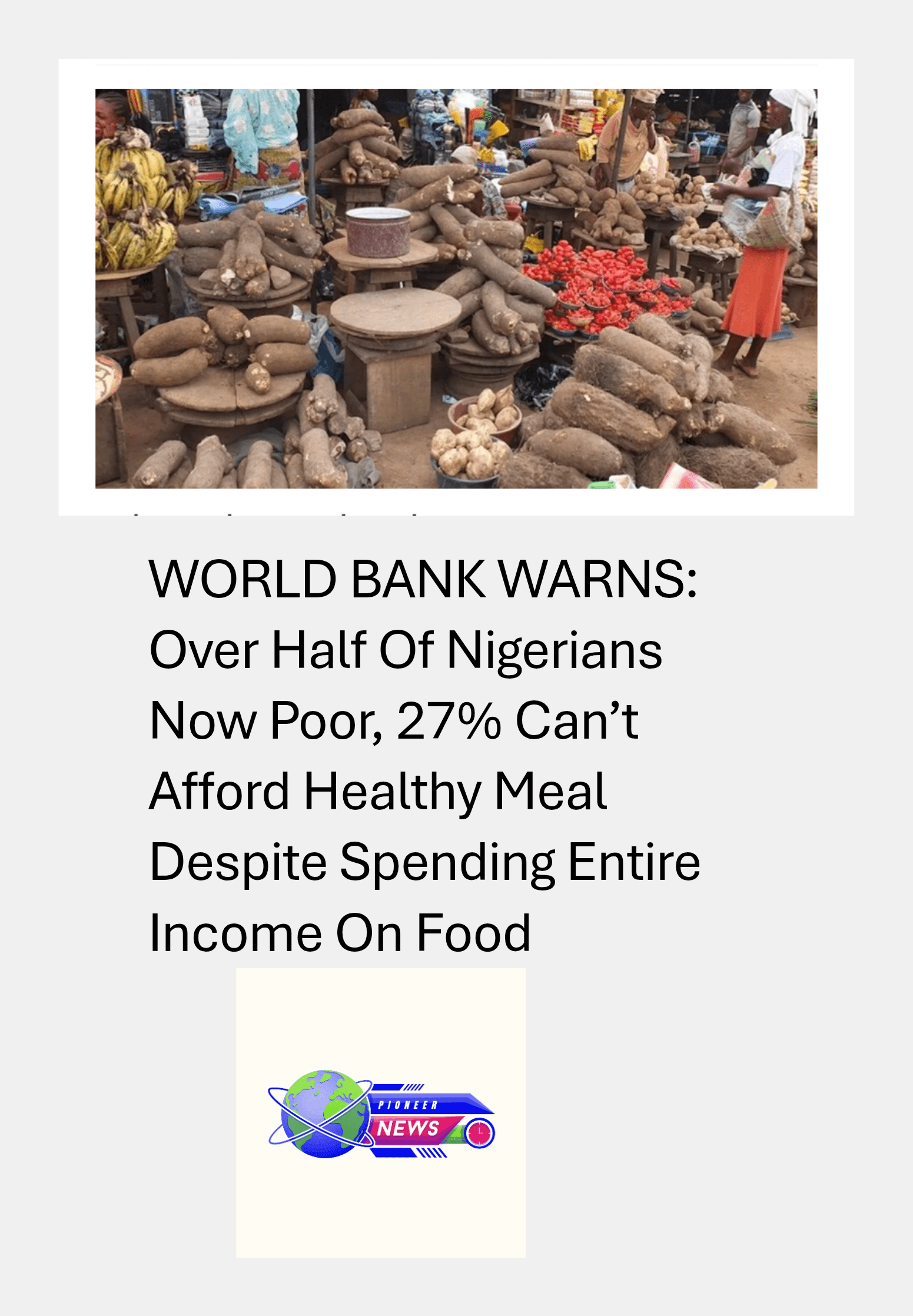
Report blames inflation, weak growth, and policy missteps for deepening hardship
A new report by the World Bank has painted a grim portrait of Nigeria’s economy, revealing that over half of the country’s population now lives in poverty, while 27 percent of citizens cannot afford a healthy meal even if they spend all their income on food.
The report, titled Nigeria Development Update (NDU), October 2025 Edition, attributes the worsening hardship to high inflation, weak economic growth, and an inadequate social protection system, all of which have combined to erode living standards and push millions deeper into poverty.
> “As a result of still timid growth, high inflation, and an underdeveloped social safety net, the previous fall in consumption levels and rise in poverty have yet to start reversing,” the Bank stated.
According to the report’s Growth Incidence Curve (GIC) analysis, average consumption levels fell by 6.7 percent between 2019 and 2023, a decline the Bank linked to “pre-2023 policy missteps” and external shocks that disrupted household welfare and business productivity.
The World Bank observed that the economic decline was most severe in urban areas, where families rely less on subsistence farming and are more vulnerable to price shocks and job losses.
Drawing from the Nigeria Living Standards Survey (NLSS) 2022/2023, the report revealed that 56 percent of Nigerians were classified as poor in 2023, a sharp rise from 40 percent in 2019.
Even more worrisome, the share of the “ultra-poor”—those who cannot meet minimum calorie requirements despite spending all their earnings on food—rose from 14 to 27 percent during the same period. This translates to an estimated 139 million Nigerians living in ultra-poverty by 2023.
While acknowledging that inflation had begun to ease slightly in 2025, the Bank cautioned that price pressures remain “high, volatile, and uneven,” adding that recent rebasing of the Consumer Price Index (CPI) complicates the accurate assessment of year-on-year inflation.
Economists say the findings underscore the continuing effects of policy inconsistencies, structural weaknesses, and income inequality, all of which have left Nigeria’s economy fragile despite its vast human and natural resources.
The Bank noted that the situation is most severe in northern Nigeria, where food insecurity, unemployment, and limited access to basic services have combined to produce some of the highest poverty rates in Sub-Saharan Africa.
In a related publication—the Africa’s Pulse Report (October 2025 Edition)—the World Bank identified Nigeria as the country with the highest number of people facing job-related challenges on the continent, with 98 million citizens either unemployed, underemployed, or working in informal, low-paying jobs.
Nigeria was followed by the Democratic Republic of Congo (72 million), Ethiopia (62 million), Tanzania (40 million), and Uganda (27 million).
> “Underemployment is widespread across the region, reflecting the inability of African economies to generate sufficient stable wage jobs for their growing populations,” the report stated. “Only one in six workers in Sub-Saharan Africa holds a wage-paying job, compared to one in two in high-income countries.”
The World Bank urged Nigerian policymakers to pursue bold, people-centered reforms aimed at stabilizing prices, boosting productivity, and expanding social protection coverage. Without such measures, it warned, the country risks a deeper economic and humanitarian crisis that could further entrench poverty and inequality.
 PIONEER NEWS