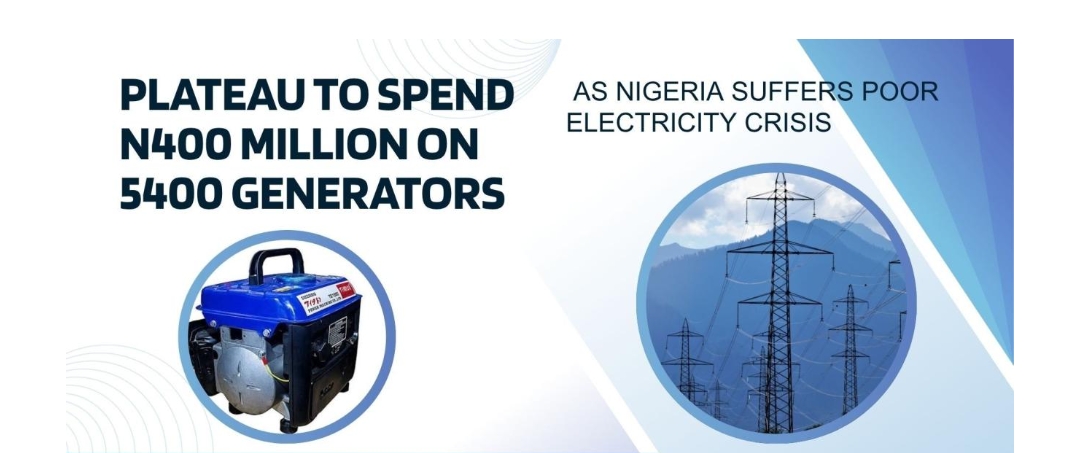
Sahara reporters has taken to its official X handle and announced that, In the face of a nationwide electricity crisis that has plunged millions of Nigerians into darkness, the Plateau State Government has earmarked a staggering N400 million for the purchase of 5,400 generators across its 17 local government areas.
According to details from the state’s 2025 proposed budget, N200 million will be spent on 3,400 generators for skilled artisans, while another N200 million will fund 2,000 more generators for artisans in the same local councils.
This controversial allocation comes as Nigerians continue to grapple with epileptic power supply, worsened by twelve national grid collapses recorded in 2024 alone. On September 10, the grid went down yet again, following a major nationwide blackout earlier in March that crippled businesses and households.
Federal Agencies Join the Generator Rush
Plateau is not alone in the “generator economy.” At the federal level, at least 44 ministries, departments, and agencies (MDAs) have set aside a mind-blowing N14.2 billion for fuelling generators and plants in 2025.
The State House Headquarters tops the list with N1.98 billion to keep its power plants running. Other jaw-dropping allocations include:
EFCC – N1.19 billion
Federal Road Safety Commission (FRSC) – N2.5 billion
National Defence College – N337.4 million
Nigerian Defence Academy – N399.5 million
Ministry of Foreign Affairs (HQ) – N567 million
Office of the National Security Adviser (ONSA) – N182.9 million
Directorate of State Security Services (DSS) – N212 million
Even regulatory and transparency agencies are not left out. The Bureau of Public Enterprises has budgeted N36.2 million for generator fuelling, while the Nigerian Extractive Industries Transparency Initiative (NEITI) will spend N35.5 million.
Beyond Plateau, state governments are also pouring billions into fuelling. In Bauchi, the Government House alone has budgeted a jaw-dropping N1 billion for fuelling vehicles and generators in 2025. Half of that amount – N500 million – is dedicated solely to powering generators.
Nigeria’s power sector remains crippled despite huge investments and promises of reform. The country, with over 200 million people, continues to operate on less than 4,000 megawatts of electricity on most days – less than what some African nations generate with far smaller populations.
As the national grid collapses repeatedly and federal and state governments budget billions for generators, critics argue that Nigeria is sliding deeper into a “generator economy,” with no end in sight to its energy woes.
Plateau Govt To Spend N400m On 5,400 Generators As National Grid Collapses 12 Times In 2024
 PIONEER NEWS