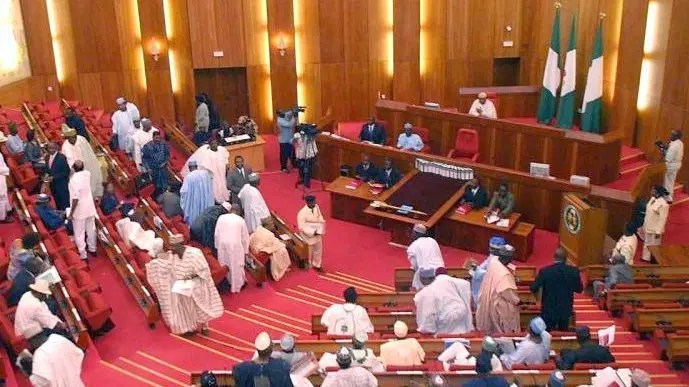
University lecturers in Nigeria are once again on a collision course with the Federal Government as a widening gulf between their meagre pay and the lavish earnings of public office holders threatens to ignite another crisis in the ivory towers.
At the heart of the agitation is the yawning disparity: a professor in a federal university earns N633,333 monthly, while senators allegedly pocket as much as N21 million. Critics say this shocking imbalance reflects Nigeria’s warped priorities and its growing disdain for education.
Last week, Imo State Governor Hope Uzodimma raised the minimum wage in his state to N104,000, far above the national benchmark of N70,000. Lecturers in Imo State-owned universities also benefitted, with professors now earning N812,000 monthly—making them the highest-paid in the country.
But at the federal level, the story is starkly different. Professors who spend decades climbing the academic ladder—acquiring PhDs, publishing in peer-reviewed journals, supervising research, and mentoring future leaders—take home salaries barely enough to survive in today’s harsh economy.
By contrast, lawmakers, whose minimum qualification is a secondary school certificate, earn astronomical sums. The Revenue Mobilization, Allocation and Fiscal Commission (RMAFC) claims senators earn around N1 million monthly. But multiple revelations from insiders tell a different story.
Former Senator Shehu Sani blew the lid off the earnings of federal lawmakers. In a 2024 interview, he confessed to earning N13.5 million monthly during his time in the 8th Senate, insisting that current senators now take home around N21 million monthly.
Sani accused RMAFC of “playing with figures,” insisting that official disclosures grossly understate the opulent reality. Another senator, Kawu Ismaila from Kano, confirmed that members of the 10th Senate receive as much as N21 million every month.
“For over two decades, the earnings of legislators have been shrouded in secrecy,” Sani lamented. “I felt it was my duty as a public servant to tell Nigerians the truth.”
The revelation has sparked outrage among Nigerians. Mrs. Yinka Ogunde, founder of the Concerned Parents and Educators Network, wrote on social media:
> “I owe all lecturers an apology. I never knew a professor earns less than 600k—less than a local government councillor. We need an urgent rethink of our education system.”
Another commentator added bitterly:
> “It takes 10 years after secondary school to become a PhD holder, yet professors earn N633,333 per month. Meanwhile, with just WAEC, a Nigerian can become a senator and earn millions. What message are we sending about the value of education?”
Others drew comparisons with the United Kingdom, where professors earn an average of £80,000 annually, funded largely by tuition fees and education loans. “In Nigeria,” one analyst wrote, “we live in the illusion of being rich, but our lecturers are treated like beggars.”
A Salary Frozen Since 2009
For the Congress of University Academics (CONUA), the matter is not just about disparity but neglect. Its National President, Dr. Niyi Sunmonu, lamented that lecturers’ salaries have been stagnant since 2009.
“Attempts to raise them have amounted to mere tokenism,” he said. “The inflationary pressure is suffocating. Our leaders go to international conferences and see how other countries treat their intellectuals with dignity, yet they come home and treat us like afterthoughts. We deserve a living wage, not handouts.”
Sunmonu warned that any new negotiation on lecturers’ welfare that excludes CONUA would be invalid.
With governors like Francis Nwifuru of Ebonyi also raising the minimum wage for state workers to N90,000, expectations are mounting across the federation. But for university lecturers, the bigger battle remains with Abuja, where pay remains frozen in the face of runaway inflation and national hardship.
If nothing changes, the stage may once again be set for strikes, disruptions, and yet another lost academic year for millions of Nigerian students.
For many Nigerians, the question is simple: Why does the nation pay its lawmakers millions while its professors—the custodians of knowledge—are left to survive on crumbs?
 PIONEER NEWS