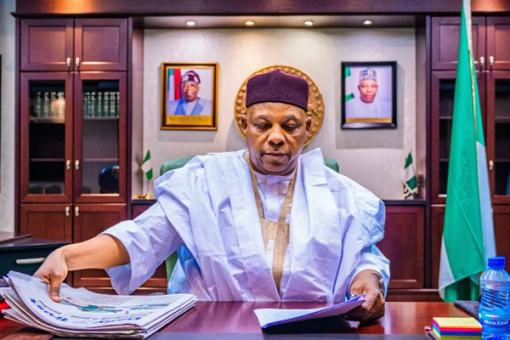
The National Economic Council (NEC) has given the green light to Nigeria’s new Medium-term National Development Plan (2026–2030), christened the Renewed Hope Economic Development Plan, a bold framework designed to consolidate ongoing reforms and push President Bola Ahmed Tinubu’s ambitious $1 trillion economic growth target.
The approval came on Thursday during the 151st NEC meeting, presided over by Vice President Kashim Shettima at the State House, Abuja.
Briefing newsmen after the meeting, the Minister of Budget and Economic Planning, Senator Abubakar Atiku Bagudu, disclosed that the Renewed Hope Plan will take over from the current 2021–2025 plan which winds down in December.
Bagudu explained that the 2026–2030 framework is the second phase of Nigeria’s 30-year development agenda (Agenda 2050)—a long-term economic vision crafted in 2020 with extensive contributions from the private sector, civil society, political parties, and traditional institutions.
According to him, the plan will ensure policy continuity, consolidate economic reforms, and address emerging socio-economic challenges while focusing on:
Accelerating job creation
Expanding human capital development
Strengthening food security
Driving sustainable infrastructure
Enhancing social protection systems
“This framework is a critical bridge between the Tinubu administration’s reform momentum and the long-term aspirations of Agenda 2050,” Bagudu stated, adding that preparatory work will begin immediately to ensure President Tinubu formally launches the plan before year-end.
The minister revealed that governance structures to steer the plan include a national steering committee, a central working group, and technical working groups co-chaired by public and private sector representatives, with state governors representing each of the six geopolitical zones.
He also noted that Governor Chukwuma Soludo of Anambra State enriched discussions by drawing on his experiences with earlier development frameworks.
Beyond economic strategy, NEC reviewed Nigeria’s fight against the Type-2 polio virus, with encouraging updates. Governor Mohammed Inuwa Yahaya of Gombe State, who heads the NEC Polio Eradication Committee, reported that cases had dropped from 78 to 42 within months due to intensified immunisation in high-risk states.
Notably, Kano and Katsina States recorded dramatic reductions of 85% and 84% respectively, while Gombe has reported zero cases in 2025. However, Sokoto State remains a flashpoint, accounting for 13 of the 23 new cases this year.
Yahaya said vaccination efforts had expanded significantly, with geo-coordinate mapping of settlements improving from 71% in April to 78% in June. Coverage also rose from 81% to 84%, reaching 2.7 million children across 11 high-risk states.
A second vaccination round is scheduled for September 11–14, followed by a nationwide integrated campaign in October, which will combine polio, measles, malaria, and nutrition interventions.
For accountability, deputy governors will be mandated to chair state task force meetings before campaigns, while local government chairmen will lead grassroots mop-up exercises. Security agencies have also been tasked to provide cover for vaccination teams in volatile areas such as Sokoto, Zamfara, and Kebbi.
“The progress is promising, but the fight must continue until Nigeria achieves total eradication,” Yahaya affirmed.
In his briefing, the Accountant-General of the Federation, Mr. Shamseldeen Babatunde Ogunjimi, painted a sobering picture of the nation’s reserves. He revealed that the Excess Crude Account has been depleted to just $535,823.39, while the Stabilisation Account holds N78.45 billion and the Natural Resources Account stands at N106.72 billion.
 PIONEER NEWS