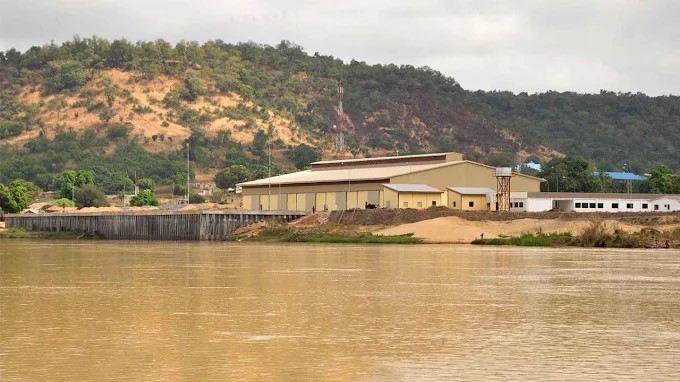
The House of Representatives Ad-hoc Committee on the Rehabilitation and Operationalisation of the Baro Inland Port has condemned the immediate past administration of President Muhammadu Buhari for what it described as a “paper commissioning” of the multi-billion naira project in 2019.
Despite heavy investment and high expectations, the lawmakers revealed that the strategic port—expected to serve as a critical gateway to Nigeria’s economy—remains in a sorry state, abandoned and non-functional.
A former Deputy Speaker of the House, Hon. Idris Wase, spoke during a courtesy visit to the Niger State Governor, Umaru Bago, at the Government House, Minna, on Sunday. Wase, who accompanied the Committee led by its Chairman, Hon. Saidu Abdullahi, said the visit laid bare the deception of the past administration.
“What we saw is nothing but a project that was merely commissioned on paper. It is unfortunate what happened in the past, but as leaders, we must take responsibility to change the narrative,” Wase declared.
The Plateau lawmaker described Baro Port as a historic “gateway to Nigeria’s economy,” tracing its origins to colonial times and recalling how the late President Umaru Musa Yar’Adua attempted to revive it before his death.
He stressed that the Committee, with full backing from the Speaker of the House, is determined to breathe life into the port, ensure its completion, and address issues of equity in infrastructural development.
“By the time we guarantee fairness in infrastructure, nobody will care where the president comes from. What matters is that every region benefits,” Wase emphasized.
He commended Governor Bago’s commitment to agriculture and infrastructure, likening his determination to the legacy of the late Sardauna of Sokoto, Sir Ahmadu Bello, and urging him to “write his name in gold” by ensuring the revival of Baro Port.
The lawmakers further pledged collaboration with the Nigerian Railway Corporation and other stakeholders to tackle the port’s challenges, particularly dredging of navigation corridors and fixing access roads, which are critical to making the facility operational.
In his response, Governor Umaru Bago described Baro Port as a national asset with enormous potential to decongest Nigeria’s highways, reduce gridlock, and revolutionise cargo transportation.
“Since I became governor, we have been working towards the realisation of the Baro Port project. This is not a Niger State project, and not even a northern project—it is a Nigerian project,” Bago said.
The governor expressed deep concern over the gridlock in Bida caused by heavy trailers, noting that billions of naira are spent annually repairing federal highways destroyed by overloaded trucks.
“With the revival of Baro Port and Nigeria’s railway network, we can drastically cut road pressure and embrace sustainable transport. Everywhere else in the world, goods move by rail. Sadly, Nigeria remains one of the few countries that abandoned its railway system,” he lamented.
Bago pledged full support for the Committee, assuring them that Niger State will play its part in ensuring the success of the project.
On his part, the Committee Chairman, Hon. Saidu Abdullahi, painted a grim picture of the neglect, revealing that the failed roads leading to the port remain a major obstacle to its operation.
“What should ordinarily be a 30-minute trip now takes over four agonising hours due to the deplorable state of the road. This is unacceptable for a facility of this magnitude, designed to be a hub for trade and industrial growth,” Abdullahi said.
He assured that the Committee will leave no stone unturned in ensuring the long-abandoned Baro Port finally becomes a functional driver of economic growth, easing road congestion, and positioning Nigeria to compete in global trade logistics.
 PIONEER NEWS