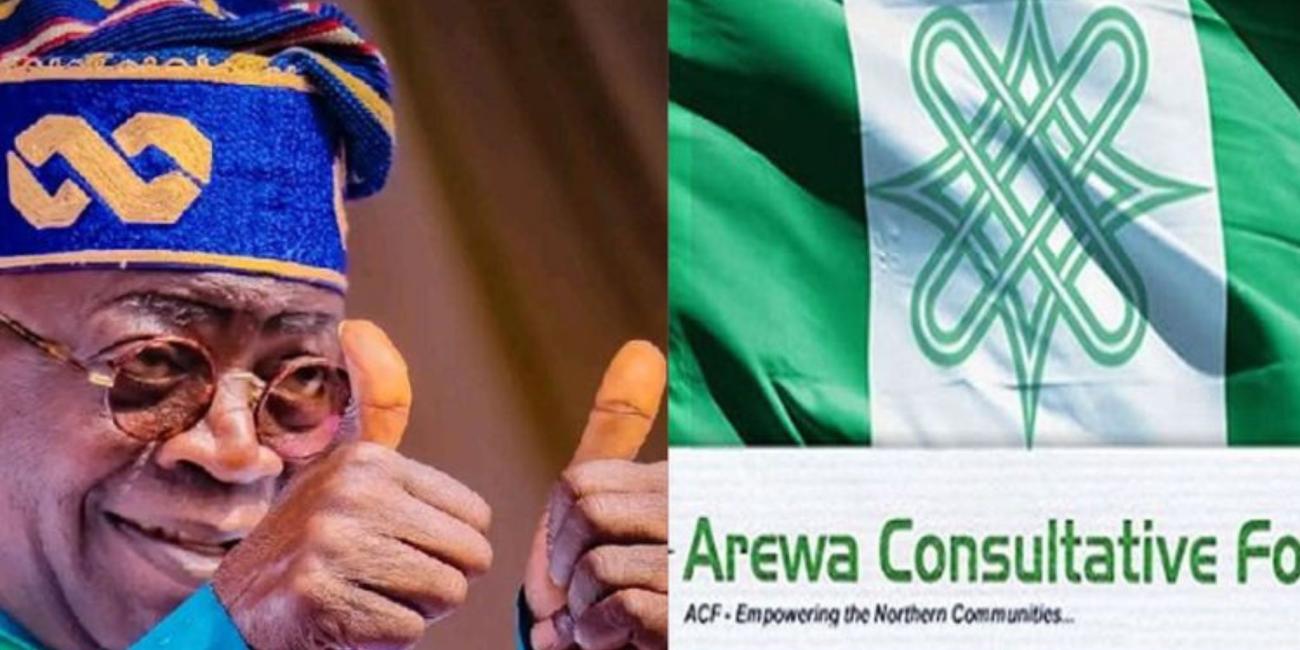
Two years into President Bola Ahmed Tinubu’s administration, a storm of discontent is brewing in Northern Nigeria, with influential voices accusing the government of turning its back on the region that handed him the lion’s share of electoral support in the 2023 general elections.
Leading the charge is the Arewa Consultative Forum (ACF), which on Tuesday levelled scathing criticism at the Tinubu-led administration, alleging gross marginalisation of the North in both federal appointments and developmental projects.
Speaking at a two-day citizen engagement forum organised by the Sir Ahmadu Bello Memorial Foundation in Kaduna, Alhaji Bashir M. Dalhatu, Wazirin Dutse and Chairman of the ACF Board of Trustees, minced no words in condemning what he described as a systematic exclusion of the region.
> “The North, which contributed over 64% of Tinubu’s total votes in the 2023 general elections, has been largely excluded from critical policy decisions and project implementation,” Dalhatu asserted.
Dalhatu’s address touched a nerve that resonates widely across Northern Nigeria, where many believe the region has become a political afterthought despite being the electoral bedrock of Tinubu’s rise to power.
He lamented the skewed distribution of federal infrastructure funds, citing recent budget allocations to back his claims.
> “Of the N1.013 trillion allocated to roads in the current federal budget, only N24 billion — less than 1% — was earmarked for projects in the North East,” Dalhatu revealed.
“According to a May 2025 statement from the Federal Ministry of Works, the South West received N1.394 trillion, the South East got N205 billion, the North West had N105 billion, while the North East was allotted just N30 billion.”
The disparities, he noted, are no longer covert.
> “This discriminatory practice is no longer hidden — it is done openly, without apology,” he said, drawing sharp contrasts with high-profile southern projects like the Lagos-Ibadan Expressway and the Second Niger Bridge, while Northern roads remain neglected, uncompleted, or in ruins.
On agriculture — the backbone of the northern economy — Dalhatu accused the administration of underfunding a sector that employs millions.
> “Despite the Tinubu administration’s stated goodwill, budgetary allocations to agriculture remain under 5%, far below the 25% benchmark recommended by the Food and Agriculture Organization (FAO),” he said.
The ACF Chairman warned that Northern support — once solidly behind Tinubu — is being dangerously eroded.
> “To our surprise, those who did not support him, did not vote for him, and hardly wished him well are now emerging from nowhere and driving a wedge between him and the North. The region’s political goodwill is being taken for granted,” he said.
These remarks echo a wider sentiment of marginalisation previously raised by Senator Rabiu Musa Kwankwaso, former presidential candidate of the New Nigeria Peoples Party (NNPP), who also accused Tinubu’s government of prioritising the South at the expense of the North.
In response, the Presidency dismissed the allegations, stating that the North is adequately represented and benefits significantly from ongoing federal government initiatives.
In a strongly worded rebuttal titled “Senator Kwankwaso, You Are Wrong. Northern Nigeria Not Left Behind,” the Tinubu administration listed multiple development projects across Northern states, arguing that the region remains central to the government’s agenda.
Despite this, political analysts caution that if the grievances remain unaddressed, President Tinubu may face serious political backlash from the North ahead of the 2027 general elections. The North’s growing frustration — once silent — is becoming increasingly vocal and coordinated, with the ACF’s statements amplifying a call for rebalancing national priorities.
As the 2027 race looms on the horizon, the big question remains: Will President Tinubu course-correct and re-engage with the North, or risk alienating a region that made his presidency possible?
 PIONEER NEWS