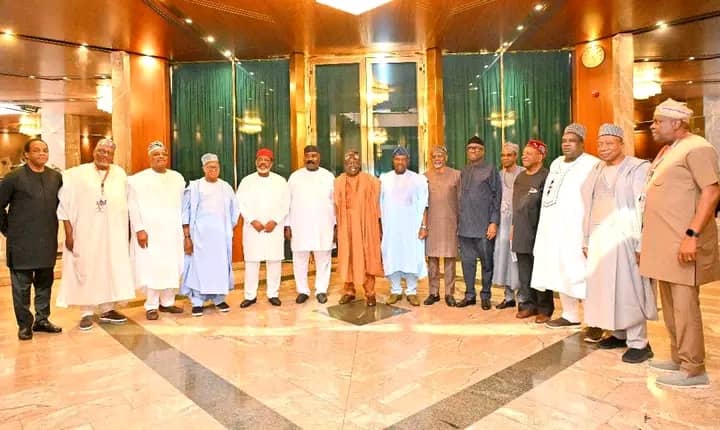
In a rare and strategic political reunion, former governors elected in Nigeria’s 1999 democratic transition have urged President Bola Ahmed Tinubu to abandon the unsustainable culture of palliatives and focus on transformative policies anchored on job creation and rural industrialization.
Led by Chief Lucky Igbinedion, former Governor of Edo State, the influential “Class of ’99” governors paid a high-profile visit to the President at the State House in Abuja on Thursday. Their mission was two-fold: a personal reunion with “one of their own” and a national appeal for bold, structural solutions to Nigeria’s mounting economic and security crises.
The delegation, a formidable political bloc, included James Ibori (Delta), Niyi Adebayo (Ekiti), Adamu Muazu (Bauchi), Joshua Dariye (Plateau), Victor Attah (Akwa Ibom), Adamu Aliero (Kebbi), Sam Egwu (Ebonyi), Jolly Nyame (Taraba), Boni Haruna (Adamawa), Saminu Turaki (Jigawa), Donald Duke (Cross River), and George Akume (Benue), who currently serves as the Secretary to the Government of the Federation (SGF).
Speaking after the closed-door deliberations, Chief Igbinedion revealed the group’s core message: Nigeria must urgently transition from handouts to hands-on economic empowerment, especially in rural areas where poverty, inflation, and insecurity are most acute.
> “We came not only to reconnect with our colleague who is now President but to raise pressing national concerns. We discussed the worsening security situation, economic hardship, and the urgent need to revitalise agriculture and industry,” Igbinedion said.
He emphasized that while President Tinubu showed “deep concern” and openness to ideas, the group was unequivocal in rejecting the over-reliance on palliatives as a long-term solution.
> “If you give someone ₦5,000 today, what happens by dinnertime? It’s gone. Palliatives are band-aids; they don’t heal. What Nigeria needs now is the establishment of cottage industries—localised, small-scale factories that generate sustainable jobs, especially for our youth,” he added.
Igbinedion proposed the creation of micro-industrial hubs across all 774 local government areas, suggesting agro-processing, small-scale manufacturing, and value-addition enterprises as key pathways to economic recovery and rural prosperity.
> “The revival of cottage industries will not only address unemployment but also spark a ripple effect of development in neglected rural economies,” he said.
Beyond economic revitalization, the governors drew a direct link between economic opportunity and national security. According to them, joblessness breeds insecurity, and no investment can flourish in an environment plagued by fear and instability.
> “We told the President clearly: without security, there can be no progress. No investor, local or foreign, will risk their capital in an unsafe zone,” Igbinedion warned.
President Tinubu, according to the delegation, was receptive to their proposals and promised continuous engagement.
> “He appreciated our ideas and assured us his doors remain open for further conversations. It was a fruitful, constructive dialogue,” the former Edo governor noted.
Their intervention comes amid mounting public criticism of the administration’s palliative-driven approach—ranging from cash transfers to food distributions—seen by many as short-lived and ineffective in tackling the root causes of hunger and poverty.
By advocating for a paradigm shift towards grassroots industrialization, the Class of ’99 governors are positioning themselves not only as elder statesmen but as catalysts for sustainable development.
Their appeal reflects a growing national consensus: that real progress will come not from handouts but from hands-on policies that empower communities, create wealth, and restore dignity to millions of Nigerians.
As the nation awaits action, the big question remains: will President Tinubu translate these timely suggestions into a robust national strategy that moves Nigeria from dependency to productivity?
 PIONEER NEWS