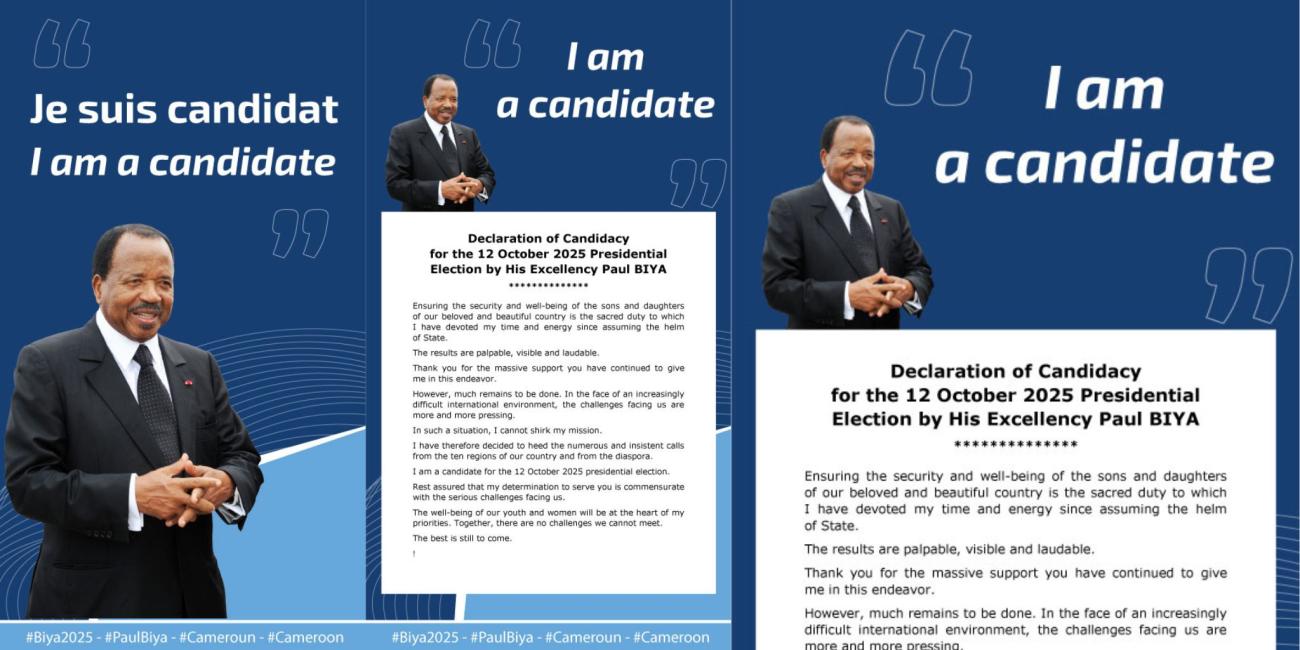
In a dramatic move that has reignited debate across Africa and beyond, Cameroon’s 92-year-old President, Paul Biya—the world’s oldest serving head of state—has officially declared his intention to run for an unprecedented eighth term in the country’s upcoming presidential election scheduled for October 12, 2025.
The announcement, made on Sunday via Biya’s official X (formerly Twitter) account in both English and French, has sent political shockwaves through Cameroon’s ten regions and the diaspora.
> “I am a candidate for the 12 October 2025 presidential election,” Biya posted.
“Rest assured that my determination to serve you is commensurate with the serious challenges facing us. Together, there are no challenges we cannot meet. The best is still to come.”
In a statement titled “Declaration of Candidacy for the 12 October 2025 Presidential Election by His Excellency Paul BIYA”, the nonagenarian leader affirmed that he was responding to “numerous and insistent calls” from across the country urging him to continue.
> “Ensuring the security and well-being of the sons and daughters of our beloved and beautiful country is the sacred duty to which I have devoted my time and energy since assuming the helm of State,” he said.
“Much remains to be done. In the face of an increasingly difficult international environment, the challenges are growing. In such a situation, I cannot shirk my mission.”
Biya’s announcement has set the stage for what may become one of the most contentious elections in Cameroon’s history. If successful, the new term would keep him in power until he is nearly 100 years old, extending his already four-decade-long rule.
Biya first rose to power in 1982 following the resignation of Cameroon’s first president, Ahmadou Ahidjo. Since then, he has become a symbol of political longevity on the African continent, but also a lightning rod for criticism over democratic backsliding, human rights abuses, and alleged electoral manipulation.
In 2008, Biya controversially amended the constitution to remove presidential term limits, effectively paving the way for lifetime rule. He subsequently won the 2018 election with 71.28% of the vote, a result hotly contested by opposition parties amid accusations of widespread fraud and irregularities.
Adding to the growing concern is Biya’s declining public appearances and persistent speculation over his health. His 42-day disappearance from the public eye last year stoked rumours that he was gravely ill. Upon his eventual return in October, the government staunchly denied the claims and even banned public discourse about the president’s health, citing national security concerns.
Biya’s decision to run again has drawn both fervent support and strong opposition. Supporters laud him as a unifying figure with unmatched experience, while critics view his extended rule as a sign of deepening authoritarianism and democratic decay.
As Cameroon heads toward yet another critical election, all eyes will be on how the people—and the international community—respond to Biya’s audacious bid to stretch his legacy well into a second century of life.
Will the nation choose continuity under a man who has outlasted five French presidents and six U.S. presidents—or will a new chapter finally begin? Only time, and the ballot box, will tell.
 PIONEER NEWS