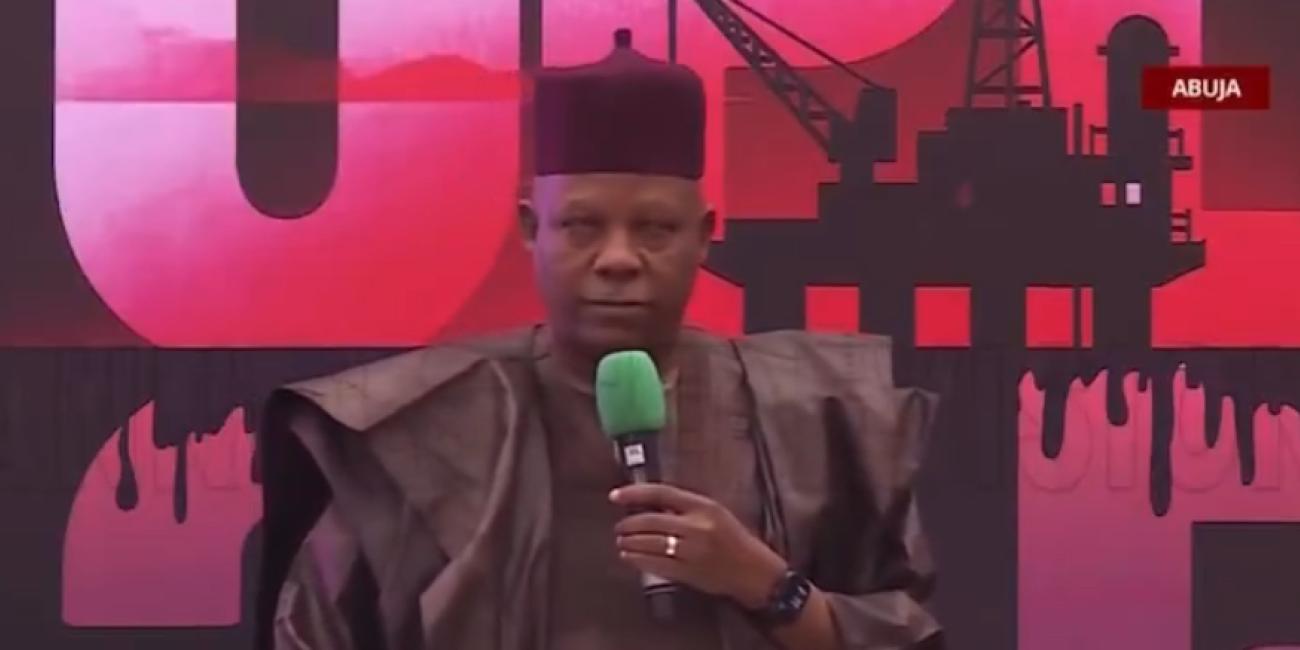
Vice President Kashim Shettima has opened a fresh chapter in Nigeria’s political drama, revealing that former President Goodluck Jonathan once attempted to illegally remove him from office as Governor of Borno State — a move that was thwarted by courageous legal minds who reminded Jonathan of the constitutional limits of presidential power.
Shettima made the explosive revelation in Abuja while speaking at the public presentation of “OPL245: The Inside Story of the $1.3bn Nigerian Oil Bloc”, a tell-all book by former Attorney-General of the Federation and Minister of Justice, Mohammed Bello Adoke (SAN).
According to Shettima, Jonathan had sought to oust him from the Borno governorship during his tenure, despite having no legal basis to do so. “Former President Goodluck Ebele Jonathan was floating the idea of removing this Borno governor,” Shettima recounted, pointing to himself. “And Aminu Waziri Tambuwal, the then Speaker of the House of Representatives, had the courage to tell the president: ‘You don’t have the power to remove an elected councillor.’”
Despite the pushback, Shettima said Jonathan persisted and escalated the matter to the Federal Executive Council (FEC). There, former Justice Minister Adoke stood his ground. “The president was still unconvinced. He mooted the idea at the FEC. Mr. Mohammed Adoke told him bluntly: ‘You do not have the power to remove a sitting governor.’ Another Senior Advocate of Nigeria (SAN) in the cabinet, Kabiru Turaki, concurred: ‘I am of the candid opinion of my senior colleague.’ That was how the matter was laid to rest.”
In a moment of candid reflection, Shettima praised Adoke for defending democratic principles even amid political tension. “I want to thank you for the courage to forgive those who have offended you. In the last four years of the Jonathan administration, I was public enemy number one.”
However, Shettima’s remarks have drawn attention to a striking contradiction: While he denounced Jonathan’s unconstitutional move, the administration in which he now serves has itself come under fire for a similarly controversial act.
In March, President Bola Tinubu declared a state of emergency in Rivers State and took the unprecedented step of suspending Governor Siminalayi Fubara, his deputy, Mrs. Ngozi Odu, and all members of the State House of Assembly for six months — a move many legal experts described as lacking constitutional grounding.
In his national broadcast, Tinubu accused Governor Fubara of dereliction, citing the demolition and failure to rebuild the House of Assembly, persistent pipeline vandalism, and administrative paralysis in the state. “The Supreme Court pronounced in very glaring terms that a government cannot run without an arm of government,” Tinubu stated.
Quoting Section 305 of the Constitution, Tinubu said, “Based on the latest security reports and ongoing breakdown of governance in Rivers State, Governor Siminalayi Fubara, his deputy, Mrs. Ngozi Odu, and all elected members of the Rivers State House of Assembly are hereby suspended for an initial period of six months.”
Observers have since questioned the legal basis and political intent behind Tinubu’s action, comparing it with the very scenario Shettima criticized. The optics, critics say, hint at a dangerous return to executive overreach, raising concerns about selective application of constitutional principles depending on who’s in power.
With the political heat rising and contradictions growing starker, many Nigerians are left wondering: Is the rule of law truly sacred in Nigeria — or merely a tool of convenience?
 PIONEER NEWS