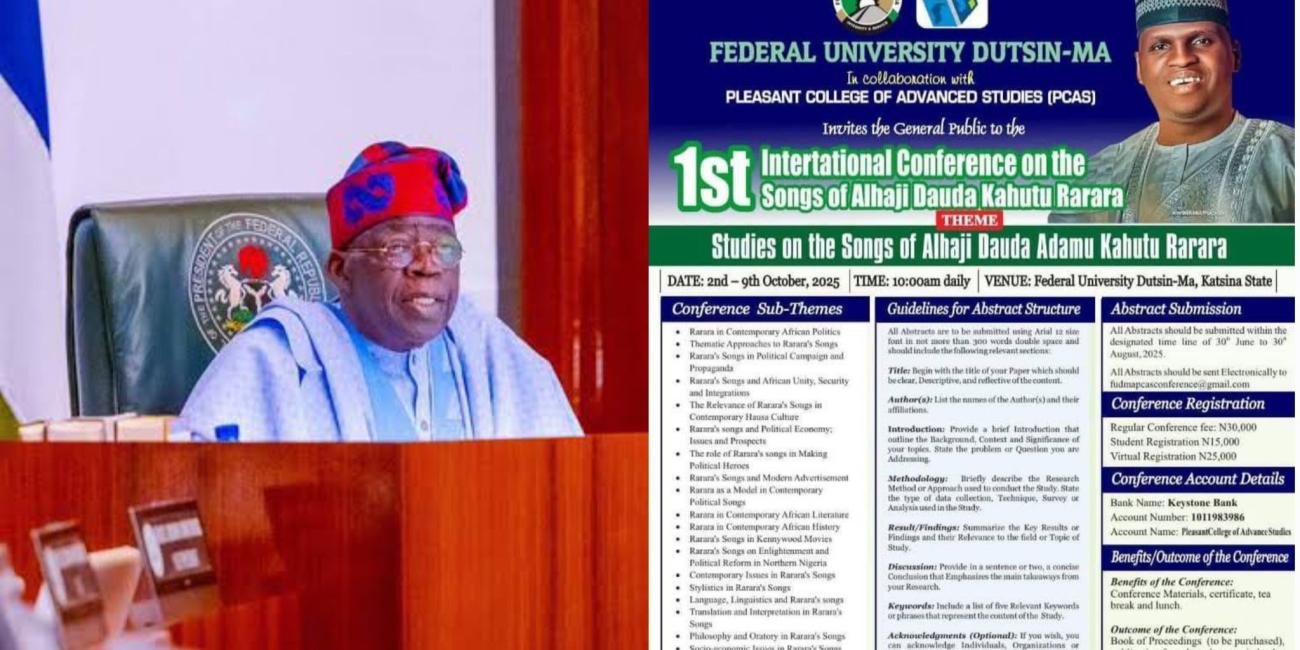
The Federal University Dutsin-Ma (FUDMA), Katsina State, has vehemently disassociated itself from a controversial “international conference” purportedly designed to academically glorify Dauda Kahutu Rarara — a notorious political praise singer famed for his jingles in support of the All Progressives Congress (APC), President Bola Ahmed Tinubu, and former President Muhammadu Buhari.
A flier for the conference, which has gone viral across social media, billed the event as the “1st International Conference on the Songs of Alhaji Dauda Kahutu Rarara” and claimed it was being co-hosted by FUDMA and a lesser-known institution named the Pleasant College of Advanced Studies (PCAS). The academic event was said to be scheduled for October 2–9, 2025, on FUDMA’s campus in Dutsin-Ma.
However, the university, in a strongly worded statement released Wednesday evening, denied any affiliation with the conference.
> “The University Management is not aware and has not entered into any collaboration with Pleasant College of Advanced Studies or any institution for that matter to host the advertised International Conference,” the statement declared.
The university further warned the public and members of the academic community to disregard the invitation and exercise caution:
> “Members of the public, particularly those in academic circles, are advised to be wary of or ignore such advertisements. The university management will not be liable for any consequences arising from the so-called international conference.”
Adding to the firestorm, Professor Abdalla Uba Adamu — whose name and image were prominently displayed on the flier as the keynote speaker — also came out forcefully to condemn the conference as fraudulent and deceptive.
In a scathing rebuttal titled “The Conference That Never Was!”, the former Vice-Chancellor of the National Open University of Nigeria (NOUN) expressed outrage over the unauthorised use of his name and academic reputation.
> “I almost deleted it when I first saw it, thinking it was just another badly edited image, only to realise my name was listed as a keynote speaker. I have never been contacted, nor did I give my consent. This is highly unprofessional,” he stated.
Prof. Adamu described the entire initiative as a “desperate rush to legitimise Rarara’s sycophantic performances under the guise of academia.”
He derided the sub-themes of the proposed conference, which include topics like “Rarara’s Role in Political Propaganda,” “The Construction of Political Heroes Through Praise Music,” and “Rarara in Contemporary African Politics.”
> “To the best of my knowledge, Rarara has never held any elected political office for him to warrant scholarly interrogation within the scope of African politics. These themes are a mockery of academic standards,” he wrote.
While maintaining his support for scholarly critique of performance arts such as music, literature, and theatre, Adamu made it crystal clear that the event is nothing more than a publicity stunt cloaked in academic garb.
> “This is not a conference. It is a charade. I am not part of it and will not be,” he asserted.
He further revealed that although academic works exist on Rarara’s artistry, including his own published papers and social media essays, this particular conference appears to be an orchestrated attempt by the singer’s loyalists to “whitewash political sycophancy through fraudulent scholarship.”
> “Dozens of papers have been written on Rarara, from blog posts to academic dissertations. But the army of his followers — many of whom lack access to such literature — seem desperate to brand him as a cultural icon worthy of academic reverence.”
The announcement of the so-called conference sparked widespread public condemnation, with many Nigerians criticizing what they see as the politicisation of academia. Social media has been awash with reactions slamming the attempt to turn a political propagandist into a subject of scholarly praise.
Critics argue that instead of promoting objective, critical discourse, the event appears tailor-made to canonise a figure known more for partisan loyalty than for meaningful artistic contribution.
With FUDMA and Prof. Adamu’s swift dissociation, questions now loom over the true sponsors of the event and what their motives are. As investigations and public scrutiny continue, one thing is clear: Nigeria’s intellectual community is pushing back against the hijacking of academic platforms for political spectacle.
 PIONEER NEWS