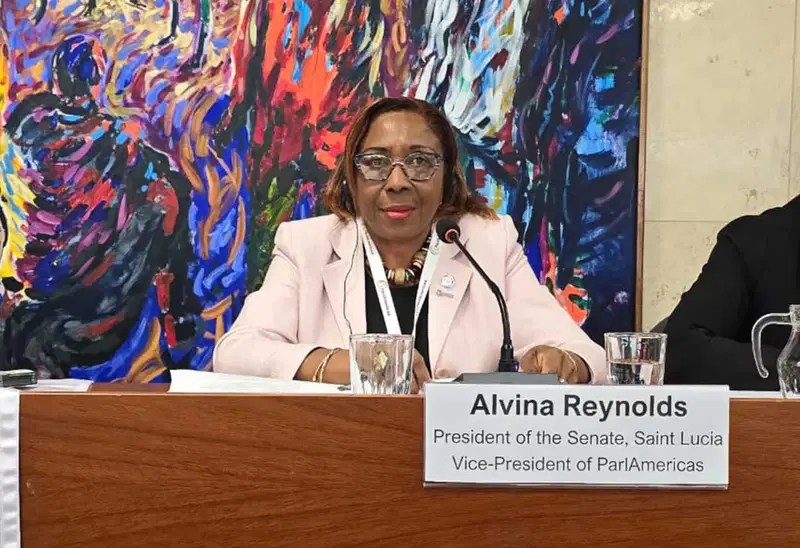
In a moving and symbolic address, the President of the Saint Lucian Senate, Alvina Reynolds, has declared that many Saint Lucians can trace their ancestral roots back to Nigeria, underscoring the enduring cultural and spiritual bond between the Caribbean nation and West Africa.
Reynolds made the remarks on Monday while officially welcoming Nigeria’s President, Bola Ahmed Tinubu, to a historic joint session of Saint Lucia’s bicameral parliament. The event coincided with World Parliament Day, adding even deeper significance to the moment.
Citing a British colonial census conducted in 1815, Reynolds revealed that of the 16,282 enslaved individuals living in Saint Lucia at the time, 3,488 were born in Africa.
“Of these,” she noted, “34 percent were from Nigeria, 11 percent from the Nigeria-Cameroon region, and 22 percent from the Congo. The remaining 12,794 were born in Saint Lucia, but most of their forefathers hailed from Sene-Gambia and Nigeria.”
Reynolds hailed Tinubu’s visit as “a mission to reunite us with our homeland,” emphasizing that the transatlantic slave trade, though tragic, had forged indelible cultural ties between Africa and the Caribbean.
“This visit is not just political; it’s deeply spiritual and ancestral,” she said. “It represents a bridge reconnecting two worlds long separated by history but united by heritage and destiny.”
In a poignant moment, Reynolds paid homage to Sir Darnley Alexander, a Saint Lucian-born jurist who served as Nigeria’s Chief Justice from 1975 to 1979. She also acknowledged the continued presence of Nigerian Catholic priests serving in Saint Lucia, introducing Father Festus, a special guest at the session, as a symbol of ongoing collaboration.
Turning to President Tinubu, she said:
“Your Excellency, your address to this Parliament today could not have occurred at a more auspicious time. On this World Parliament Day, we reflect not only on governance but also on the deeper bonds that link our peoples.”
Responding to President Tinubu’s address, Saint Lucian Prime Minister Philip Pierre described the visit as “a moment of freedom and celebration.” He spoke passionately about the island’s historical and emotional ties to West Africa.
“Saint Lucia is but a small fragment of Africa,” he said. “Our people have been separated by oceans, but spiritually and culturally, we have never been apart. We are African people who, though once enslaved, have built permanent homes here—homes built not just for ourselves, but in service of all humanity, especially Africa.”
With a touch of humor, Pierre noted that the population of Saint Lucia is smaller than that of Eti-Osa Local Government Area in Lagos, yet proudly reaffirmed the island’s sovereignty and its strong ties to Nigeria.
“Despite our size, we are a confident, sovereign nation deeply connected to the world, to Nigeria, and to West Africa,” he said. “We deeply value the contributions of the Nigerian community in Saint Lucia—in healthcare, religion, cuisine, tourism, and more. We are richer for it.”
The Prime Minister praised the momentum gained from the 2021 Africa-CARICOM Summit and looked ahead to the next summit scheduled for Addis Ababa. He called for deeper collaboration in tourism, fintech, renewable energy, medical services, creative industries, and sports.
He highlighted air connectivity as a major hurdle preventing more Nigerians from visiting Saint Lucia, despite the island receiving over a million tourists annually.
“There is so much we can do together,” Pierre emphasized. “We welcome Nigerian expertise in football, cricket, fintech, and healthcare. The potential for partnership is enormous.”
The joint parliamentary session was attended by top officials from across the Organisation of Eastern Caribbean States (OECS), dignitaries, diplomats, and members of the Nigerian delegation—marking a powerful moment of historical reckoning, diplomatic reengagement, and hopeful forward-looking cooperation between the Caribbean and Africa.
 PIONEER NEWS