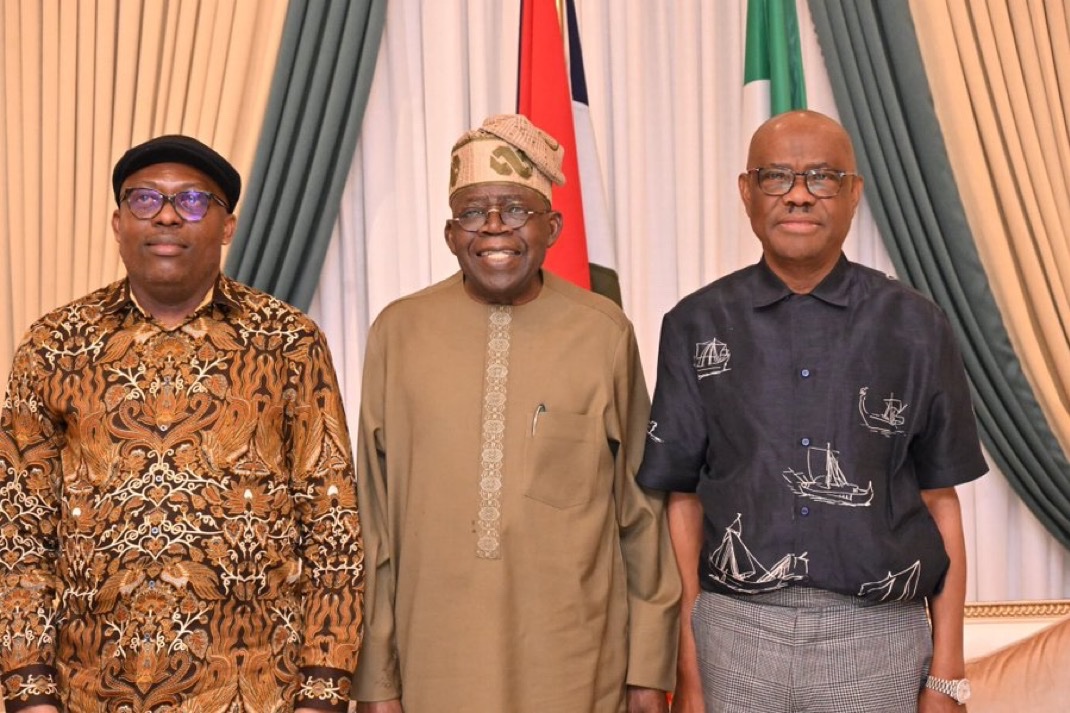
In a high-stakes political gamble to quell the unending crisis in Rivers State, President Bola Ahmed Tinubu has reportedly struck a power-sharing deal that will see Governor Siminalayi Fubara reinstated — but at a steep personal and political cost. According to an exclusive report by TheCable, Fubara’s return to Government House comes with strict conditions: no second-term ambition and total surrender of grassroots control to his estranged political godfather, Nyesom Wike.
The peace accord was sealed during a tense, closed-door meeting at the Presidential Villa in Abuja on Thursday night. Those in attendance included FCT Minister Nyesom Wike, Governor Fubara, embattled House Speaker Martin Amaewhule, and a select group of lawmakers loyal to the former governor.
Multiple presidency sources revealed that Tinubu, deeply concerned about the protracted instability in the oil-rich state, insisted on a political compromise to restore calm. The President is said to have issued a firm ultimatum: “There must be peace in Rivers — but not without sacrifice.”
One senior source familiar with the negotiations disclosed, “The deal is straightforward: Fubara completes his tenure but won’t seek re-election in 2027. Wike gets full control of the local government structure. In return, the impeachment proceedings against Fubara will be dropped, and the state will move forward.”
Under the terms of the agreement, Wike is granted the authority to nominate all 23 local government chairpersons — a move that solidifies his grip on the political grassroots and positions him strategically for the 2027 elections. Political observers say this effectively crowns Wike as the “unofficial kingmaker” in Rivers State.
“Wike is the ultimate winner here,” a presidency insider admitted. “With local government under his thumb, he controls the engine room of Rivers politics. Fubara, on the other hand, becomes more of a ceremonial figure until his tenure expires.”
Governor Fubara has also reportedly agreed to pay all outstanding allowances and entitlements owed to the 27 pro-Wike lawmakers, led by Amaewhule, who defected to the All Progressives Congress (APC) amid the turmoil. Despite their defection, they continued to assert their seats in the assembly — triggering legal battles and accusations of constitutional violations.
The deep-rooted feud between Governor Fubara and his predecessor-turned-adversary, Wike, exploded into the public arena in late 2023. At the heart of the conflict was control — over state resources, political appointments, and influence within the assembly.
What began as behind-the-scenes power play quickly degenerated into open warfare, culminating in attempts to impeach the governor, a divided state legislature, and administrative stagnation. Despite earlier intervention efforts by Tinubu, the hostilities persisted — threatening governance and investor confidence in the oil-rich Niger Delta state.
Tinubu’s Drastic Move
On March 18, 2025, President Tinubu took a historic and controversial step by declaring a state of emergency in Rivers. He suspended Governor Fubara, his deputy Ngozi Odu, and the entire state assembly for six months — a drastic move that underscored the gravity of the crisis.
A retired naval chief, Ibok-Ette Ibas, was appointed as sole administrator to run the state, while political stakeholders were urged to resolve their differences during the suspension period.
As the September expiration of Fubara’s suspension draws near, this latest agreement brokered by the presidency appears to be the final blueprint for peace — albeit a fragile one.
While the truce may temporarily stabilize the state, many political analysts warn it could sow seeds of further discontent.
“This isn’t reconciliation. It’s submission,” said a political commentator who asked not to be named. “Fubara is being allowed back on the throne, but the sceptre now belongs to Wike.”
With Governor Fubara’s political wings clipped and Wike firmly in control of the grassroots, all eyes now turn to the 2027 elections — and the question of who truly rules Rivers State.
 PIONEER NEWS