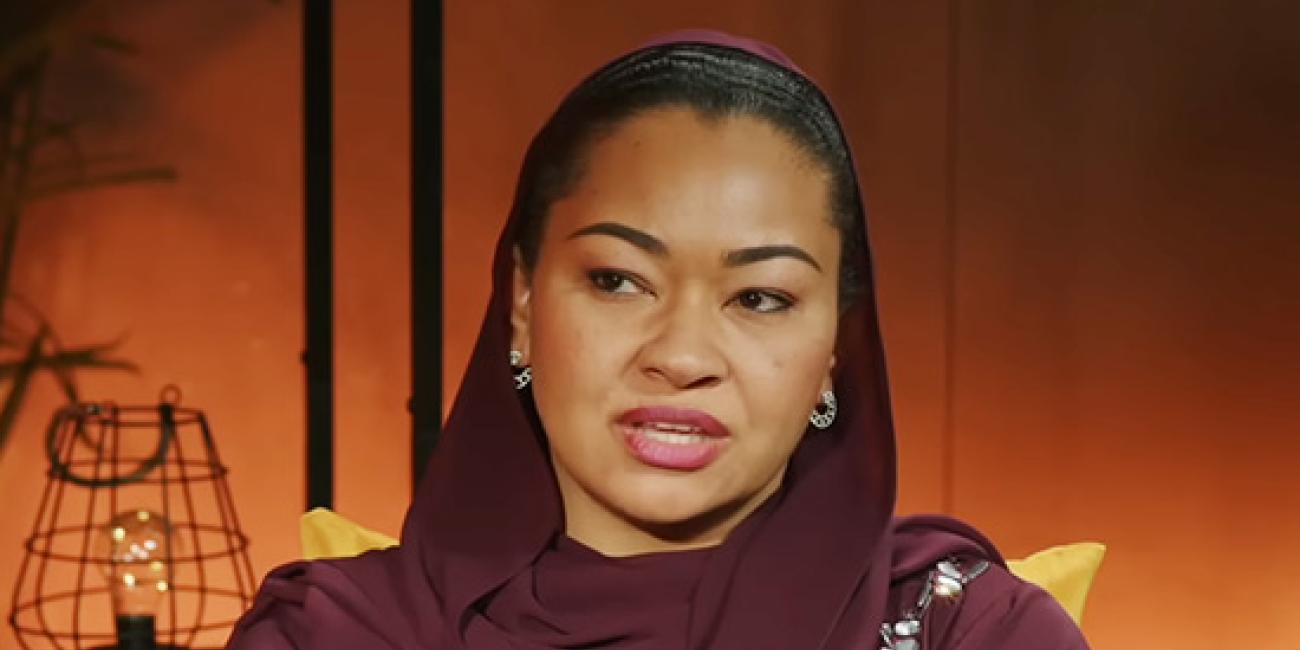
Suspended Senator representing Kogi Central, Natasha Akpoti-Uduaghan, has broken her silence after the Nigerian government slammed her with two fresh criminal charges, a move she believes is politically motivated and rooted in vendettas by Senate President Godswill Akpabio and former Kogi State Governor Yahaya Bello.
In a detailed statement released via her verified Facebook page on Monday, Akpoti-Uduaghan confirmed that her legal team, led by Senior Advocate of Nigeria J.J. Usman, was officially served the charges at 9:18 a.m. on the same day—despite her only learning about them through social media prior.
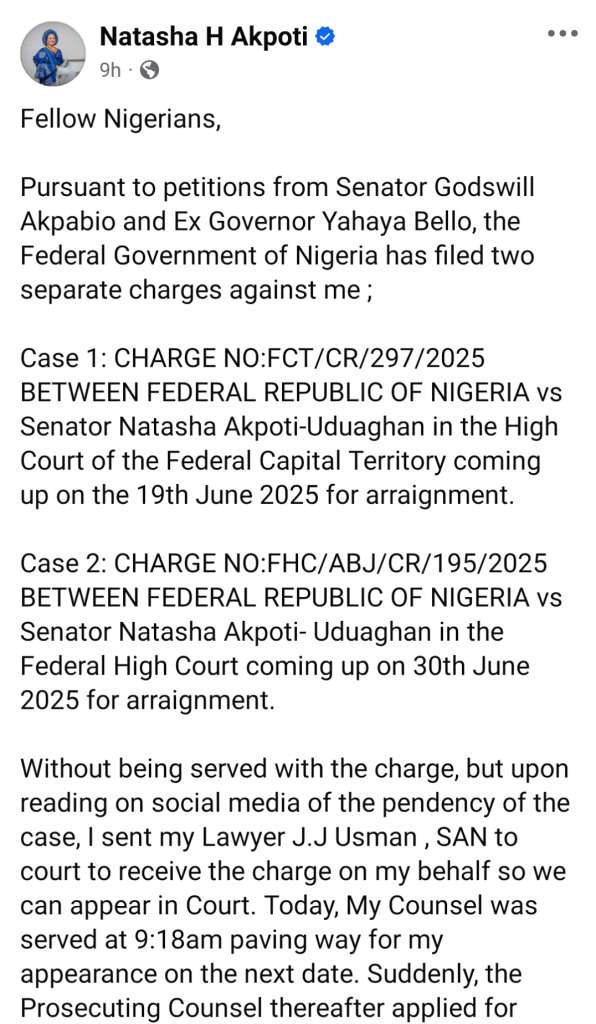
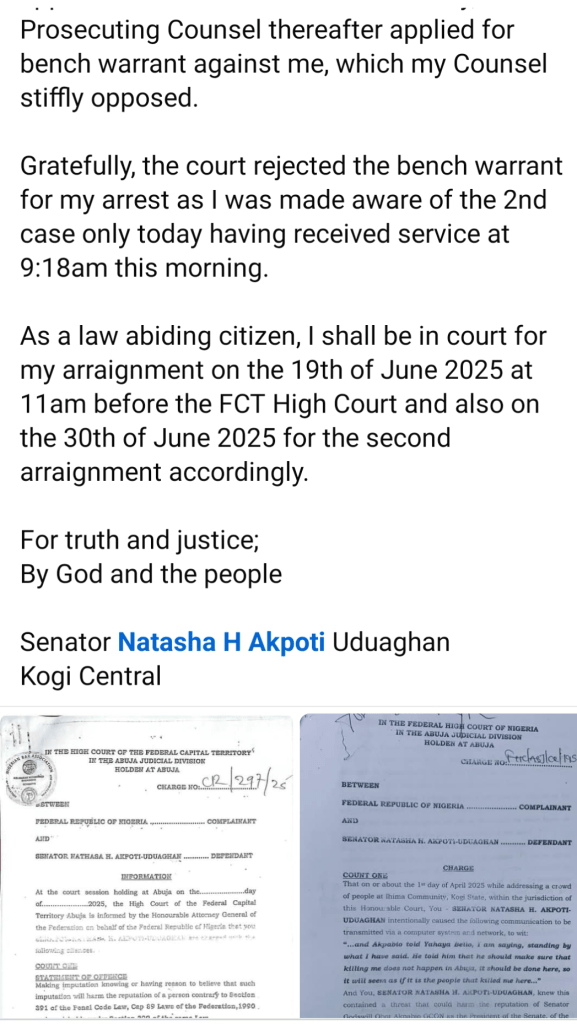
The development adds another layer of drama to Nigeria’s unfolding political theatre, as the cases—seen by many as part of a broader power struggle within the upper echelons of government—have sparked fierce debate over the boundaries of free speech, political persecution, and democratic integrity.
Despite her swift legal response, the prosecuting counsel reportedly attempted to obtain a bench warrant for her arrest—a move that her legal team fiercely opposed. The court, in an apparent nod to due process, declined the application, recognising that the Senator had only just been served and had already committed to appearing in court.
> “As a law-abiding citizen, I shall be in court for my arraignment on the 19th of June 2025 at 11am before the FCT High Court, and also on the 30th of June 2025 for the second arraignment accordingly,” Akpoti-Uduaghan stated.
She further disclosed that the two cases are based on separate charges:
Case 1: Charge No: FCT/CR/297/2025 before the High Court of the Federal Capital Territory, scheduled for June 19, 2025.
Case 2: Charge No: FHC/ABJ/CR/195/2025 before the Federal High Court, scheduled for June 30, 2025.
According to SaharaReporters, the charges against Akpoti-Uduaghan stem from her televised comments on April 1 and April 3, 2025, during which she accused Akpabio and Bello of plotting her assassination. Specifically, she alleged that Senate President Akpabio instructed Bello to “eliminate” her in Kogi State to make it appear as a local political incident.
In a six-count indictment filed by Abubakar Mohammed Babadoko of the Department of Public Prosecutions (DPP), she is accused of cyberstalking, defamation, and making statements capable of inciting public unrest. The charges fall under the amended Cybercrimes (Prohibition, Prevention, etc.) Act of 2024 and are being prosecuted by the Office of the Attorney-General of the Federation.
In a separate three-count charge—Suit No: CR/1277/25—Akpoti-Uduaghan is accused of deliberately harming the reputations of Akpabio and Bello through televised interviews and online publications.
> “It was part of the meeting, the discussions that Akpabio had with Yahaya Bello that night, ehm… to eliminate me,” she had claimed on Channels TV’s Politics Today on April 3.
Human rights lawyer and Senior Advocate of Nigeria, Femi Falana, has weighed in on the matter, condemning the charges as “unconstitutional” and “a direct assault on freedom of expression.”
> “The attempt to criminalise criticism of public office holders is not only outdated but unlawful under Nigeria’s democratic framework,” Falana said.
He urged public officials who feel aggrieved by such accusations to seek civil remedies through libel suits, rather than resorting to criminal prosecution that could stifle political opposition and erode democratic values.
> “Where a writer exceeds the bounds, there should be a resort to the law of libel where the plaintiff must of necessity put his character and reputation in issue,” Falana argued.
Akpoti-Uduaghan’s lead counsel, West Idahosa, SAN, reaffirmed her commitment to due process, stating:
> “Our client is a law-abiding citizen. Why wouldn’t she be in court? It’s a summons we have undertaken.”
Observers believe the unfolding legal drama has all the markings of a political showdown, as the suspended senator—known for her vocal stance against corruption and gender injustice—continues to rattle political elites both in her home state and in Abuja.
This case is about more than one woman facing criminal charges. At its core lies a broader battle over:
Freedom of speech in a fragile democracy
The politicisation of the judiciary
Women’s voices in Nigerian politics
Public trust in government accountability
Whether Akpoti-Uduaghan’s allegations prove true or are dismissed in court, the outcome of this case will echo far beyond the courtroom, setting precedents for future political discourse, transparency, and the right to dissent in Nigeria.
As the political chessboard continues to shift, all eyes remain on June 19 and June 30—when a suspended senator takes her place not in the red chamber, but in the dock.
 PIONEER NEWS