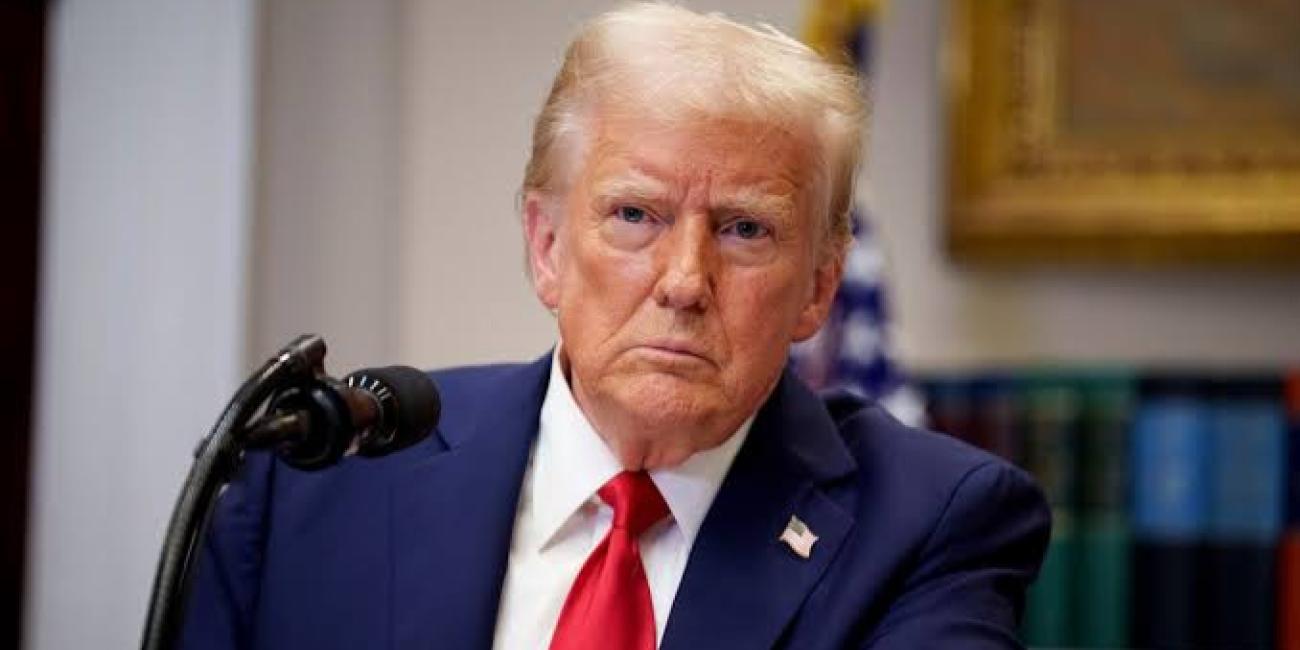
In a bombshell revelation that further intensifies the already volatile Middle East crisis, U.S. President Donald Trump has hailed Israel’s recent large-scale military assault on Iran as “excellent,” ominously warning that “there’s more to come.”
The striking comments were made during an exclusive sit-down with ABC News Chief Washington Correspondent Jonathan Karl, who pressed Trump on the controversial Israeli operation that rocked Iran’s capital, Tehran, and several other cities.
> “I think it’s been excellent. We gave them a chance and they didn’t take it,” Trump stated. “They got hit hard, very hard. They got hit about as hard as you’re going to get hit. And there’s more to come—a lot more.”
Trump’s unapologetically hardline rhetoric comes as the Middle East teeters on the edge of wider conflict. Israel’s aerial offensive—reportedly involving over 200 fighter jets striking more than 100 locations inside Iran—has sent shockwaves across the region and sparked a flurry of international condemnation.
Iran Vows Retaliation Amidst Grief and Outrage
In a strongly worded statement posted on its official X (formerly Twitter) account, Iran’s Ministry of Foreign Affairs condemned what it called a “blatant act of aggression” and a “violation of national sovereignty” by the “Zionist regime.”
> “This morning, the occupying and rogue Zionist regime violated the territorial integrity of our dear Iran, attacking several locations, including residential areas in Tehran and other cities,” the ministry said.
Among the casualties were some of Iran’s most senior military and nuclear figures. Confirmed dead are General Mohammad Bagheri, Chief of the General Staff of Iran’s Armed Forces, and Hossein Salami, head of the powerful Islamic Revolutionary Guard Corps (IRGC). At least six prominent nuclear scientists were reportedly assassinated in what Israel dubbed “Operation Rising Lion.” Some were targeted in their homes, underscoring the surgical precision and scale of the operation.
The Iranian government, invoking Article 51 of the United Nations Charter, asserted its legal right to respond with force.
> “The Armed Forces of the Islamic Republic of Iran will not hesitate to defend Iran’s sovereignty with full strength and in a manner they deem appropriate,” the statement declared, warning that a retaliatory strike could be imminent.
The international community has responded with alarm and calls for de-escalation. The United Nations Secretary-General Antonio Guterres urged both countries to avoid what he termed “a descent into deeper conflict.” Meanwhile, Turkey, Saudi Arabia, and Oman have all condemned the Israeli strikes, describing them as reckless and provocative.
Oman, which had been scheduled to host critical U.S.-Iran nuclear talks this weekend, labeled the strike a “dangerous and reckless escalation”, casting doubt on the future of diplomatic efforts.
While the United Kingdom did not participate in the operation, defence sources told The Telegraph that Britain is carefully monitoring the situation. Prime Minister Sir Keir Starmer has urged both nations to exercise restraint, while Foreign Secretary David Lammy described the moment as “very dangerous,” underscoring the importance of renewed diplomacy.
In a notable departure from previous posture, the UK has opted not to dispatch military assets in support of Israel this time around. This comes amid cooling relations between London and Tel Aviv, highlighted by the suspension of bilateral free trade talks and a partial arms embargo over Israel’s conduct in Gaza.
Sources indicate the UK may nonetheless reinforce its RAF base in Akrotiri, Cyprus, where Typhoon jets are on standby for potential operations.
The sheer magnitude of the Israeli strikes—combined with Trump’s endorsement—has escalated fears of a full-blown regional war, potentially dragging in global powers and destabilizing oil markets.
For now, the world watches and waits. Iran is mourning its losses but promising vengeance. Israel is on high alert. And Donald Trump, ever the provocateur, appears unfazed by the looming storm, signaling not restraint but a ramp-up.
As both sides dig in, the Middle East stands on a knife’s edge, and the next move could ignite a firestorm that engulfs the entire region.
 PIONEER NEWS