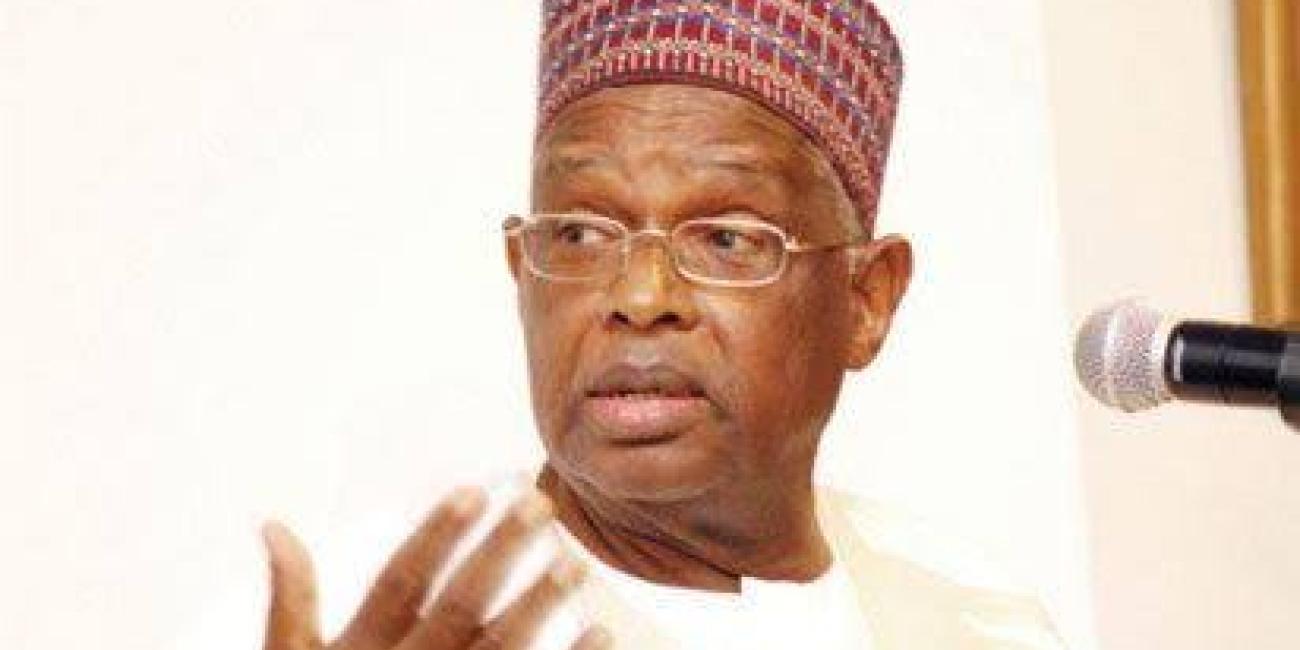
Nigeria has lost one of its most influential yet controversial figures—Professor Jibril Aminu, a renowned cardiologist, statesman, and academic titan whose life journey straddled medicine, education, diplomacy, and politics.
The death of the former Minister of Education and Petroleum was confirmed by a family member, Abdullahi Adamu Prambe, who serves as Adamawa State Commissioner for Housing and Urban Development.
Born on August 25, 1939, in Song, then part of Adamawa Province in Colonial Nigeria, Professor Aminu’s life was a mosaic of brilliance, discipline, and contradictions. A man of unmatched intellect and ambition, he began his journey in medicine, earning a degree from the University of Ibadan in 1965. His pursuit of excellence led him to the Royal Post-Graduate Medical School in London, where he obtained a Ph.D. in Medicine.
His professional trajectory was equally impressive. From 1973 to 1975, Aminu served as Consultant, Senior Lecturer, and Sub-Dean of Clinical Studies at the University of Ibadan Medical School. His reputation in academic administration soared as he became the Executive Secretary of the National Universities Commission (NUC) between 1975 and 1979, shaping policies that defined Nigeria’s university system for decades.
He also took Nigeria’s academic pedigree to the global stage, serving as Visiting Professor of Medicine at Howard University College of Medicine in Washington, D.C., from 1979 to 1980.
Arguably, one of the most defining chapters of his life was his tenure as Vice-Chancellor of the University of Maiduguri from 1980 to 1985. Here, he simultaneously served as a Professor of Medicine until 1995. While many credit him for instilling academic excellence and discipline, his administration was also marked by heavy-handedness and repression of student activism.
Notably, during the turbulent era of student protests in the 1980s, Aminu expelled several students, including the fiery student leader Orji Uzor Kalu—later Governor of Abia State—for his role in the infamous “Ali Must Go” campaign. Kalu, then a key figure in the Student Union Government, was disciplined under Aminu’s orders and later refused to return to the university, even after being recalled, unless his colleagues were also reinstated.
Aminu’s actions during this period culminated in the landmark legal case Mr. Yesufu Amuda Garba & Others v. University of Maiduguri, in which the Supreme Court of Nigeria ruled in 1986 that the university’s domestic tribunal lacked the jurisdiction to determine criminal guilt. The apex court’s decision, spearheaded by legal luminary Gani Fawehinmi (SAN), not only reinstated the expelled students but also set a historic precedent affirming the supremacy of fair hearing and judicial oversight in disciplinary proceedings.
As a politician, Professor Aminu carved a space for himself within Nigeria’s military and democratic establishments. He served in General Ibrahim Babangida’s cabinet as Minister of Education and later as Minister of Petroleum and Mineral Resources between 1989 and 1992. His tenure in these ministries was marked by technocratic competence, but also by controversial policies, such as the 1986 proscription of the National Association of Nigerian Students (NANS), after which he established the Akanbi Panel to monitor student activities nationwide.
From 1999 to 2003, Aminu served as Nigeria’s Ambassador to the United States, where he helped bolster Nigeria’s international diplomatic ties during a critical period of democratic transition. He returned to domestic politics, becoming Senator for Adamawa Central from 2003 to 2011, winning re-election in 2007.
His service to the nation earned him several prestigious honors, including the national award of Commander of the Order of the Niger (CON) in 2002 and an Honorary Doctor of Science degree from Ahmadu Bello University in 1988.
Yet, Aminu’s legacy remains complex. While he was hailed in elite academic and policy circles for his intellect and leadership, many democracy activists and human rights advocates regarded him as a staunch ally of autocratic rule—willing to suppress dissent in favor of stability and state authority.
He was also a key player in General Sani Abacha’s 1994–1995 National Constitutional Conference, a body many saw as a tool to legitimize military rule.
Professor Jibril Aminu’s life was a study in contradictions: a healer who often sided with the establishment over the oppressed, an educator who believed in excellence but showed little tolerance for dissent, and a patriot whose actions left both admiration and resentment in their wake.
He is survived by his family, colleagues, and a generation of protégés who continue to navigate the rich yet conflicted path he helped pave.
As Nigeria mourns his passing, the nation must also grapple with the nuanced legacy of a man who was never content to be ordinary—a man who shaped institutions, touched lives, and left behind a name that history will remember with both reverence and debate.
 PIONEER NEWS