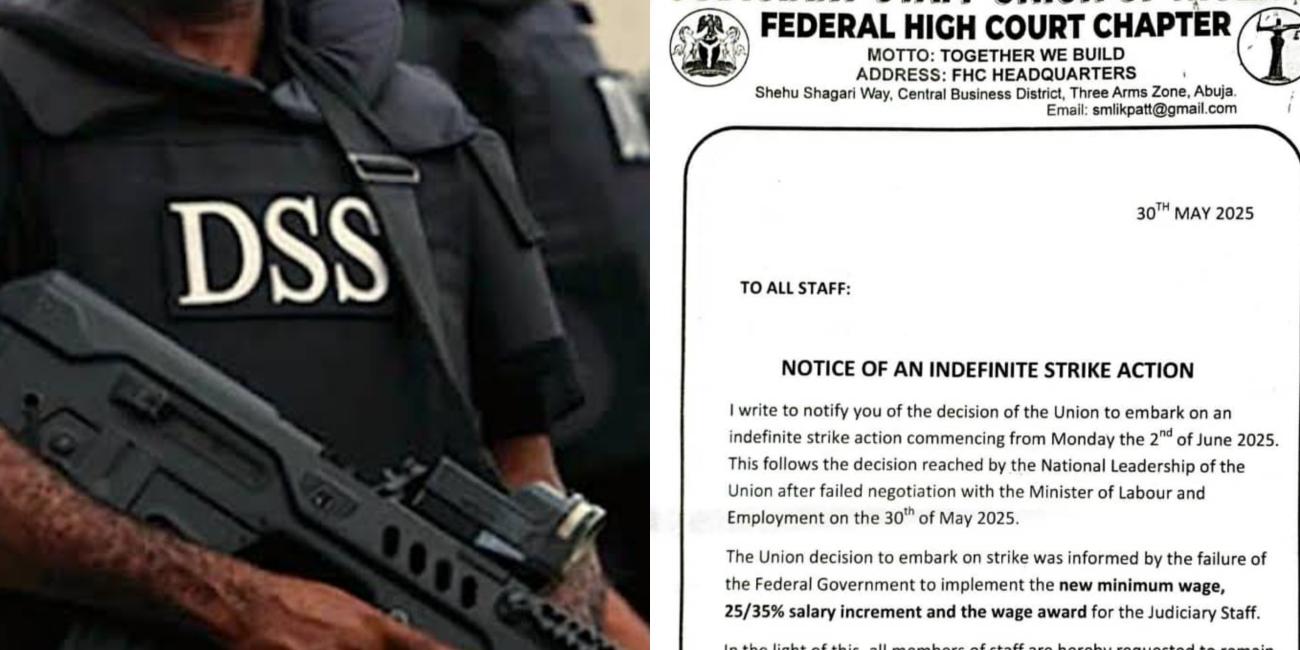
In a dramatic turn of events, the Judiciary Staff Union of Nigeria (JUSUN), Federal High Court Chapter, has vowed to commence an indefinite nationwide strike beginning Monday, June 2, 2025, despite last-minute negotiations and the Supreme Court’s decision to opt out.
The industrial action, aimed at forcing the government to fulfill long-standing wage-related commitments, is set to paralyze court operations across the country. This comes on the heels of a tense four-hour closed-door meeting between JUSUN executives and top officials of the Department of State Services (DSS) on Sunday, which ended in a deadlock.
Speaking exclusively to SaharaReporters, a senior JUSUN official confirmed that no compromise was reached during the high-stakes dialogue. “The strike continues even as the Supreme Court and National Judicial Council (NJC) have pulled out,” the source revealed. “We met with the Director General of the DSS and the Director of Operations. It was a four-hour engagement, but unfortunately, no resolution was achieved. Another meeting has been scheduled at the behest of the Chief Justice of Nigeria, involving all key stakeholders, including the DSS.”
Until then, JUSUN says it will maintain its position and proceed with the strike.
Meanwhile, Comrade Mohammed Isah, Secretary of JUSUN’s Supreme Court Chapter, reiterated the union’s unwavering stance. “We are just out of the meeting with the necessary stakeholders, but JUSUN remains resolute. The strike must continue. All staff should remain at home until further notice,” he wrote in a message sent to members on Sunday evening.
Despite the nationwide mobilization, the Supreme Court chapter of JUSUN has distanced itself from the industrial action. In a communiqué issued after an emergency executive meeting on May 31 at the Supreme Court complex in Abuja, the chapter announced it would not be joining the strike.
Citing “unique circumstances” and ongoing internal efforts by the Chief Justice of Nigeria, Hon. Justice Kudirat Motonmori Olatokunbo Kekere-Ekun, to address pending staff entitlements, the chapter argued that a blanket approach would be counterproductive.
“The Supreme Court Chapter of JUSUN hereby resolves not to join the proposed strike action by Federal Courts slated to commence on June 1, 2025,” the communiqué read.
While expressing solidarity with their counterparts in lower courts, the chapter emphasized the CJN’s sustained efforts in addressing judiciary workers’ welfare, which they say warrants a more nuanced approach. The communiqué was jointly signed by twelve senior union executives, including Comrades Danladi Nda Y., Bala Sambo, Bala Nuhu Aseku, Comfort Ataghar M., Idrisa Sadiq N., Faustina Onyinyechi Amadi U., Adamu Yunusa Kyara, Musa N. Chonoko, Leonard Okafor, Godwin Afemonbhio, Christian Onwurah, and Iyal Muhd. Tukur.
The storm has been gathering for weeks. On Saturday, SaharaReporters reported that JUSUN’s Federal High Court Chapter had officially declared an indefinite strike, citing the government’s continued failure to implement crucial wage agreements.
In a circular dated May 30 and circulated nationwide, the union ordered the immediate shutdown of all Federal High Courts starting June 2. The circular, signed by JUSUN’s Public Relations Officer, Mr. Gideon A. Maku, said the action was prompted by a total collapse in negotiations with the Minister of Labour and Employment.
Among the union’s key demands are the immediate payment of five months’ wage award arrears, implementation of the recently approved N70,000 national minimum wage, and the enforcement of the 25% and 35% salary increment promises.
“The government’s failure to act in good faith has left us with no choice,” the circular declared. “As a result of the failed negotiations and lack of commitment from the authorities, the union has resolved to proceed with an indefinite strike effective from Monday, June 2. All members of staff are hereby directed to remain at home until further notice.”
As the nation awaits the outcome of the next round of talks convened by the CJN, the strike threatens to grind Nigeria’s already burdened justice system to a halt, stoking concerns over delayed trials, remand backlogs, and systemic disruptions.
If unresolved quickly, this face-off may plunge the judiciary into one of its most severe institutional crises in recent history.
 PIONEER NEWS