
Sahara Reporters has taken to it’s official X handle and announced that, In a bombshell development shaking the foundations of Nigeria’s security establishment, the Inspector-General of Police (IGP), Kayode Egbetokun, has filed a 14-count criminal charge against several retired senior officers of the Nigeria Police Force. The charges, filed at the High Court of the Federal Capital Territory (FCT), Abuja, include allegations of conspiracy, age falsification, forgery, and fraudulent judicial manipulation—marking one of the most scandalous internal reckonings in the Force’s history.
Among those indicted are former Assistant Inspector-General of Police (AIG) Idowu Owohunwa, retired Commissioners of Police Benneth Igweh and Ukachi Peter Opara, as well as retired Deputy Commissioner of Police Obo Ukam Obo, and Simon Lough (SAN), a retired Assistant Commissioner of Police. Others implicated in the saga are reportedly still at large.
According to the charge sheet, filed under suit number CR/353/25, the accused officers, all of whom joined the Force around 1999, are alleged to have systematically forged official signals and altered service records in a deliberate effort to falsify their ages and extend their service tenure—actions that contravene both the Penal Code Law and the Public Service Rules of the Federal Republic of Nigeria.

Fabricated Signals, Fake Documents
One of the key pieces of evidence cited is Signal No. DTO 221535/05/89, purportedly issued from the Nigeria Police Administrative Unit in Lagos to the Commandant of the Police Academy, Kaduna. The document, along with another signal No. DTO 261340/061/89, was allegedly forged and used as the cornerstone of fraudulent claims filed in several high-profile cases at the National Industrial Court.
The Inspector-General’s case alleges that these falsified documents were used to deceive the judiciary and secure favorable rulings in legal battles involving police promotions and retirements, thereby undermining the integrity of the Nigeria Police Force.
In one instance, the accused reportedly used the forged signals in a 2019 case (NICN/ABJ/354/2019) between ACP Chinedu Ambrose Emengaha & Ors vs Police Service Commission (PSC). Another fraudulent use was recorded in NICN/ABJ/353/2019, involving ACP Sunday Okuguni & Ors vs PSC, where the court was allegedly misled into ruling in favor of the claimants.
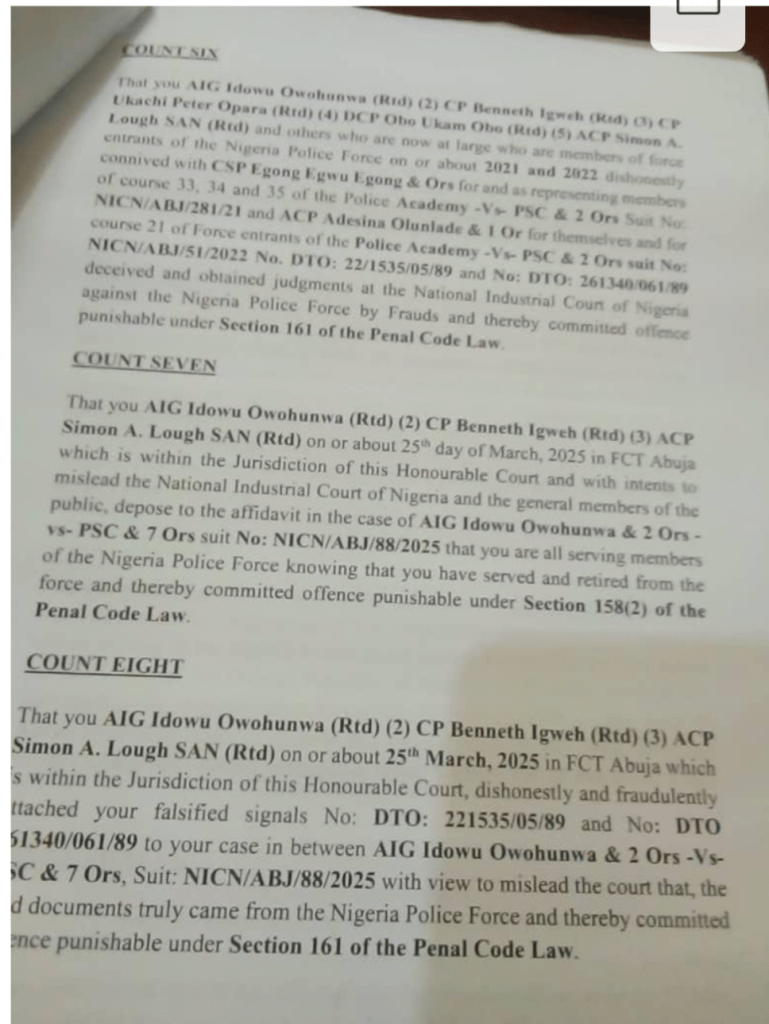
The IGP’s suit further alleges that Simon A. Lough (SAN) and others deposed false affidavits in March 2025, falsely claiming to be active-duty officers in another matter: AIG Idowu Owohunwa & Ors vs PSC & 7 Ors (NICN/ABJ/88/2025). The affidavit was allegedly used to lend credibility to their claims, despite the fact that the officers had already retired.
In a calculated effort to reinforce their deceptive litigation strategy, the accused are said to have attached the falsified signals to court processes, presenting them as authentic documents from the Nigeria Police. These actions, according to court filings, violate Sections 97, 158, 161, 178, and 366 of the Penal Code Law.

The case also uncovers a disturbing pattern of age falsification across different cohorts within the Force. For instance:
AIG Idowu Owohunwa is accused of submitting a falsified declaration of age dated April 4, 1990, claiming he was born on July 20, 1970, in a bid to remain in service beyond the lawful retirement age.
CP Benneth Igweh, according to investigations, altered his birth record from October 7, 1964, to October 7, 1968, suggesting he enlisted in 1996 instead of his actual enlistment year, 1988.
ACP Simon Lough (SAN) allegedly falsified his birth date from May 14, 1967, to May 14, 1969, to circumvent mandatory retirement provisions.
The manipulation of age and service records appears to have been coordinated across various police training courses, including Courses 19 through 35, with coordinated legal action initiated under the guise of class-action lawsuits. The officers reportedly acted in collusion with other police personnel, including CSP Egong Egwu Egong, to extend their stay in the Force through judicial subterfuge.

Legal analysts describe the IGP’s action as a bold move to restore integrity within the Police Force and reclaim public trust. “This is not just an internal disciplinary matter; it is a criminal enterprise that sought to subvert both the justice system and public service regulations,” said one legal expert.
The revelations have sparked reactions across security and legal circles, with many calling for a full-scale institutional audit to uncover the depth of systemic rot within the ranks of the Police Force.
Meanwhile, the whereabouts of several other implicated officers remain unknown as law enforcement intensifies its search for those “now at large.”
The High Court of the FCT is expected to commence hearing on the matter in the coming weeks, with potential legal fireworks on the horizon. If convicted, the defendants could face lengthy prison terms, disbarment, and the forfeiture of all retirement benefits.
This unfolding scandal, with its far-reaching implications, raises troubling questions about the ethical standards and accountability mechanisms within Nigeria’s law enforcement architecture. For many, it may finally be time to confront the ghosts lurking behind the Police Force’s badge of honor.
 PIONEER NEWS