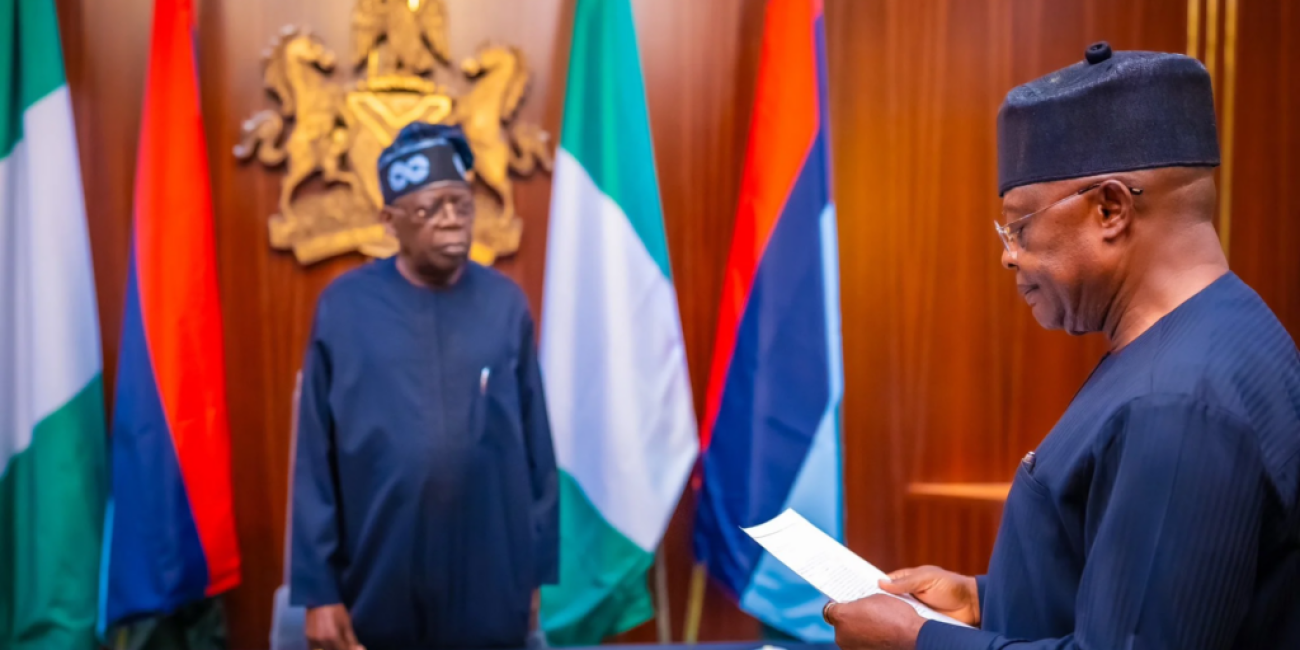
In a bold and controversial move, President Bola Tinubu has submitted a N1.48 trillion emergency budget proposal for Rivers State to the National Assembly, following the Supreme Court’s nullification of the state’s 2025 budget and the imposition of what critics are calling an “unpopular emergency rule.”
In a letter addressed to the National Assembly, Tinubu defended the extraordinary measure as a federal lifeline to prevent a complete breakdown of governance and public service delivery in the oil-rich state. The proposed intervention budget outlines major allocations to critical sectors: N324 billion for infrastructure, N166 billion for healthcare, N75.6 billion for education, and N31.4 billion for agriculture.
However, the timing of Tinubu’s emergency request is raising eyebrows, coinciding with growing national outrage over alleged financial manipulation within the recently passed 2025 national budget.
Just days ago, BudgIT, a civic-tech organization championing budget transparency, released a damning 18-page report detailing the insertion of 11,122 dubious projects worth a staggering N6.93 trillion—representing 12.5% of the total N54.99 trillion budget signed by Tinubu in February.
According to BudgIT’s analysis, these insertions were smuggled in without proper oversight or alignment with Nigeria’s core developmental goals. Among the revelations:
238 projects cost over N5 billion each, totaling N2.29 trillion.
984 projects valued at N1.71 trillion lacked clear justification.
1,477 streetlight installations accounted for N393.29 billion.
538 borehole projects totaled N114.53 billion.
2,122 ICT-related items gulped N505.79 billion.
N6.74 billion was set aside for the “empowerment of traditional rulers.”
BudgIT also flagged a suspicious inflation in the capital budget of the Ministry of Agriculture, which ballooned from N242.5 billion to N1.95 trillion, with 4,371 inserted projects worth N1.72 trillion routed through the ministry. Similar anomalies were found in the Ministries of Science and Technology (N994.98 billion) and Budget and Economic Planning (N1.1 trillion), raising alarms about widespread misuse of public funds.
Even more startling, several ministries and federal agencies were assigned projects far beyond their statutory responsibilities. The National Centre for Agricultural Mechanisation in Ilorin received N400 million for scholarships in Bayelsa West and N350 million for a health insurance scheme—projects completely unrelated to its core mandate. The Nigerian Building and Road Research Institute in Lagos and the Federal Co-operative College in Oji River were similarly misused.
President Tinubu’s original “Budget of Restoration: Securing Peace, Rebuilding Prosperity” was presented in December 2024 at N49.7 trillion, before being revised upward to N54.2 trillion in February 2025 following higher revenue projections from the FIRS (N1.4 trillion), Customs (N1.2 trillion), and other sources (N1.8 trillion). The National Assembly then added N700 billion of its own, further inflating the final figure to N54.99 trillion.
The Rivers emergency budget—meant to stabilize governance—has now become entangled in this broader controversy, as Nigerians question whether it will meet its purpose or fall prey to the same murky budgetary practices.
Nationwide Calls for Reform
BudgIT is now demanding sweeping reforms, including:
Transparent frameworks for including constituency projects.
Independent verification of project costs.
Standardized systems for monitoring and evaluation.
“Although unofficial reports suggest senators and House members get N1 to N2 billion for constituency projects, our analysis shows allocations are often far higher,” the organization revealed.
A policy analyst at the Centre for Fiscal Reform in Abuja warned, “This isn’t just about Rivers State or inflated streetlight contracts—it’s a test of Nigeria’s entire public finance system. If we don’t fix the process now, we risk institutionalizing a culture of inefficiency and systemic corruption.”
As lawmakers deliberate over Tinubu’s emergency budget for Rivers State, public scrutiny intensifies. Will this N1.48 trillion intervention serve its intended purpose, or become another case study in Nigeria’s worsening fiscal credibility crisis? The nation waits—and watches.
 PIONEER NEWS