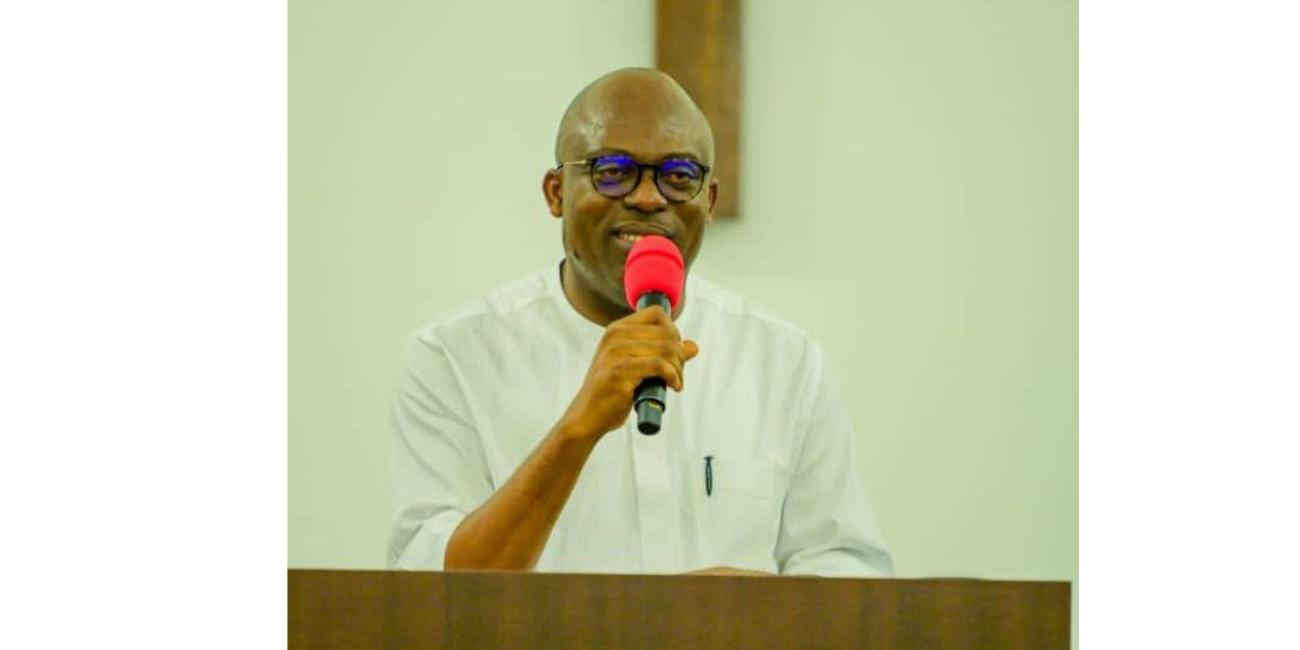
In a startling declaration that sent ripples through Nigeria’s political landscape, suspended Governor of Rivers State, Siminalayi Fubara, appeared to renounce any ambition of returning to office, revealing that his “spirit” had long departed from the corridors of power.
Fubara made the explosive remark on Sunday during a service of songs held in honour of the late elder statesman, Chief Edwin Clark, in Port Harcourt. As speakers at the memorial continued to refer to him as “Governor” and voiced their support for his reinstatement, Fubara responded with chilling clarity.
“Can’t you see how much better I look? Do you think I’m interested in going back there?” he asked rhetorically, drawing gasps and uneasy chuckles from the audience.
“My spirit has already left that place long ago,” he added, underscoring a growing sense of disillusionment with the political theatre playing out in the oil-rich state.
His comments come amid a deepening constitutional crisis triggered by the controversial state of emergency declared by President Bola Ahmed Tinubu on March 18, 2025. The declaration led to the unprecedented suspension of Governor Fubara, Deputy Governor Ngozi Odu, and the entire Rivers State House of Assembly—a move widely condemned as a democratic backslide.
In their place, the President appointed retired Chief of Naval Staff, Ibok-Ete Ibas, as sole administrator, effectively placing the state under federal control and dismantling its democratically elected structures.
Though President Tinubu had previously brokered a fragile peace deal between Fubara and his political rival, former governor and now FCT Minister, Nyesom Wike, in December 2024, the truce quickly collapsed under the weight of deep-seated political animosities.
Sunday’s event, organized by the Rivers Elders Forum, became a hotbed of political expression, as attendees lambasted the federal government’s heavy-handed intervention. But Fubara, in an apparent bid to de-escalate tensions, urged caution.
“Not everything is by ‘oshogbe’,” he quipped—a local idiom urging restraint over confrontation. He also lamented that some of his supporters, though well-intentioned, may have inadvertently worsened his plight through their actions.
Meanwhile, the legal storm surrounding the emergency rule continues to swirl. A bloc of 11 Peoples Democratic Party (PDP) governors has dragged the Federal Government before the Supreme Court, arguing that the President’s suspension of a duly elected government is a brazen violation of Nigeria’s constitutional order.
But the National Assembly has pushed back, filing a motion urging the apex court to throw out the suit. It contends that the case lacks procedural merit and is outside the Supreme Court’s jurisdiction, even going so far as to demand N1 billion in damages against the PDP governors for what it described as a “frivolous and speculative” petition.
As the political and legal drama unfolds, Fubara’s unexpected remarks have thrown a wrench into expectations. Once the focal point of a state teetering on the edge, the embattled leader now seems more focused on inner peace than political redemption.
His words have left many wondering: Has Siminalayi Fubara truly bowed out of the political ring—or is this a calculated silence before a louder storm?
 PIONEER NEWS