
The Independent National Electoral Commission (INEC) has categorically denied reports suggesting it has recognised new leadership within the Labour Party (LP) and the Peoples Democratic Party (PDP), insisting that Julius Abure remains listed as the LP National Chairman—at least for now.
In a strongly worded statement issued Thursday by Rotimi Oyekanmi, Chief Press Secretary to the INEC Chairman, the electoral umpire dismissed the circulating reports as “false and misleading,” clarifying that no new official decisions have been made regarding the internal structures of either political party.
The controversy stems from a recent Supreme Court judgment delivered in April 2025, which has sent ripples through the political landscape and sparked widespread speculation. The apex court, in a unanimous decision by a five-member panel, invalidated the earlier judgment of the Court of Appeal in Abuja that had affirmed Julius Abure’s position as LP’s National Chairman.
Crucially, the Supreme Court held that leadership wrangles within a political party fall under internal affairs, and thus are beyond the jurisdiction of the courts—a legal standpoint that effectively stripped Abure of judicial backing, intensifying the power struggle within the Labour Party.
While some interpreted the ruling as a green light for a new leadership structure within the LP, INEC has stepped in to temper the frenzy.
“The names of the National Officers of the LP had previously been uploaded to our website following a court order, not related in any way to the latest judgment of the Supreme Court,” Oyekanmi clarified.
He further addressed claims suggesting INEC had altered the PDP’s National Secretary listing. “The name of the National Secretary of the PDP on the same website was neither deleted nor reinstated,” he noted.
According to INEC, all listings on its platform remain unchanged and are based on earlier court directives—not the recent Supreme Court judgment that has sparked the latest storm of controversy.
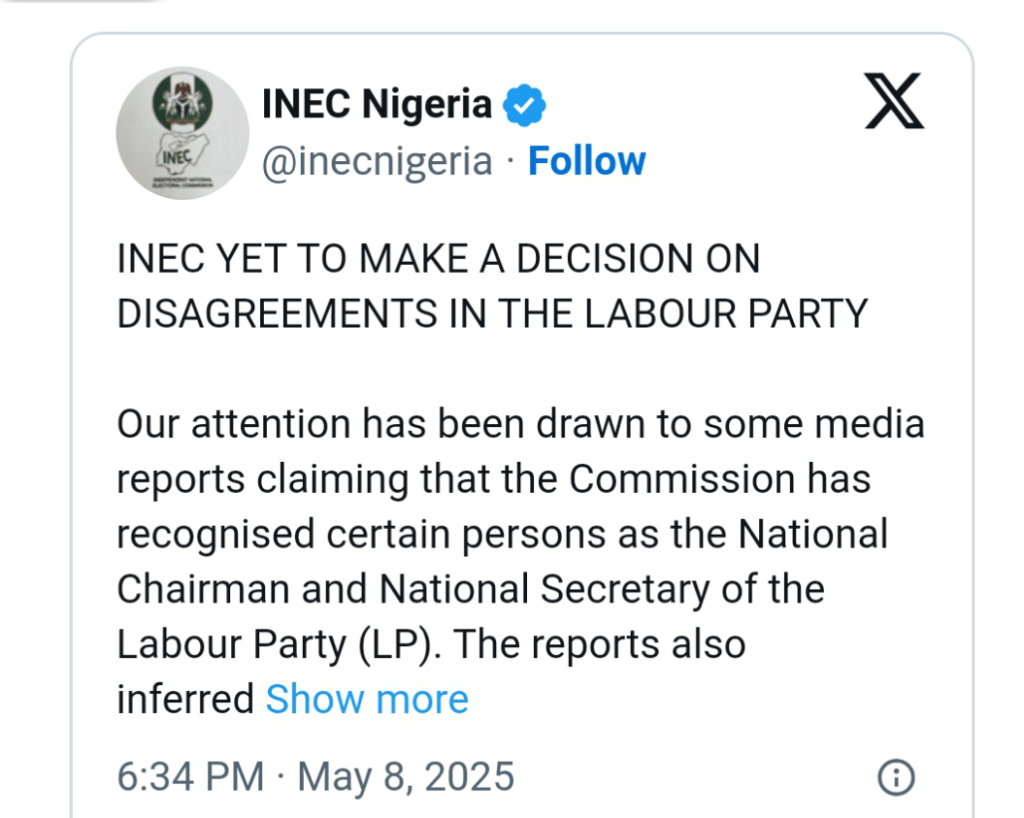
“As a law-abiding institution, the Commission is carefully studying the judgement of the Supreme Court on the Labour Party and will communicate its decision to the public in due course,” the statement added.
The development underscores the deepening crises within Nigeria’s two major opposition parties. The Labour Party continues to grapple with months-long internal warfare, factional rivalry, and contested mandates, while the PDP remains ensnared in legal and political wrangling over its National Secretary position.
While the Supreme Court’s ruling might have offered clarity on legal jurisdiction, it has done little to resolve the political chaos. Instead, it has handed the ball back to the parties—and INEC—igniting fresh uncertainty over the future of their national leadership.
With tension mounting and political stakeholders watching closely, INEC’s next move could significantly shape the internal dynamics and electoral readiness of both parties heading into future elections. Will Abure remain? Will PDP resolve its secretary saga? Only time—and INEC’s final word—will tell.
 PIONEER NEWS