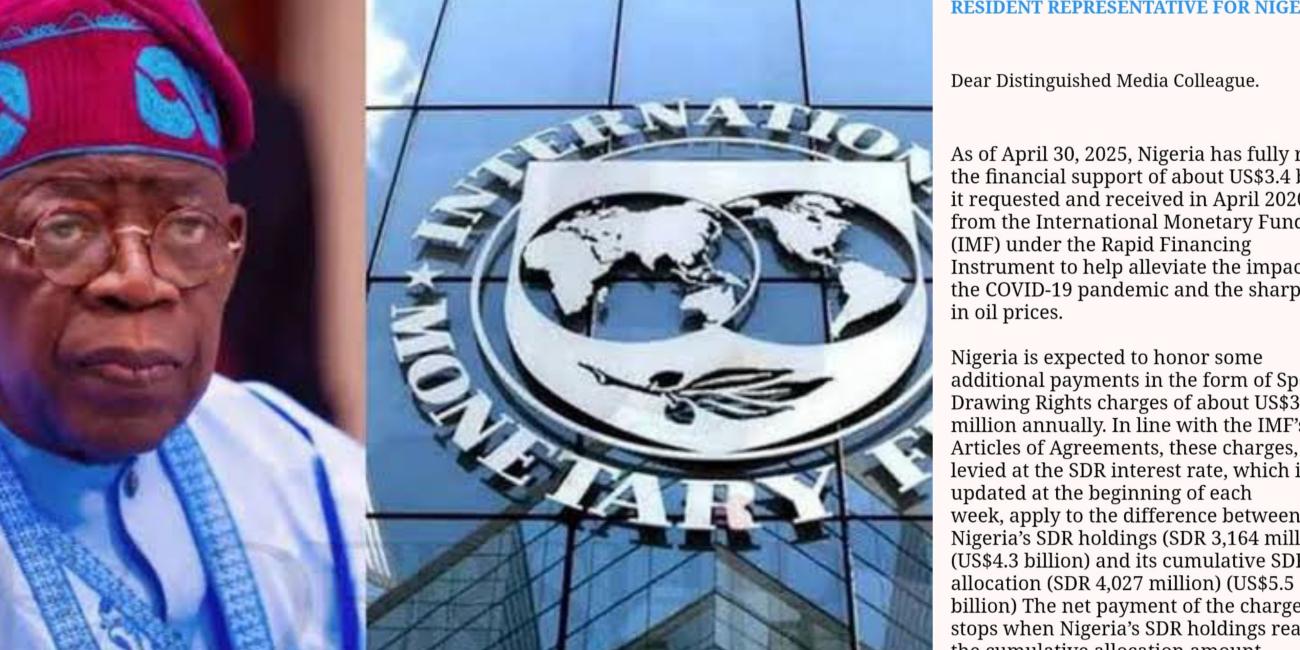
In a significant financial milestone, the International Monetary Fund (IMF) has confirmed that Nigeria has fully repaid the US$3.4 billion emergency loan it secured at the height of the COVID-19 pandemic. However, the West African nation remains tethered to annual charges of about US$30 million until at least 2029, due to the structure of the loan and Special Drawing Rights (SDR) obligations.
This revelation was made in an exclusive correspondence sent to SaharaReporters on behalf of Mr. Christian Ebeke, IMF Resident Representative for Nigeria. According to the statement, Nigeria completed repayment of the principal under the Rapid Financing Instrument (RFI) as of April 30, 2025. The facility was granted in April 2020 to cushion the dual shocks of a global pandemic and plummeting oil prices.

“As of April 30, 2025, Nigeria has fully repaid the financial support of about US$3.4 billion it requested and received from the IMF under the Rapid Financing Instrument,” the Fund stated.
Nonetheless, the IMF confirmed that Nigeria is still liable for annual SDR charges — a form of interest payment — amounting to roughly US$30 million each year.
Hidden Costs of “Full Repayment”
Though the principal debt is settled, the IMF clarified that Nigeria must continue paying SDR charges until its SDR holdings (currently at SDR 3,164 million or US$4.3 billion) match its cumulative allocation of SDR 4,027 million (US$5.5 billion).
“These charges, calculated at the weekly-adjusted SDR interest rate, are standard obligations outlined in the IMF’s Articles of Agreement,” the Fund explained. “The net payment of charges stops once Nigeria’s SDR holdings equal its cumulative allocation.”
An earlier SaharaReporters investigation noted that despite clearing the core loan, Nigeria remains on the hook for millions in annual SDR-related payments. According to IMF projections, Nigeria will pay:
SDR 22.35 million in 2025
SDR 25.91 million annually from 2026 to 2027
SDR 25.92 million in 2028
SDR 25.90 million in 2029
Using the current SDR-to-USD exchange rate of 1 SDR = US$1.35, this equates to about US$30.17 million in 2025, and approximately US$34.9 million annually from 2026 through 2029 — totalling nearly US$170 million over five years.
At Nigeria’s current official exchange rate of N1,609 to the dollar, the US$30 million in yearly charges translates to an estimated N48 billion per annum — a recurring fiscal pressure amid a deepening economic crunch.
Further compounding the situation, SaharaReporters previously revealed — citing the Central Bank of Nigeria’s (CBN) 2024 financial report — that Nigeria’s IMF-related obligations surged to nearly N5 trillion by December 2024. The staggering increase was largely attributed to severe exchange rate depreciation.
While the original IMF debt stood at about N2.5 trillion in 2023, the weakened Naira nearly doubled the obligation in local currency terms within a single year.
This finding sparked controversy, with presidential aides Bayo Onanuga and Dada Olusegun disputing the figures. However, SaharaReporters stood by its reporting, which was backed by the CBN’s official disclosures.
Debt servicing has now become an insatiable drain on Nigeria’s finances. The Central Bank’s economic report for January 2025 revealed that the country spent N696 billion on debt service that month alone — matching December 2024’s figure. This totals N1.3 trillion over just two months, exceeding the federal government’s monthly budgetary provision of N689 billion for debt obligations.
Even more alarming, the report disclosed that the government allocated zero naira for capital expenditure in January 2025, underscoring the devastating impact of debt on national development goals.
While the repayment of the IMF’s US$3.4 billion pandemic loan is an important fiscal achievement, Nigeria’s ongoing commitment to SDR-related charges — amid a plunging Naira, surging debt-servicing costs, and absent capital investment — paints a stark picture of economic fragility.
The country may have closed one financial chapter with the IMF, but the next few years will continue to test its resilience under the weight of persistent obligations and strained resources.
 PIONEER NEWS