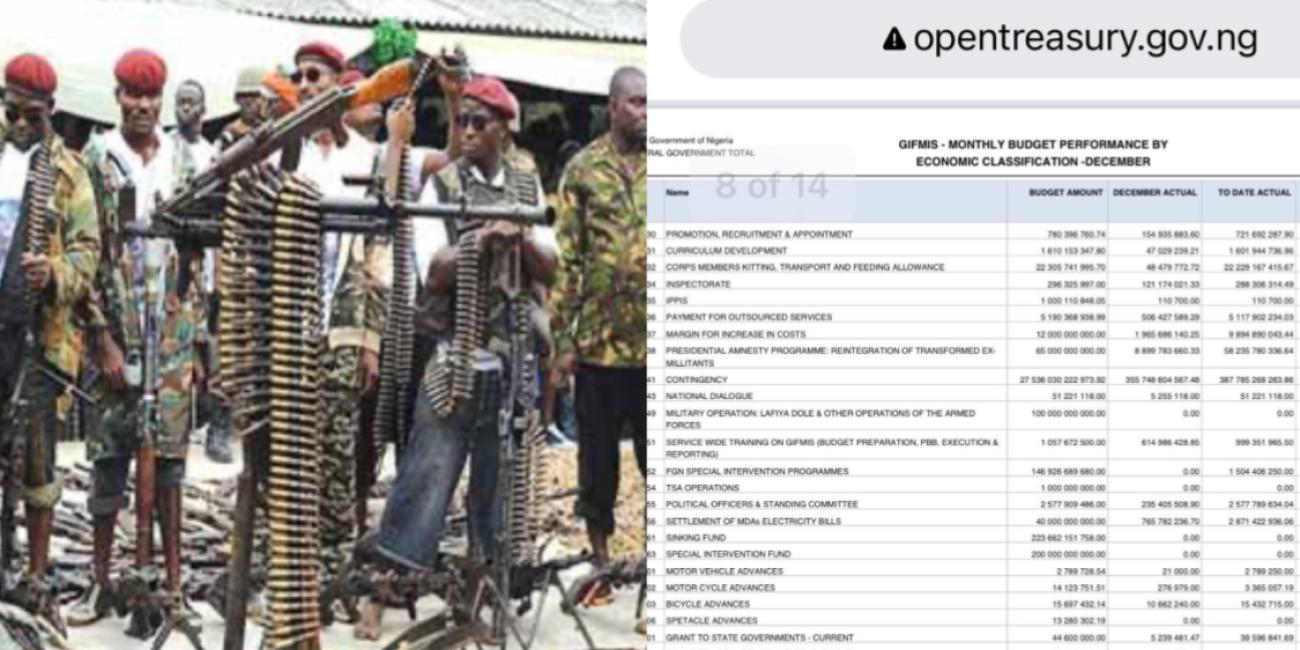
Nigeria’s Presidential Amnesty Programme (PAP) has come under renewed scrutiny following revelations that the country spent a staggering N58 billion on the reintegration of “transformed” ex-militants in 2024 alone, with N8.8 billion disbursed in December. The findings, sourced from the Open Treasury Portal, have sparked concerns over financial accountability within the programme.
According to the 2025 proposed budget, the government is set to increase spending on the initiative, earmarking N65 billion for reintegration efforts in the coming year—raising fresh questions about transparency and oversight.
Further intensifying these concerns, an audit report by the Auditor-General of the Federation has unearthed shocking financial irregularities within the PAP. The report revealed that over N6 billion was withdrawn without proper auditing processes, including questionable payments for tuition fees without verifiable records of the beneficiaries.

Key findings from the audit include:
N1.53 billion paid in tuition fees without supporting documentation, violating the 2009 Financial Regulations.
N3.62 billion raised without internal audit checks, leading to unapproved payments and potential fund mismanagement.
N1.3 billion approved, disbursed, and recorded in the cash book without corresponding paid vouchers—a blatant breach of financial protocols.
These revelations have heightened concerns over the management and accountability of the funds allocated to the programme, which was initially designed to rehabilitate and reintegrate Niger Delta militants who had surrendered their arms in exchange for amnesty.
Adding to the controversy, Sahara Reporters previously reported that the official Presidential Amnesty Programme website (osapnd.gov.ng) was non-functional, displaying a message indicating a critical error. The website’s inactivity raises further doubts about the programme’s efficiency and the transparency of its operations.
This is not the first time the PAP has been marred by financial scandals. In 2020, then-President Muhammadu Buhari suspended the programme’s coordinator, Charles Dokubo, following corruption allegations related to the mismanagement of funds. Despite the leadership change, new revelations suggest that the issues of fraud, mismanagement, and lack of transparency persist.
With billions of naira continuously funneled into the programme, stakeholders and anti-corruption watchdogs are calling for a comprehensive probe and stringent reforms to prevent further financial leakages.
As Nigeria faces economic challenges, the question remains: How much longer can the government justify these expenditures without ensuring proper accountability?
 PIONEER NEWS