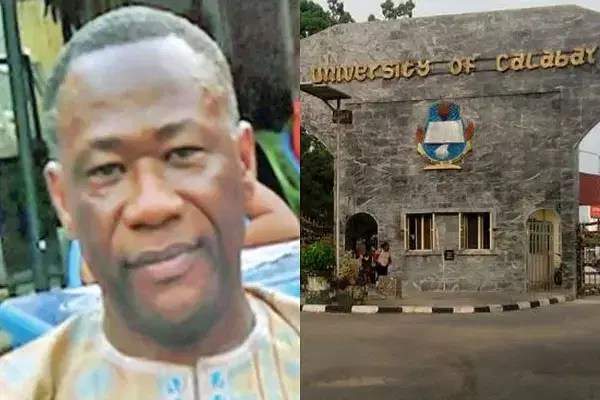
In a dramatic turn of events, a forensic analyst has told a Federal High Court in Abuja that no nude photographs were found in the mobile phones belonging to Prof. Cyril Ndifon, the suspended Dean of the Faculty of Law, University of Calabar (UNICAL). The revelation was made on Thursday by CSP Babagana Mingali, a forensic expert from the Office of the National Security Adviser (ONSA), who testified as the second defence witness (DW-2) in the high-profile sexual harassment case.
The Independent Corrupt Practices and Other Related Offences Commission (ICPC) is prosecuting Ndifon on a four-count charge, including sexual harassment, cybercrime, and an attempt to pervert the course of justice. The ICPC alleges that the embattled professor coerced a female Diploma student, identified as TKJ, into sending him explicit photographs via WhatsApp.
However, Mingali’s forensic analysis—conducted on two mobile phones submitted to the court—indicated that there were no nude images, incriminating messages, or voice recordings. “My lord, we used highly professional forensic tools, including the universal forensic extraction device, touch tool, and multiple specialized cables to retrieve data, but found nothing,” Mingali stated.
He further explained that the WhatsApp applications on both phones were outdated, spanning from January 2021 to January 2024, which might have affected data retrieval. “For complete extraction of data, the phones would need to be updated,” he added.
The defence team, led by Senior Advocate of Nigeria (SAN) Joe Agi, seized on Mingali’s testimony to challenge the ICPC’s case, arguing that the allegations lacked digital evidence. The defence also pointed out that Ndifon’s co-defendant, his lawyer Samuel Anyanwu, was added to the case for allegedly threatening the key witness over the phone—a claim both men have denied.
During cross-examination, ICPC’s counsel, Osuobeni Akponimisingha, attempted to undermine Mingali’s testimony by questioning his forensic expertise and the credibility of his findings. However, the analyst stood firm, maintaining that his office, along with agencies like the Economic and Financial Crimes Commission (EFCC) and the ICPC, utilizes similar forensic tools for investigations.
Despite the ICPC’s claims that it used the same forensic tools to extract evidence against Ndifon, Mingali’s findings suggest that no explicit materials were retrieved from the professor’s phones. With this crucial testimony, the prosecution now faces an uphill battle in proving its case.
Justice James Omotosho has adjourned the trial to April 3, 2025, for the continuation of the defence. As the case unfolds, it remains to be seen whether the prosecution can provide further evidence to substantiate its allegations or if Ndifon will walk free due to a lack of digital proof.
This courtroom drama continues to grip public attention, as many await the outcome of one of Nigeria’s most controversial academic scandals.
 PIONEER NEWS