
A recent, alarming statement by an Okun man from Kogi State, identifying more with his Fulani roots, has sent shockwaves through the Yoruba community. The man, speaking during a recorded X Space titled “No Space for Hate Mongering in Nigeria,” made ominous remarks threatening the Yoruba people, accusing them of rejecting Sharia law and fueling rising tensions between Muslims and non-Muslims in Southwest Nigeria.
The individual, known as Abbey, ignited a storm of concern after declaring that “it’s time for Jihad conversation to start.” His comments targeted Yoruba conservatives, framing the rejection of Sharia in the South West as a direct attack on Muslims’ right to practice their faith. He boldly stated, “The Yoruba tribe fell so horribly, I don’t know where we got it wrong,” expressing disgust at what he described as the intolerance of non-Muslim Yoruba towards Islam.
Abbey’s words were laced with threats and fueled by a deep sense of betrayal, lamenting that the Yoruba people—whom he once believed were tolerant—had become a source of division. He accused them of attempting to exclude Muslims and their practices from the region, suggesting that this marginalization warranted a response of “Jihad.” He elaborated, “When you are being threatened in your right to practice your religion peacefully, that’s when Jihad should come about.”
Abbey’s tone turned even more inflammatory as he likened the situation of Muslims in Southwest Nigeria to that of Palestinians under Israeli occupation. “You are no better than Palestinians in Gaza,” he said, drawing a controversial parallel between the treatment of Muslims in Yoruba-dominated regions and the ongoing Palestinian-Israeli conflict. He further described the Yoruba people’s actions as an attempt to reduce Muslims to “second-class citizens” in their own homeland.
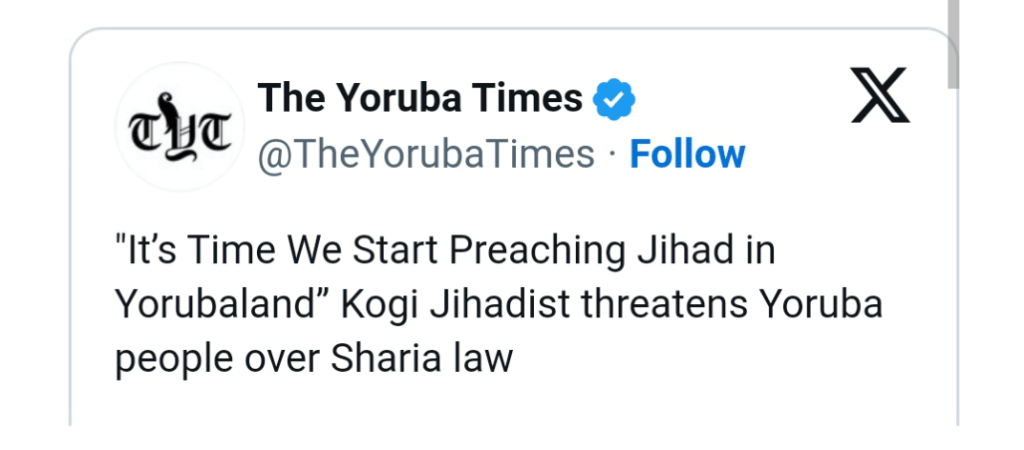
He also distanced himself from the Yoruba community, asserting that his identity as an Okun man, with a Fulani mother, aligned him more with the Fulani heritage. “I don’t need your votes,” he emphasized, dismissing the political weight of Yoruba influence. His comments appeared to set the stage for what he suggested would be an intense and forthcoming conflict. “This is just wetting the ground for what will happen in the coming days, months, and weeks,” he warned.
The backlash was immediate and fierce. His divisive rhetoric has been widely condemned as hate speech and a direct threat to Nigeria’s ethnic and religious harmony. His call for jihad has raised alarms about the rising extremism and the growing religious intolerance in the region.
Further fueling the controversy, SaharaReporters recently highlighted the heated debate surrounding the imposition of Sharia law in the Southwest. A group known as the Society for Yoruba Culture Renaissance rejected the establishment of Sharia panels in states like Oyo and Ekiti, arguing that the application of Sharia law is alien to Yoruba society and could disrupt the peaceful coexistence of people from different religious backgrounds.
The issue took on a legal dimension when the Ekiti State government distanced itself from the Independent Sharia Arbitration Panel, arguing that Sharia law is not recognized within the state’s legal framework. However, the Nigerian Supreme Council for Islamic Affairs (NSCIA), led by the Sultan of Sokoto, has defended the initiative, stating that it is constitutional and urging southern governors to respect Muslims’ rights to practice their religion.
The call for Sharia law in the Southwest has sparked deep divisions, with the Society for Yoruba Culture Renaissance accusing the Sultan of Sokoto of attempting to incite religious conflict by pushing for Sharia’s implementation in the region. They argue that Sharia is a practice best suited for societies with a predominant Muslim population, which is not the case in Yorubaland.
As tensions rise and dialogue intensifies, it is clear that the future of religious and ethnic coexistence in Southwest Nigeria remains uncertain. What began as a debate over Sharia law has now escalated into a broader conflict, raising critical questions about religious freedom, cultural identity, and national unity in Nigeria.
 PIONEER NEWS