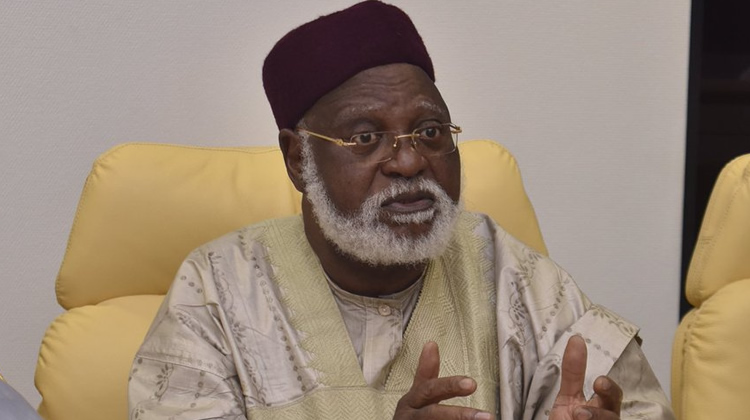
Former Head of State, General Abdulsalami Abubakar (retd.), has reaffirmed the pivotal role his administration played in entrenching democratic governance in Nigeria, as the country marks 26 years of uninterrupted democracy.
Speaking at the Inter-Party Advisory Council (IPAC) public launch of its book, 100 Years of Political Parties Evolution in Nigeria (1923 – 2023), held in Abuja on Thursday, Abdulsalami emphasized the need for Nigerians to uphold and strengthen democracy for national progress.
Represented by his Chief Security Officer, General Abdulrashid Aliyu, the former military leader, who was the event’s Chairman, highlighted the historical significance of 2025, which will mark 102 years since the formation of political parties in Nigeria. He described this milestone as a testament to Nigeria’s evolving democratic landscape and the resilience of its political institutions.
Reflecting on his administration’s transition from military rule to democracy, Abdulsalami asserted that his government laid the solid foundation upon which Nigeria’s current democratic system thrives.
> “Despite military interventions, democracy has come to stay in Nigeria. There is no substitute for a government of the people, by the people, and for the people, as sovereignty resides with the people.”
He further noted that since Nigeria’s independence on October 1, 1960, no period of constitutional governance has lasted as long as the current one. He credited this endurance to patriotic leadership, strong democratic institutions, and unwavering commitment to democratic principles.
Abdulsalami stressed the need for continuous efforts to safeguard democracy from reactionary forces that seek to undermine it. He urged political actors to prioritize stability and democratic consolidation through institutional reforms, including amendments to the Constitution and Electoral Act.
> “We must explore political parties’ development priorities to consolidate democracy and ensure an environment conducive to successful elections and political stability, which aligns with the IPAC mandate.”
According to him, strengthening democratic values requires:
Supremacy of party leadership in maintaining discipline and direction.
Adherence to party manifestos to ensure accountability and policy consistency.
Formation of parties based on ideology rather than personal interests.
IPAC’s Role in Democracy
The National Chairman of IPAC, Yusuf Dantalle, who served as the event’s chief host, underscored the significance of the newly launched book. He described it as a historical documentation of Nigeria’s century-long political evolution, which will serve as a valuable resource for future political discourse.
With Nigeria’s democracy still evolving, Abdulsalami’s call for vigilance, reforms, and ideological-driven politics resonates as the nation moves toward future elections and governance improvements.
 PIONEER NEWS